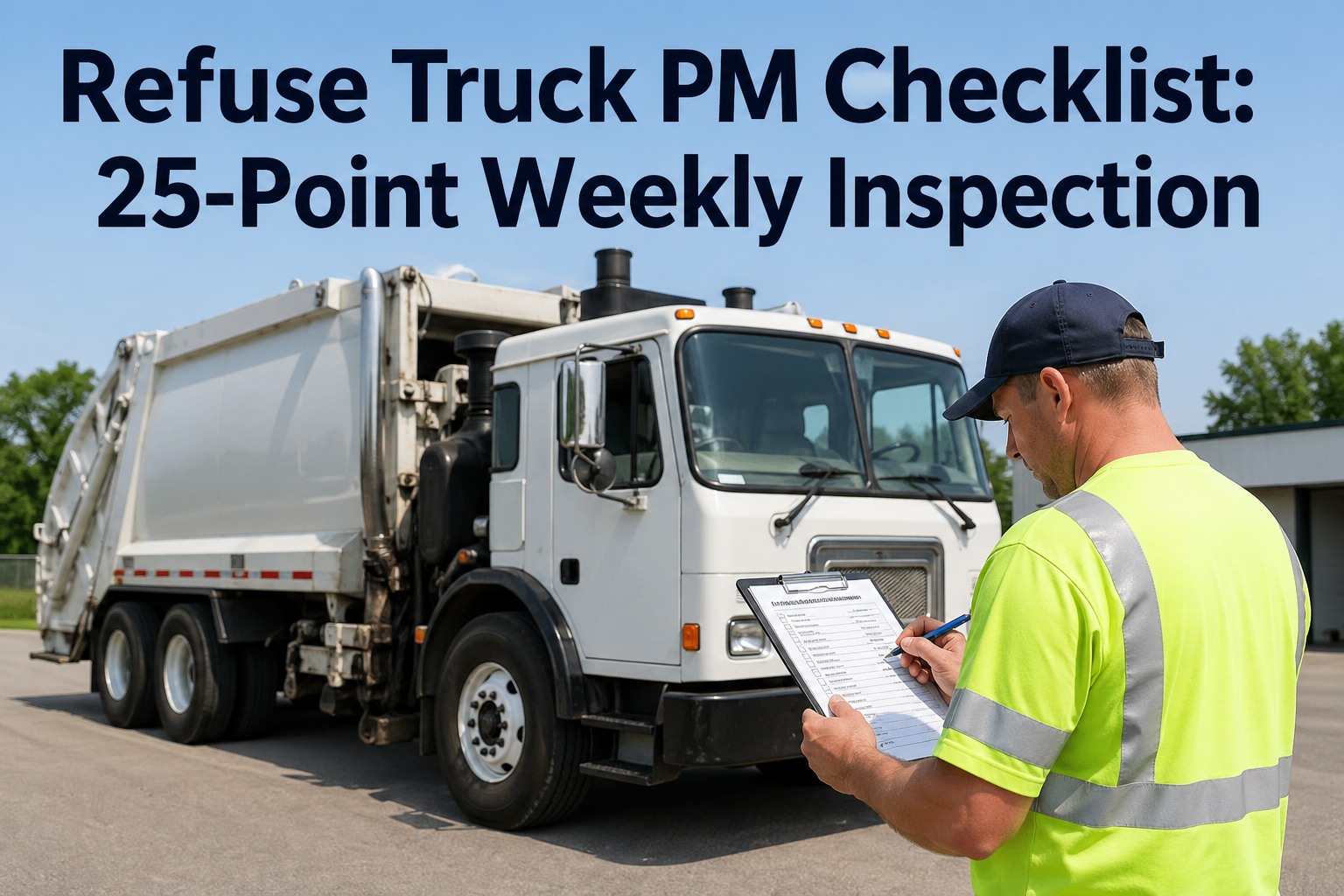
A garbage truck stops every 30 seconds, runs hydraulics 800-1,200 cycles per shift, carries 25,000+ pounds of compaction load, and operates in conditions that destroy ordinary commercial vehicles within months. The hydraulic system alone accounts for 30-40% of total maintenance spend on a refuse fleet and hydraulic-related failures are the leading cause of mid-route breakdowns industry-wide. The fleets that prevent 85% of these breakdowns share one habit: a structured weekly preventive maintenance inspection that catches the small issues before they become catastrophic ones. A worn $200 hydraulic hose caught at the weekly walkaround stays a $200 fix. The same hose ruptured mid-route on a residential street becomes an $8,000+ event with contaminated downstream components, towing, customer credits, and a route nobody finished. This 25-point weekly PM checklist organized by truck system covers exactly what experienced refuse fleet managers inspect every Friday afternoon — hydraulics, packer body, brakes, undercarriage, and cab/safety. Print it, post it in your shop, or load it into Fleet Rabbit's mobile checklist app for digital photo-verified inspection records. Built for rear-loaders, side-loaders, front-loaders, and roll-offs running residential, commercial, and roll-off operations across 2026.
Catch the $200 Problem Before It Becomes the $8,000 One.
Weekly preventive maintenance built specifically for refuse trucks. Hydraulics, packer body, brakes, undercarriage, cab safety — 25 inspection points across 5 truck systems. Takes ~25 minutes per truck. Prevents 85% of mid-route breakdowns.
Why Weekly PM Matters — The Cost of Skipping
Refuse trucks operate under conditions no other commercial vehicle faces. Weekly inspections are not bureaucracy — they're the difference between a $28,000 annual maintenance budget per truck and a $48,000-$60,000 one.
The 5 Truck Systems — Where the 25 Points Live
The checklist is organized by physical truck system because that's how technicians actually work. Walk one zone, complete its checks, move to the next. The visual below shows where each system sits on the truck and how many points it carries.
The Complete 25-Point Weekly Checklist
Each section below contains the inspection points for that system. Items are sequenced so the technician walks the truck efficiently — no backtracking, no missed zones. Estimated time per system included.
Check sight glass or dipstick. Fluid should be amber-clear, not milky (water intrusion) or dark (overheated). Top up if low. Schedule fluid analysis if appearance off.
Inspect every cylinder rod, hose connection, and pump fitting. Even a slow weep means seal degradation. Photo-document any leak source.
Walk the entire hose run from pump to actuator. Look for chafe marks where hoses contact frame, sharp bends, or swollen sections. Replace before failure.
Extend cylinders fully. Inspect chrome rod surfaces for pitting, scoring, or rust. Damaged rods destroy seals fast. Major source of unplanned downtime.
Check filter indicator. If in red zone, filter needs replacement. Contaminated fluid causes 85% of pump failures — this is the cheapest way to protect them.
With operator running normal cycle, observe relief valve activation at end of stroke. No relief = system at risk. Sticky relief = fluid contamination indicator.
Check pump mounting bolts torque. Inspect PTO drive coupling for play. Loose mounts cascade into pump shaft damage costing $2,500-$4,500 to replace.
Measure blade edge thickness vs spec. Heavy wear creates jagged compression and stresses cylinders. Build into rotation schedule before edges go critical.
Check panel sits square in body during full stroke. Misalignment creates uneven wear, destroys cylinder rods, and reduces compaction efficiency.
Inspect rubber/poly grip pads for wear, tears, or contamination. Worn pads drop containers — liability event waiting to happen. Replace at first sign of degradation.
Test latch engagement and release. Inspect hinge pins for wear and lubrication. Failed latch mid-route = load spillage, road hazard, citations.
Inspect floor pan, walls, and weld seams for cracks, perforations, or rust-through. Corrosive waste fluids attack body steel faster than any standard fleet.
Verify hopper-area sensors, e-stop buttons, and interlock circuits. Bypassed or failed interlocks = potential life-safety event. Test, don't assume.
Measure pushrod travel against spec. Inspect lining thickness through inspection port. Improper adjustment multiplies wear 3-5× and increases stopping distance.
Pressure-up to governor cutout. Engine off, count psi drop per minute. Anything >3 psi/min indicates leak. Refuse trucks lose system fast under cycling load.
Use calibrated gauge — not visual. Refuse trucks at full payload need exact spec PSI. Underinflation wears tires fast and increases blowout risk.
Measure tread depth at multiple points. Note uneven wear (alignment issue) or shoulder cupping (suspension issue). Don't just measure — read the pattern.
Visual + pry-bar test. Excessive movement = adjustment needed. Brake chambers should hold pressure without external leaks. FMCSA top citation category.
Torque-check critical body mounts. Refuse load cycling loosens these bolts faster than any other vehicle type. Loose mounts cascade into frame damage.
Visual inspection of leaf springs for cracks, missing leaves. Check bushings for play. Sag and uneven ride height = compromised handling and tire wear.
Inspect frame rails behind cab, around body mounts, and at axle attachment points. Refuse trucks see torsional loads that develop cracks over time.
Walk the chassis with a grease gun. Hit every fitting on lift arms, pivot points, slack adjusters, and U-joints. Skipping this is the #1 driver of premature wear.
Engage reverse, confirm alarm sounds and camera displays. OSHA requirement plus core safety control for residential street operations.
Headlights, brake, turn, marker, hazards, reverse, strobes. Test each circuit. Refuse trucks operate in early-morning low light — visibility is non-negotiable.
Verify fire extinguisher pressure gauge in green and inspection tag current. First-aid kit stocked. DOT decals legible. All required for OSHA + DOT compliance.
Print or post this list in your shop. Or load it into Fleet Rabbit's mobile checklist app for photo-verified completion records that satisfy DOT 49 CFR 396.11 automatically. See the Mobile Checklist Demo →
The Severity Legend — How to Score Findings
Not every finding is a roadblock. Standardize how the team categorizes issues so the maintenance manager knows what blocks dispatch versus what gets scheduled. Photo-documenting every flag protects against disputes later.
Component meets spec. Continue normal operation. Document inspection completion with timestamp.
Wear approaching threshold but within spec. Note in log. Re-inspect at next weekly check. No work order required.
Wear at or near minimum. Schedule repair within 7 days. Truck continues service but on watch list.
Safety-critical defect or below regulatory minimum. Truck does not roll until repaired. Hard stop, no exceptions.
Daily vs Weekly vs Monthly vs Quarterly — The Full Cadence
Weekly PM is one tier of a complete refuse truck maintenance program. Daily covers safety-critical pre-trip items. Weekly covers structural and wear items. Monthly digs deeper. Quarterly is mechanic-led service.
| Frequency | Owner | Time | Focus | Coverage |
|---|---|---|---|---|
| Daily (pre-trip) | Driver | 10-15 min | Safety + walk-around | Lights, tires, fluids, mirrors, leaks visible |
| Weekly (this guide) | Tech / Lead Driver | ~25 min | Wear + structural | 25 points across 5 systems |
| Monthly | Shop Mechanic | 2-3 hours | Detailed system check | Hydraulic test, brake adjustment, fluid analysis |
| Quarterly | Shop / Specialist | half-day | Major service | Hydraulic flush, brake hardware, frame survey |
| Annual (DOT) | Certified Inspector | full day | 49 CFR 396.17 | Federal compliance, certification, sticker |
The Top 5 Highest-Failure Items — Inspect These First
Industry data on refuse truck breakdowns clusters around five specific failure modes. If shop time is limited, these get inspected before anything else. The numbers below are conservative — many fleets see worse.
Constant cycling and abrasion against frame. $200 hose becomes $8,000 event with contaminated fluid downstream. Inspect every hose run weekly without exception.
800-1,200 stops per shift = 40-60% shorter brake life vs OTR trucks. Top FMCSA citation category. Adjust within 1/8" of spec — not "close enough."
Worn pads drop containers — liability event, customer credit, route disruption. $80 pad replacement vs $500+ in incident costs.
Refuse load cycling loosens bolts faster than any other fleet type. Cascades into body shift, frame stress, alignment issues. Torque-check weekly.
Failed latch mid-route causes load spillage on residential streets. Citation event plus environmental cleanup costs. Test latch engagement weekly.
The 25-Minute Walkthrough Sequence
Total time per truck: ~25 minutes if the technician walks the route below. The sequence is optimized so you walk the truck once — not back-and-forth between zones. Bring a flashlight, gauge, grease gun, and phone for photos.
Start at driver door. Test backup alarm, camera, lights. Verify fire extinguisher and first-aid kit. ~2 min.
Front tire pressure + tread, slack adjusters, air system pressure-up. ~3 min.
Pump mounting, drive coupling, filter indicator, fluid sight glass. ~4 min.
Cylinder rods, hose runs, grip pads, pressure relief valve. ~4 min.
Open hopper. Blade wear, panel alignment, safety interlocks, body welds. ~5 min.
Cam lock test, hinge pins, rear tire pressure + tread. ~3 min.
Body mount bolts, suspension, frame survey, grease all fittings. ~4 min.
Photo any flagged items. Submit checklist. Return truck to dispatch ready or service queue.
Frequently Asked Questions
Can drivers do this checklist or does it need a technician?
For pure inspection (no repair), a trained driver or lead driver can complete the 25 points in ~25 minutes. Items 5 (filter status), 7 (pump mounting), and 19 (body mount torque) benefit from technician-level familiarity. Most fleets have lead drivers do the weekly walk and a shop tech do the monthly deep check. Mobile checklist apps with photo verification close the gap on inspection quality.
What if we run side-loaders or front-loaders, not rear-loaders?
The 25 points are configuration-aware. Side-loaders skip the tipper grip pads but add side-arm cylinder inspection. Front-loaders skip rear tipper but add fork arm and chassis-mounted cylinder checks. Roll-offs replace packer body items with hoist cylinder, cable, and roller inspection. Fleet Rabbit's mobile checklist auto-adapts the questions per truck profile. See Truck-Specific Templates →
Does completing this checklist satisfy DOT requirements?
Daily pre-trip DVIR is the FMCSA 49 CFR 396.11 requirement — that's a separate, shorter checklist drivers complete before every shift. This weekly PM is supplementary maintenance discipline, not a federal mandate. However, the documentation it creates is exactly what FMCSA auditors want to see during a maintenance program review (49 CFR 396.3 systematic maintenance compliance).
How does this work with an existing CMMS or work-order system?
Findings flagged on the weekly checklist auto-create work orders in Fleet Rabbit's CMMS. Photo evidence attaches to each WO. Severity (PASS / WATCH / FLAG / BLOCK) determines routing — BLOCK halts dispatch immediately, FLAG goes to maintenance manager for scheduling, WATCH logs for next-week re-check. See WO Auto-Generation →
What if a finding is borderline — is it WATCH or FLAG?
Default rule: when in doubt, escalate one level. A "looks borderline" hose goes from WATCH to FLAG. A FLAG that's getting visibly worse becomes BLOCK. Refuse trucks operate at the high end of failure-cost ratios, so erring toward over-caution is genuinely cheaper than under-caution. The maintenance manager has final say on severity calls — but only after seeing the photo.
How is the digital checklist priced?
Included in the standard $3/vehicle/month subscription — no per-checklist fee, no per-photo fee. Free tier (up to 3 vehicles) includes full mobile checklist with photo verification for testing. Book a Demo to See Pricing →
Stop printing checklists. Start photo-verifying them.
Fleet Rabbit's mobile checklist app loads this 25-point inspection automatically per truck profile (rear-loader / side / front / roll-off). Drivers capture photos at each flagged item. Findings auto-create work orders. DOT 49 CFR 396.3 documentation generated automatically. Free for up to 3 trucks indefinitely.