The global digital twin market reached $21 billion in 2024 and is projected to hit $29 billion in 2025, with automotive and fleet management among the strongest growth sectors. Unlike basic telematics that tell you what's happening now, digital twin technology creates AI-powered virtual replicas of each vehicle component — predicting failures 30-90 days before they occur with 85-95% accuracy.
This case study documents how Mountain States Heavy Haul, a 180-truck operation specializing in overweight and oversize freight, deployed digital twin technology across their tire management and engine monitoring systems. The results: tire life extended by 50%, engine failure prediction accuracy of 93%, and $680,000 in annual maintenance savings — achieved without replacing a single truck.
For fleets still running on calendar-based maintenance schedules and reactive repairs, this case study provides a replicable blueprint for the transition to predictive operations. Book a demo to see digital twin technology in action.
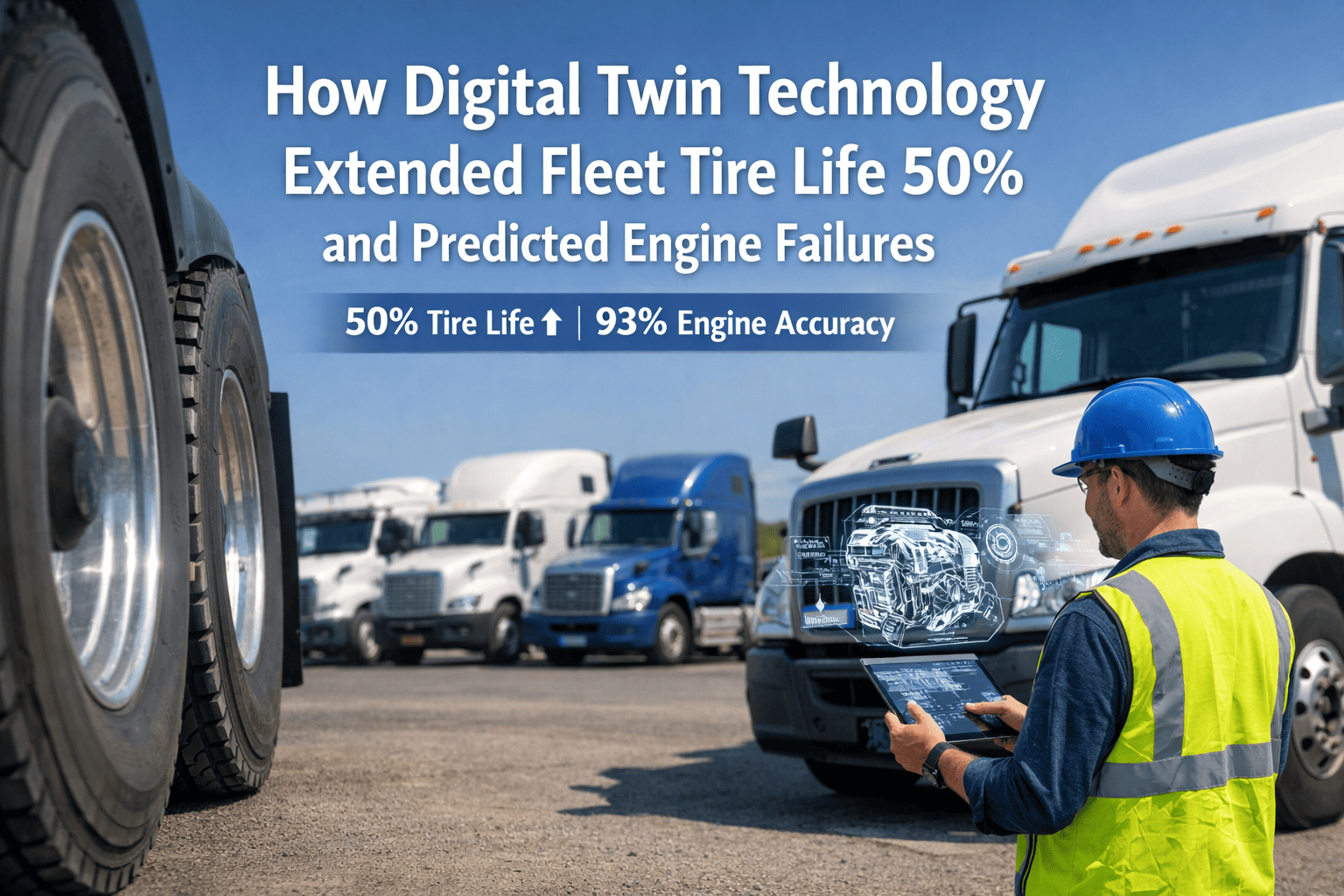
How Digital Twin Technology Extended Fleet Tire Life 50% and Predicted Engine Failures
A 180-truck heavy haul fleet deployed AI-powered virtual vehicle simulation to transform maintenance from reactive to predictive. Tire costs dropped 35%, engine breakdown events fell 78%, and total maintenance spend decreased by $680K annually.
The Fleet Profile: Heavy Haul Operations
Mountain States Heavy Haul operates 180 Class 8 trucks across the Rocky Mountain region, specializing in overweight and oversize loads for mining, energy, and construction clients. Their operational profile creates extreme stress on tires and powertrains — averaging 95,000 loaded miles per truck annually with payloads frequently exceeding 80,000 lbs GVW.
Heavy haul operations create a compounding maintenance challenge: extreme loads accelerate tire wear by 40-60% compared to standard freight, while mountain grades stress powertrains beyond normal operating parameters. Before digital twin deployment, the fleet relied on calendar-based maintenance and reactive repairs — a costly combination that consumed 28% of total operating budget.
Understanding Digital Twin Technology
A digital twin is not just another dashboard — it's an AI-powered virtual replica of each physical asset that continuously updates based on real-time sensor data. Unlike basic monitoring that alerts when something is already wrong, digital twins understand WHY components wear and predict WHEN they'll need service.
Digital Twin Implementation: Tires
Tire costs represented the single largest maintenance expense for Mountain States — $1.2M annually across 180 trucks. The digital twin system created individual virtual models for all 3,240 tires in the fleet, tracking wear rates, pressure patterns, and rotation optimization.
The AI analyzed 150+ variables per tire — including acceleration patterns, braking frequency, cornering forces, load weights, route terrain, and ambient temperature — to create individualized wear curves. Instead of replacing tires at arbitrary 6/32" thresholds, the system calculated actual remaining safe life for each tire position based on projected operating conditions.
Rather than rotating tires on arbitrary mileage intervals, the digital twin calculated optimal rotation timing based on actual position-specific wear rates. Heavy haul trucks experience asymmetric wear patterns due to load distribution — the AI modeled these dynamics and scheduled rotations to equalize wear across all positions.
TPMS data fed continuously into the digital twin, correlating pressure fluctuations with wear acceleration. The system identified that even brief underinflation events (as little as 10 PSI for 4 hours) caused measurable tread life reduction — something calendar inspections would never catch.
See Your Fleet's Digital Twin Potential
Every fleet has maintenance costs hiding in reactive repairs and premature replacements. We'll show you exactly where digital twin technology can deliver ROI — free, in 15 minutes.
Digital Twin Implementation: Engine and Powertrain
Engine failures in heavy haul operations average $14,500 per incident when including towing, emergency repairs, cargo delays, and rental equipment. Mountain States experienced 23 unplanned powertrain events annually before digital twin deployment.
The AI built thermal profiles for each engine, tracking coolant temperature, oil temperature, intake air temperature, and exhaust gas temperature across different load and grade conditions. Deviations from established baselines — even within normal operating ranges — triggered predictive alerts weeks before traditional diagnostics would detect issues.
MEMS sensors capturing up to 20,000 Hz detected vibration signatures invisible to human observation. The digital twin compared each truck's patterns against fleet norms and manufacturer baselines, identifying bearing wear, gear mesh faults, imbalance, and misalignment before they progressed to failure.
Traditional oil changes occur on fixed intervals regardless of actual oil condition. The digital twin modeled oil degradation based on operating conditions — tracking wear metals, contamination levels, and viscosity degradation to calculate actual remaining useful life. Result: optimal drain intervals that extended oil life without risking engine damage.
Before vs. After: The Complete Transformation
Here's how every key metric changed over the 12-month digital twin deployment. These are actual measured results from Mountain States' maintenance management system.
| Metric | Before (Traditional) | After (Digital Twin) | Change |
|---|---|---|---|
| Average Tire Life (miles) | 68,000 | 102,000 | +50% |
| Annual Tire Spend | $1.2M | $780K | -35% |
| Tire Roadside Events | 47/year | 8/year | -83% |
| Engine Failure Prediction | 0% (reactive) | 93% | +93% |
| Unplanned Powertrain Events | 23/year | 5/year | -78% |
| Maintenance as Percent of OpEx | 28% | 21% | -25% |
| Total Annual Maintenance Spend | $3.1M | $2.42M | -$680K |
Implementation Timeline and ROI
Savings Potential by Fleet Size
Digital twin ROI scales with fleet size, but even smaller operations see significant returns. Research from the National Science Foundation demonstrates that digital twin frameworks can extend tire lifespan by nearly 50% compared to conventional management.
Leading fleets using digital twin technology achieve 85-95% accuracy in predicting failures and reduce unplanned downtime by up to 70%. The global predictive maintenance market reached $9.21 billion in 2025, with cloud-based solutions now commanding 66% market share — making enterprise-grade AI accessible to fleets of any size.
What Digital Twins Monitor
Mountain States' digital twin deployment covered these component categories. The AI builds individual virtual models for each, tracking degradation and predicting service timing:
Tread depth, wear rate, pressure, temperature, rotation timing, irregular wear patterns, casing condition, retread eligibility, wheel bearing wear, hub temperature.
Thermal profiles, oil degradation, turbocharger efficiency, injector performance, coolant system health, exhaust gas analysis, transmission shift patterns, driveline vibration.
Brake lining wear, air system pressure, ABS sensor function, slack adjuster condition, drum/rotor wear patterns. Integrated with DTC alerts.
Battery health, alternator output, starter motor performance, wiring resistance, A/C compressor cycles, refrigerant system efficiency, auxiliary power unit condition.
Air bag condition, shock absorber performance, frame stress points, fifth wheel wear, kingpin condition, steering component play, alignment degradation.
Frequently Asked Questions
Basic telematics tells you what's happening now — location, speed, fault codes. Digital twins understand WHY components wear and predict WHEN they'll fail. The AI creates virtual replicas that simulate future conditions based on operating patterns, enabling 30-90 day failure predictions vs. reactive alerts after damage has begun.
Tire wear prediction typically achieves 94-96% accuracy for 60-90 day projections. Engine/powertrain predictions reach 85-95% accuracy depending on component type and data quality. Models improve continuously — fleets with 12+ months of data see measurably better predictions than new deployments.
Hardware costs range from $500-1,500 per truck depending on existing telematics and desired monitoring depth. Software typically runs $50-150/truck/month. Most fleets see measurable results within 60-90 days and full ROI within 6-9 months. Mountain States achieved payback at month 7.
Yes. Digital twin technology works with any truck equipped with basic telematics connectivity. Mountain States' fleet includes trucks from 2016-2024 model years across multiple OEMs. The AI adapts to each vehicle's specific characteristics and builds individual models regardless of make or age.
Digital twins excel at predicting gradual wear and degradation. They cannot predict sudden catastrophic events like road debris damage, accidents, or vandalism. Hidden manufacturing defects may not manifest until failure. However, these limitations affect less than 12% of failures in typical operations — the AI successfully predicts the vast majority.
What Would 50% Longer Tire Life Mean for Your Fleet?
Digital twin technology is no longer experimental — it's delivering verified ROI for fleets of all sizes. See exactly how much you could save with AI-powered predictive maintenance tailored to your operation.