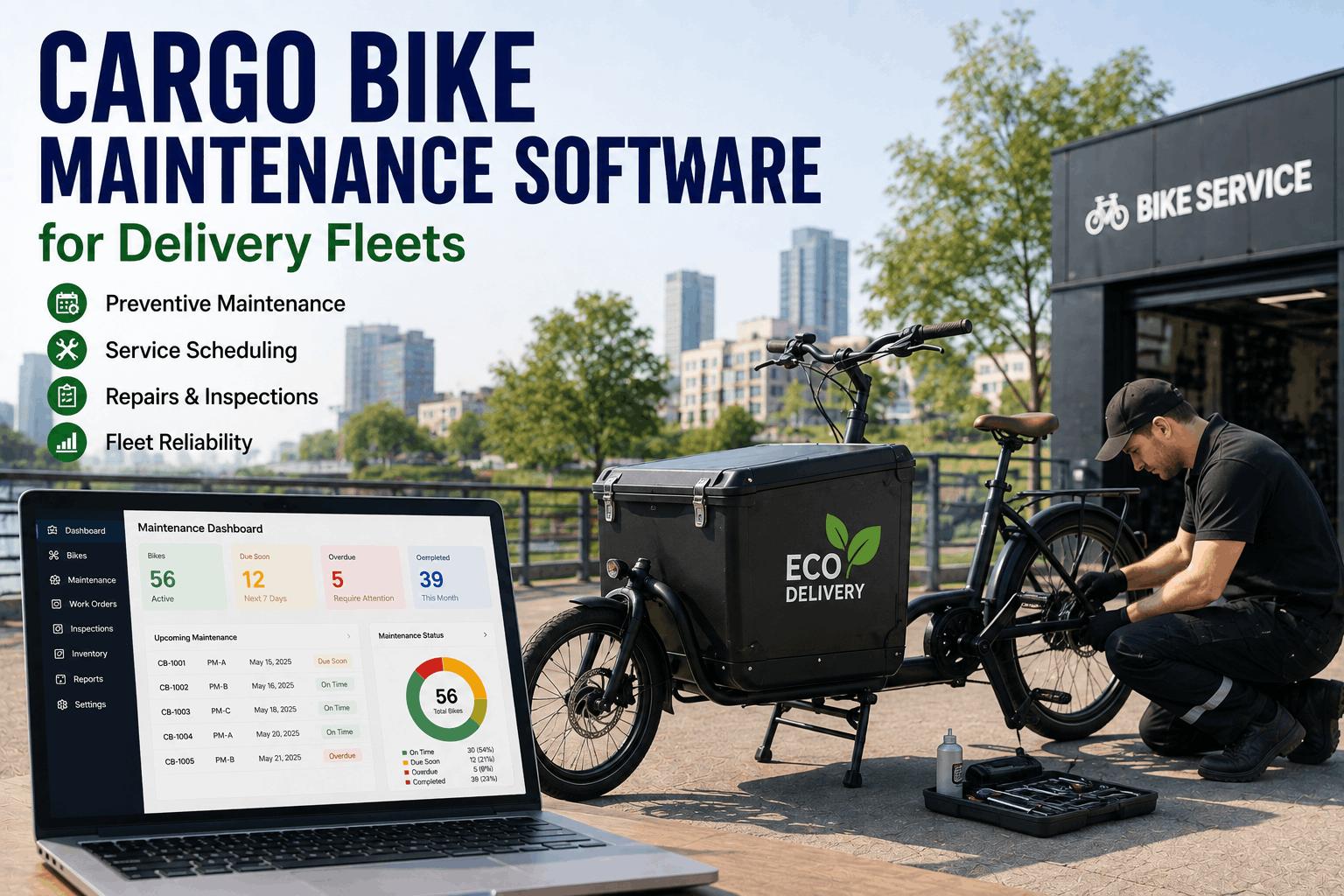
Cargo bikes have quietly become the backbone of dense urban delivery, weavingthrough traffic that vans sit stuck in and parking where a van never could. But a fleet of cargo bikes breaks in ways most delivery software was never built to watch for. A worn chain does not throw a warning light. A stressed frame does not beep at a driver. A cargo bike maintenance program built on guesswork eventually shows up as a missed delivery window, and that is the gap cargo bike maintenance software is built to close.
Why cargo bikes wear out differently than vans
A cargo bike carries a fraction of a van's weight capacity but takes a disproportionate amount of daily mechanical stress. Chains, brake pads, tires, and on e-assist models, the motor and battery, are all working against constant stop-start city riding, curb hits, and cargo loads that shift with every turn. None of that shows up on a mileage-based service sheet, which is exactly why so many operations teams are choosing to sign up for software that reads actual component wear instead of a calendar.
Give every cargo bike a health record
Track wear, plan service around real routes, and keep proof-of-delivery connected to every ride, all from one dashboard.
What cargo bike maintenance software should actually do
A tool built for vans and simply relabeled for bikes will miss most of what matters here. The right platform is built around how a cargo bike fleet actually operates through a delivery day.
Component wear on the chain, brakes, tires, and battery is tracked continuously, so a rider gets flagged before a part fails mid-route, not after.
Service is scheduled around dense urban delivery windows, so a bike is serviced during natural gaps instead of pulling a rider off an active zone.
Delivery confirmations sit next to ride condition data, so a late stop and a mechanical issue can be reviewed side by side instead of separately.
Every bike, every rider, every open service item lives in one screen, whether the fleet has five bikes or five hundred.
Operations leads running dense city zones often notice the same thing after switching: fewer riders stuck waiting on a fix mid-shift, and a maintenance backlog that finally shrinks instead of growing. That shift is usually reason enough to book a demo before the next fleet expansion.
A typical service cycle for an urban cargo bike fleet
Each bike reports brake condition, tire pressure trend, and battery health where applicable, so only cleared bikes go out on routes.
Ride data is compared against expected wear curves in the background, flagging anything drifting off pattern before it becomes a breakdown.
Delivery stops, proof-of-delivery confirmations, and any flagged components land in one place, ready for the next day's plan.
Wear history builds a real picture of which bikes need closer attention before their next heavy load or long shift.
What actually improves after switching
The value rarely lands as a single dramatic change. It shows up as steadier delivery windows, fewer riders calling in a mid-route breakdown, and a maintenance team working from real component data instead of a printed schedule.
None of this requires replacing an existing system overnight. Most delivery operations start with a small group of bikes, watch how the platform holds up across a few real weeks of city riding, and expand from there. Teams that want to see this against their own fleet usually find it faster to just sign up and connect a handful of bikes first.
Questions worth asking before you choose a platform
- Does it track component-level wear, or just distance and time since last check
- Can service be scheduled around real delivery zones instead of fixed depot slots
- Is proof-of-delivery connected to ride condition, or kept in a separate log
- Does it handle both pedal-only and e-assist cargo bikes on the same dashboard
- Can the fleet manager see every bike's status without switching tools
Fleets that already answer yes to most of these are ahead of the curve. If your current setup still runs on a fixed calendar and a paper checklist, the fastest way to see the gap is to book a demo and walk through your own ride data live.
Start free with FleetRabbit
Predictive maintenance, route-optimized scheduling, and proof-of-delivery for your whole cargo bike fleet, live in days, not months.
Frequently asked questions
How is cargo bike maintenance software different from van fleet software
It tracks the wear points specific to bikes, chains, brakes, tires, and where relevant, battery and motor health, instead of the engine and fuel metrics a van platform is built around.
Does it work for both regular and electric-assist cargo bikes
Yes. Pedal-only bikes are tracked on ride frequency, load, and mechanical wear, while e-assist models add battery health and charge-cycle monitoring on the same dashboard.
How quickly can a fleet get started
Most cargo bike fleets are live within days. Bikes connect through existing tracking hardware or a simple onboarding step, and the dashboard is ready to use from day one.
Can route-optimized scheduling really fit around dense city delivery zones
Yes. Service windows are placed inside the natural gaps of a rider's shift, so a bike gets serviced without pulling it off an active delivery zone during peak hours.
Is proof-of-delivery included, or a separate add-on
Proof-of-delivery is built into the same platform, sitting alongside ride and maintenance data so a late stop and a mechanical flag can be reviewed together.
Does this work for a small fleet, or only large operations
The platform scales with the fleet. A five-bike courier team and a fleet running hundreds of bikes across a city both use the same core dashboard, sized to fit.