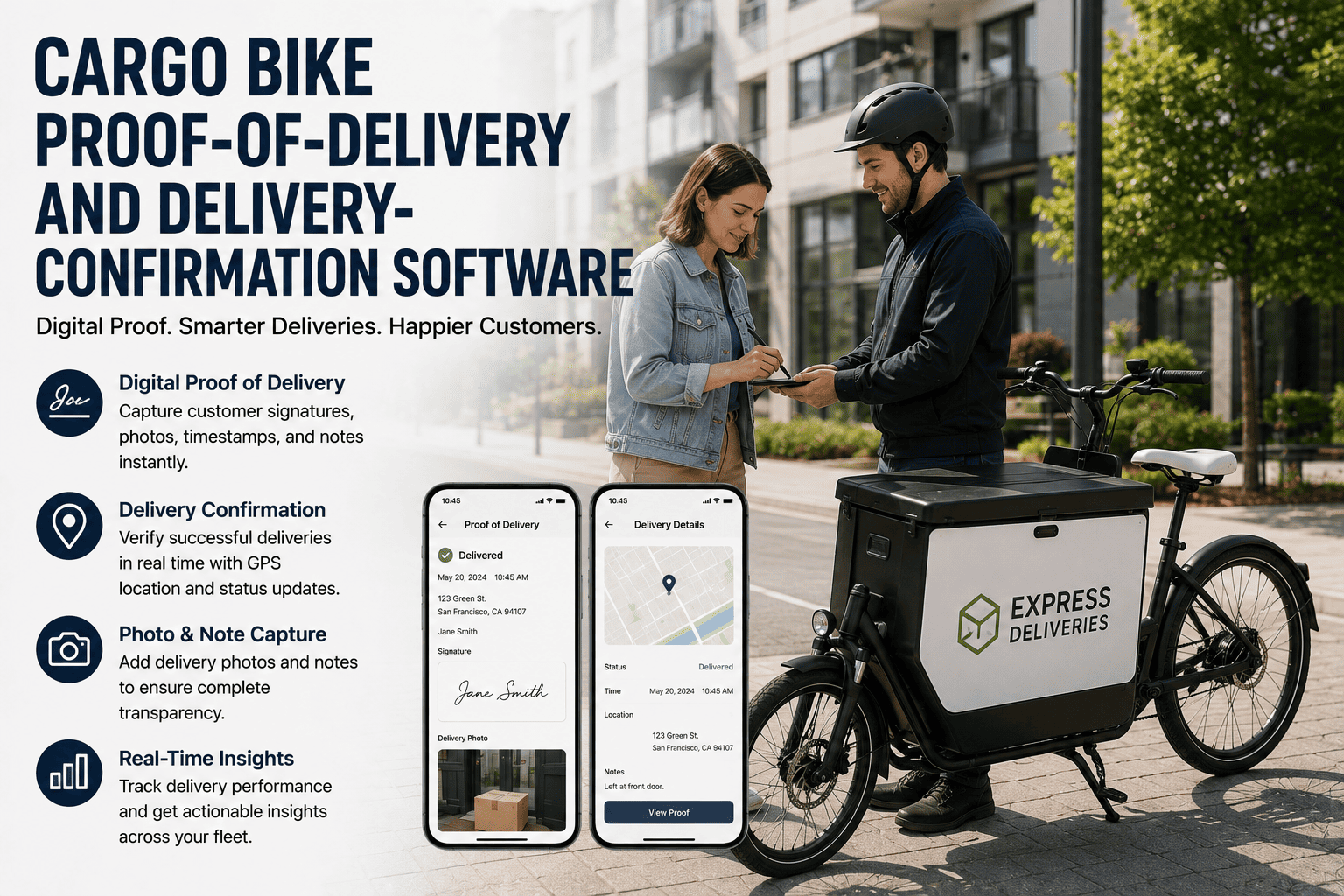
A courier weaves through a closed city center on an e-cargo bike, drops a parcel at a fourth-floor walk-up with no buzzer, and pedals off to the next stop before the customer even checks their phone. There's no loading dock signature, no van parked outside for a neighbor to notice, and no paper slip that survives a rainy route. If that delivery gets disputed later, the courier's memory is often the only evidence anyone has. Cargo bike proof-of-delivery software fixes that by capturing confirmation the same way the delivery itself happens — fast, mobile, and built for a rider, not a truck driver.
Why cargo bike deliveries need their own confirmation model
Software built for van and truck fleets assumes things that don't hold up on a bike route: a dock to sign at, a driver with both hands free at the vehicle, a stop that takes a few minutes to complete. Urban cargo bike couriers work in seconds per stop, often through gated buildings, bike lanes, and pedestrian zones that a van could never reach. Confirmation has to happen in one motion — a tap, a photo, a scan — without slowing the rider down or asking them to dig through a bulky app mid-route. Operations teams still running truck-style POD tools on a bike fleet can sign up to see a confirmation flow actually designed around how a courier moves through a city.
0:00
Rider arrives, GPS logs exact location against the address on file
0:04
Parcel photographed at the door or handed to the recipient
0:08
Signature or OTP captured in one tap, no app switching
0:12
Confirmation syncs instantly, rider is already back on the bike
What proof of delivery looks like on two wheels
Stop 14 of 22 — Rue Marché, 4th floor
Location
Confirmed within 8 meters of address
Photo
Parcel at door, timestamped
Signature
Captured via recipient tap
Status
Delivered — synced to dispatch
That record is the entire point. A dense city route can mean twenty or more stops in a single circuit, and every one of them needs to close out clean and fast, or the rider falls behind the whole day's schedule. Delivery confirmation that takes fifteen seconds instead of ninety compounds across a full shift into real time saved — and real disputes avoided. Fleet managers curious what that adds up to across a full courier team can book a demo and see the numbers against their own stop counts.
What audit-ready actually requires
GPS-verified arrival
Location confirmed against the delivery address, not just a driver's word that they reached the stop.
Timestamped photo capture
Visual proof of the parcel's condition and placement, taken in the same motion as the rest of the confirmation.
Digital signature or OTP
A verified recipient confirmation that holds up when a delivery is questioned weeks later.
Offline capture
Records save locally in dead zones between buildings and sync the moment signal returns, so no stop gets lost.
Exception flagging
A structured way to log a locked gate, a missed buzzer, or a refused parcel, instead of a note that never makes it back to dispatch.
Instant dispatch visibility
Every confirmation lands on the dispatcher's screen in real time, so a stalled route shows up before a customer calls to ask.
Give every bike delivery a record that holds up
Fast, mobile proof-of-delivery capture built for cargo bike couriers, with route-optimized scheduling on the same platform.
Route optimization for a fleet that ignores traffic rules trucks can't
Cargo bikes aren't just smaller vans — they move through a city differently, using bike lanes, pedestrian shortcuts, and restricted zones that a delivery truck is legally barred from entering. Route optimization built for bikes has to account for that: sequencing stops around what a rider can actually access, not around the road network a van would use. In cities running low-emission and traffic-restricted zones, that difference alone often saves up to 30% of delivery time compared with a van covering the same ground. Pairing that routing intelligence with proof-of-delivery capture means a dispatcher can see not just that a route was fast, but that every stop on it closed out correctly. Teams evaluating a bike-specific platform can sign up to map their own delivery zone and see the routing difference directly.
Predictive maintenance matters here too, in a smaller but real way. A cargo bike battery or drivetrain issue caught early keeps a rider on schedule instead of stranding them mid-route with a full cargo box and no backup. On a connected platform, maintenance alerts, route sequencing, and delivery confirmation all live on the same dashboard, so a fleet manager isn't juggling three separate tools to keep a courier team moving. Operations leads managing a growing bike fleet can book a demo to see all three working together on one screen.
Up to 30%
time saved on last-mile delivery routes using cargo bikes over vans in dense urban zones
4-7 days
typical time to fully connect a courier fleet to a live tracking and confirmation platform
Real time
delivery confirmation sync to dispatch and billing, no end-of-shift paperwork required
Frequently asked questions
How is cargo bike proof-of-delivery software different from a standard courier tracking app
It combines GPS-verified location, timestamped photo capture, and a digital signature into a single fast confirmation step designed for a rider moving on foot or by bike, rather than a driver working from a parked vehicle.
Does it work when a courier loses signal between buildings
Yes. Confirmation data captures offline and syncs automatically once connectivity returns, so a dead zone in a dense urban block doesn't mean a lost delivery record.
Can dispatch see route progress in real time across a full courier team
Yes. Every stop confirmation and location update syncs to the dispatch dashboard immediately, giving a live view of the full team's progress rather than a summary at the end of the shift.
Does route optimization account for bike lanes and pedestrian-only zones
Route optimization built for cargo bikes sequences stops around the paths a bike can actually use, including bike lanes and low-emission zones that delivery trucks are restricted from entering.
Is the delivery record detailed enough to resolve a dispute weeks later
The GPS-stamped location, timestamped photo, and signature or OTP together create an audit-ready record that holds up when a delivery is questioned after the fact, without relying on a rider's memory.
How long does it take to onboard a cargo bike courier fleet
A typical courier fleet is fully connected within four to seven days, with riders using the confirmation app on their normal routes from day one.