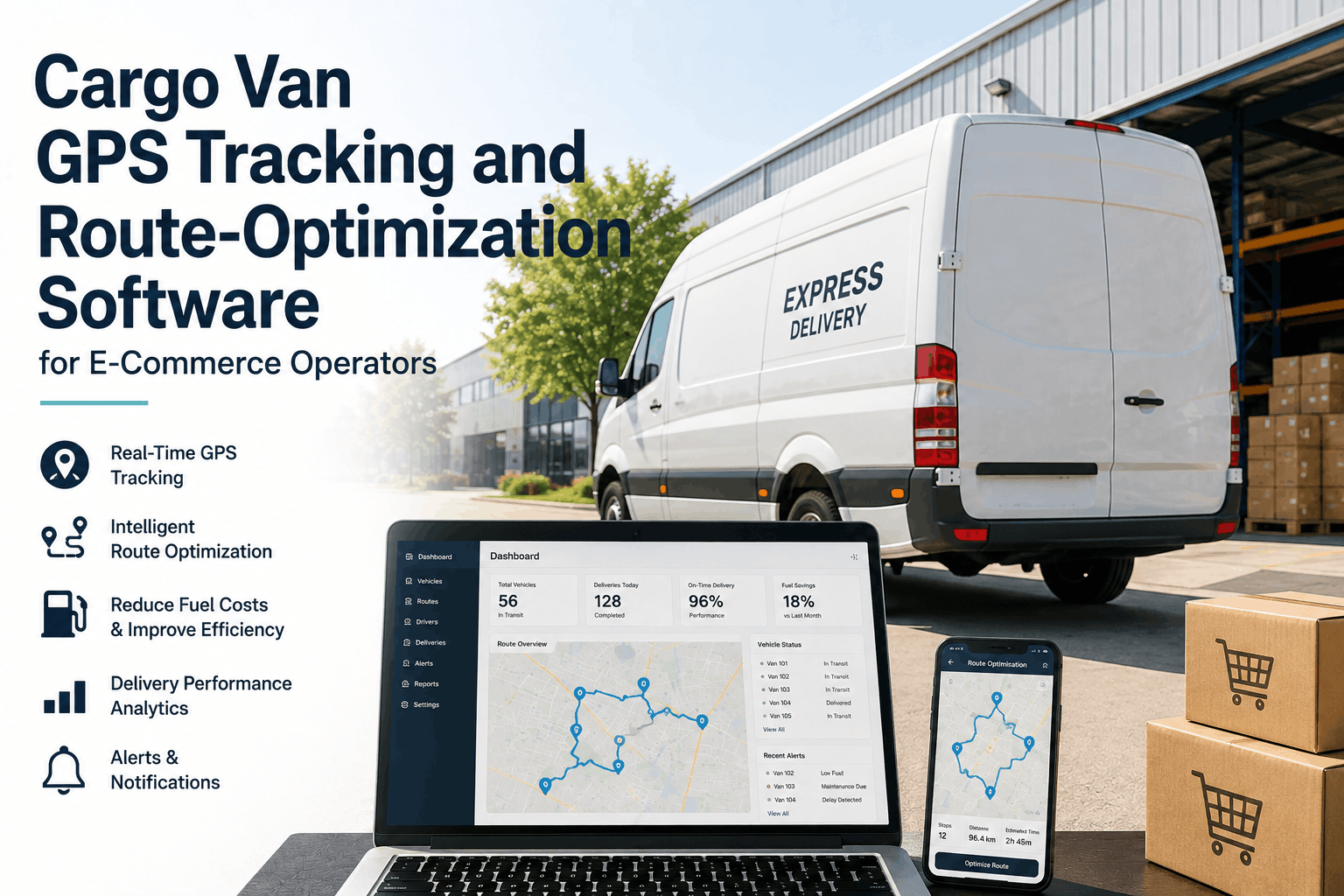
Last-mile delivery is the most visible and most expensive leg of any e-commerce supply chain, often swallowing close to half of total shipping cost before a package ever reaches the doorstep. For operators running cargo vans against same-day and next-day promises, the margin on that leg comes down to three things: how tight the routes are, how often a van breaks down mid-shift, and how quickly a delivery dispute gets resolved. Cargo van GPS tracking software brings all three under one system instead of three separate headaches. If cost-per-delivery has been creeping up on your routes, you can sign up free and see where your fleet is actually losing money.
Breaking down the cost hiding inside a last-mile route
E-commerce operators tend to budget last-mile delivery as a single line item, but the cost underneath it splits into distinct sources, and most of them are addressable once a fleet has real visibility. Route waste, unplanned breakdowns, failed first attempts, and delivery disputes each pull margin out of the same route in different ways.
Approximate share of avoidable last-mile cost by source, based on patterns reported across e-commerce delivery fleets. Cargo van GPS tracking software for last-mile operations is built to shrink every one of these segments at once, not just the routing piece. See it against your own numbers when you book a demo.
Predictive maintenance catches trouble before the parking lot does
Vehicle breakdowns are behind a large share of last-mile delivery failures, and the damage rarely stays contained to one van. A single breakdown on a multi-stop route can cascade into more than a dozen missed delivery windows before dispatch even finishes reassigning the load. Cargo van GPS tracking software with predictive uptime built in flags a developing issue days before it becomes a roadside call, giving dispatch time to route the van to a shop during a normal window instead of losing the whole day.
- Breakdown discovered when the van stops moving
- Dispatch reassigns stops manually, mid-panic
- Repair happens whenever a shop has an opening
- Same failure pattern repeats on the next van
- Early fault signal flagged days before failure
- Service scheduled around the day's route plan
- Van returns to service before it ever stalls out
- Fleet-wide patterns flag similar vans early
Operators running dozens or hundreds of vans across a service area feel this compounding fastest, since one avoided breakdown protects every stop scheduled behind it that day. The quickest way to see the model in action is to create a free account and connect a handful of vans to start.
Stop losing routes to breakdowns you could have seen coming
Predictive fault alerts, live GPS tracking, and route optimization running from one dashboard built for e-commerce delivery fleets.
Proof of delivery that closes the loop, not just a checkbox
"It never arrived" is one of the most expensive sentences in e-commerce, since every disputed delivery usually means a refund, a reshipment, or both. Cargo van GPS tracking software fixes this by attaching a verifiable record to every stop the moment it happens, so the record exists before a customer ever opens a support ticket.
None of that record needs a manager to assemble it after the fact. It's generated automatically at the moment of delivery, which is what makes proof-of-delivery data genuinely audit-ready instead of something a support team has to reconstruct from memory and text messages. Operators who want to see this running against their own order volume can sign up and test it on a live route today.
Holding delivery promises when volume spikes
Average-day performance is not what breaks an e-commerce delivery promise. Peak volume does, whether that's a seasonal spike, a flash sale, or a regional weather event that compresses every route into a tighter window. Route optimization software that only performs well on a light Tuesday isn't built for the days that actually matter to the business.
Dynamic resequencing
Routes rebuild automatically as new orders, cancellations, and delays land mid-shift.
SLA-aware dispatch
Time-sensitive stops surface first, so promised delivery windows stay protected under load.
Fleet-wide visibility
Every van's location, ETA, and status rolls up to one dashboard, even across multiple depots.
Scaling a delivery promise up for peak season shouldn't mean adding headcount to watch more spreadsheets. It should mean the software absorbs the extra load automatically, which is exactly what happens when a fleet is already running route-optimized scheduling instead of building it fresh every morning. Talk through your own peak volumes when you book a demo.
Give every order the delivery experience e-commerce customers expect
Route optimization, predictive uptime, and audit-ready proof of delivery, all from one platform for your cargo van fleet.
Cargo van GPS tracking software for e-commerce, answered plainly
How is this different from the tracking most carriers already use
Basic tracking shows a van's position. This platform ties that same location feed into route optimization, predictive maintenance alerts, and proof of delivery, so the data drives decisions instead of just filling a map.
Can it actually reduce delivery disputes
Yes. Every stop generates a photo, signature, GPS-stamped location, and timestamp automatically, which gives support teams a complete record to resolve a claim in minutes instead of chasing down a driver for details.
Does predictive maintenance really catch issues before a breakdown
The system reads live engine and mileage data continuously and flags developing issues against known fault patterns, which typically surfaces a problem days ahead of a roadside failure rather than at the moment it happens.
Will this handle a spike in order volume during peak season
Routes rebuild dynamically as new orders and delays come in, and SLA-aware dispatch keeps time-sensitive stops prioritized, so the system is designed to hold up under a volume spike rather than just an average day.
Does it work for fleets that already use other telematics hardware
Yes. The platform is built to layer route optimization, predictive maintenance, and proof of delivery on top of most existing GPS hardware and telematics data, so a fleet doesn't need to replace equipment that's already in place.
How fast can I see this working on my own routes
Sign up and connect a few vans to see live data the same day, or book a short demo where our team walks through your current cost-per-delivery numbers against what optimized routing and predictive maintenance would change.