E-commerce delivery operations leaders, final-mile courier contractors, and parcel fleet maintenance superintendents manage an asset class with one of the most punishing duty cycles in transportation: the high-roof cargo van. Between 100-plus daily residential stop-and-start cycles, constant curb mounting, rapid package door cycles, and extended auxiliary idling, cargo vans accumulate severe mechanical stress that traditional passenger-vehicle service schedules completely overlook. When last-mile fleets rely on static 5,000-mile calendar oil-change reminders or grease-stained paper shop logs, vans suffer premature brake pad wear-down, fried alternators, neglected transmission thermal stress, and unexpected roadside breakdowns during afternoon peak delivery windows. Fleet Rabbit delivers dedicated cargo van preventive maintenance scheduling software built to protect parcel delivery routes and fleet uptime. By pairing live OBD-II diagnostic trouble code (DTC) interrogation with real engine-hour tracking, dynamic mileage intervals, and driver mobile vehicle inspection reports (DVIR), our software shifts your garage from emergency roadside firefighting to planned off-peak servicing. Prevent route cancellations, streamline technician work orders, and maintain 99%+ delivery vehicle availability. Book a Demo to see our cargo van preventive maintenance scheduling platform live.
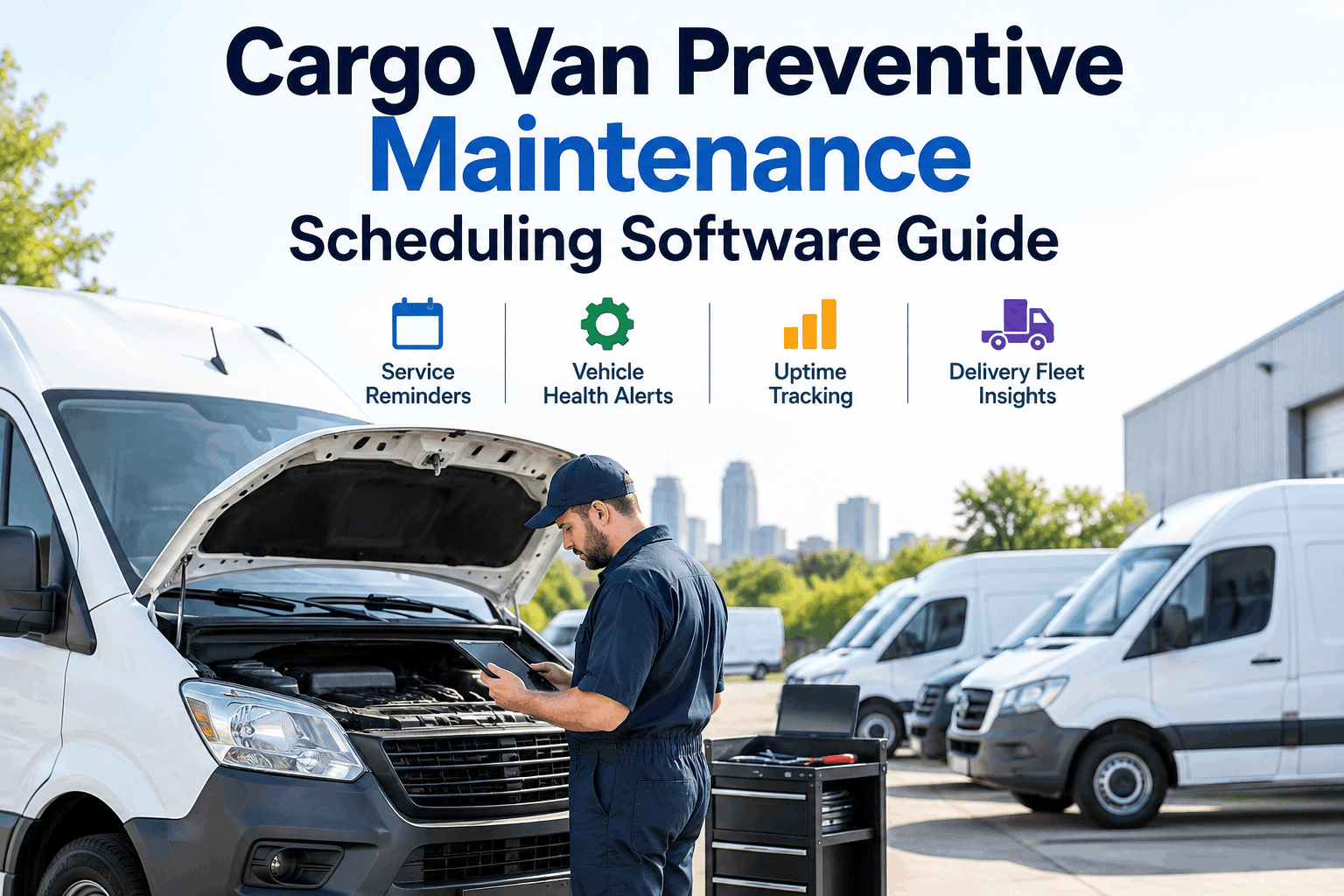
Cargo Van Preventive Maintenance Scheduling Software Guide
An engineering-backed operations guide for high-velocity delivery fleets: align service tiers to real-world parcel delivery duty cycles, automate predictive component reminders, eliminate catastrophic route failures, and streamline garage work orders.
The Hidden Failure Points of High-Density Cargo Van Delivery
Urban delivery vans operate under mechanical duty profiles drastically different from highway linehauls or personal passenger vans. Subjected to continuous door openings, rapid acceleration out of cul-de-sacs, and hours of stationary idling in loading zones, standard odometer mileage schedules fail to predict critical component failure. Sign up to modernize your delivery van maintenance scheduling.
The Tiered Cargo Van Preventive Maintenance Matrix
To eliminate unexpected route disruptions, progressive parcel carriers structure their van servicing around standardized, telematics-driven inspection tiers rather than arbitrary calendar dates. Book a demo to explore our customizable cargo van PM tiers.
| Service Tier | Trigger Interval | Inspection & Replacement Scope | Operational Downtime Window |
|---|---|---|---|
| Tier A: Safety & Lubrication | Every 4,000 mi / 250 Engine Hours | Full synthetic oil & filter flush, brake pad caliper check, tire pressure & wear pattern balance, sliding door track lubrication, fluid top-offs. | 45 minutes (Night shop shift) |
| Tier B: Electrical & Powertrain | Every 12,000 mi / 750 Engine Hours | Tier A scope PLUS: cabin & engine air filter swap, battery conductance test, alternator ripple check, steering tie-rod & ball-joint torque, serpentine belt inspection. | 2.5 hours (Scheduled weekend bay) |
| Tier C: Drivetrain & Cooling | Every 30,000 mi / 1,800 Engine Hours | Tier A & B scope PLUS: transmission fluid flush, brake hydraulic line bleed, cooling system pressure test, DPF soot clean cycle, suspension shock dampener test. | 5 hours (Planned route coverage) |
| Tier D: Heavy Lifecycle Overhaul | Every 60,000 mi / 3,600 Engine Hours | Tier A, B & C scope PLUS: timing chain/belt service, water pump replacement, differential fluid change, fuel injection clean, motor mount re-torque. | Full day (Reserve asset deployed) |
The 4 Pillars of Telematics-Linked Van PM Software
Fleet Rabbit bridges hardware diagnostic ports, driver mobile walkaround routines, and garage inventory into an automated, proactive workflow. Sign up to connect your cargo van diagnostic telemetry.
Closed-Loop Preventive Maintenance Workflow: From Telematics Trigger to Bay Sign-Off
Follow the frictionless operational journey that keeps cargo vans out of emergency repair bays and running smoothly along customer delivery routes. Book a demo to see our technician tablet interface.
Platform Comparison: Manual Spreadsheets vs. Fleet Rabbit PM Software
Compare the operational, financial, and mechanical differences between conventional whiteboard scheduling and Fleet Rabbit’s connected software. Book a demo to evaluate your fleet's preventive maintenance ROI.
| Preventive Maintenance Capability | Fleet Rabbit Connected Platform | Spreadsheets & Calendar Reminders | Generic Fleet GPS Trackers |
|---|---|---|---|
| Subscription Rate | $5 / asset / month | Hidden breakdown labor & towing costs | $25 – $45 / vehicle / month |
| Engine-Hour & Mileage Hybrid PM | Automated dual-threshold trigger | Odometer only (ignores idle hours) | Odometer miles only |
| DTC Diagnostic Fault Triage | Real-time CAN-bus early alerts | None; visible only on instrument cluster | Basic check engine light alerts only |
| Mobile Driver Pre-Trip DVIR | Included photo-verified mobile app | Paper clipboards prone to pencil-whipping | Driver hours-of-service app only |
| Automated Shop Work Orders | Instantly generated with labor & parts | Manual verbal instructions to mechanics | Not supported |
| Storeroom Parts Inventory Link | Automated parts deduction on job close | Separate disconnected inventory log | Not available |
| Contract Terms & Rollout | 14-day free trial, self-serve in 14 days | Not applicable | 1 to 3-year auto-renewing contract |
Courier Fleet Case Study: SwiftMile Parcel Express
Learn how an urban delivery service partner deployed Fleet Rabbit's preventive maintenance software across 46 high-roof cargo vans to slash unscheduled maintenance costs. Sign up to achieve similar delivery fleet uptime results.
Handling over 5,500 daily residential deliveries in a congested metropolitan market, SwiftMile Parcel Express operated 46 Ford Transit and Mercedes-Benz Sprinter vans under severe strain. The fleet was suffering from an average of three roadside breakdowns per week: seized brake calipers, dead starter batteries, and engine overheating caused by neglected coolant leaks. The maintenance shop scheduled servicing strictly every 6,000 odometer miles using a manual whiteboard, completely missing the fact that vans spent 45% of their operating day stationary with engines idling.
By implementing Fleet Rabbit at $5/asset/month, the carrier integrated live OBD-II telematics to track engine hours, battery cranking voltages, and diagnostic fault codes in real time while equipping drivers with mobile photo DVIR checklists. Automated alerts scheduled brake pad and starter inspections based on actual operating hours, catching worn pads before rotors were destroyed. Over 12 months, emergency roadside tow calls dropped by 48%, morning dispatch vehicle readiness rose to 99.6%, and the company saved $72,000 in eliminated towing bills, reduced rotor replacements, and avoided route failure chargebacks.