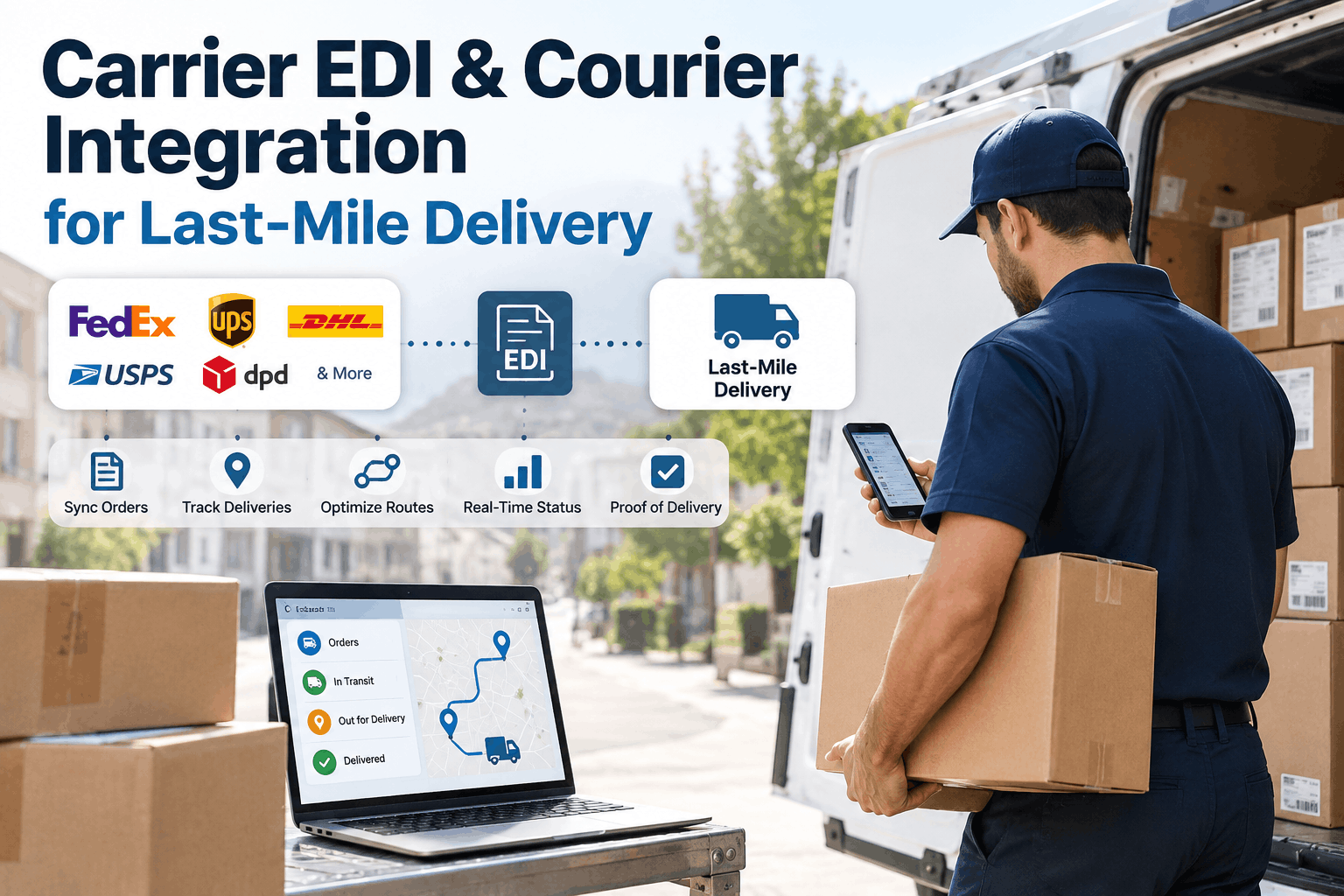
Logistics vice presidents, regional courier founders, and final-mile distribution dispatchers routinely navigate a demanding technical divide: translating legacy carrier Electronic Data Interchange (EDI) transaction sets into live, curb-level delivery fleet operations. While primary national shippers and freight brokers transmit shipment tenders, manifests, and billing updates via legacy ANSI X12 EDI protocols, roadside couriers operate on dynamic smartphone apps, turn-by-turn routing, and live photographic handovers. When last-mile fleets rely on manual batch parsing or third-party value-added networks (VANs) that process updates on hours-long delays, parcel operators encounter missed pickup windows, delayed status messaging, billing disputes, and customer chargebacks. Fleet Rabbit bridges this technological chasm with a modern Carrier EDI and Courier Integration platform. By transforming incoming EDI 204 load tenders into dynamic multi-stop routes, feeding automated EDI 214 status messages upon doorstep scan, and generating instant EDI 210 freight invoices with cryptographic photographic proof-of-delivery (ePOD), carriers achieve end-to-end operational synchronization. Eliminate manual data entry, accelerate order-to-cash velocity, and handle high-volume enterprise e-commerce contracts with confidence. Book a Demo to see our real-time carrier EDI and courier integration in action.
Carrier EDI & Courier Integration for Last-Mile Delivery
A unified architectural blueprint for delivery carriers and final-mile couriers: translate legacy EDI 204, 214, and 210 feeds into real-time mobile parcel routes, sub-second tracking webhooks, and automated proof-of-delivery settlement.
The Acute Technical Friction of Legacy Carrier EDI in Final-Mile
National retail shippers, third-party logistics (3PL) brokers, and enterprise freight platforms mandate strict Electronic Data Interchange (EDI) compliance. Yet for final-mile courier fleets running urban delivery routes, traditional EDI processing creates significant operational hurdles. Sign up to automate your carrier EDI data pipelines.
The 4 Essential EDI Transaction Sets for Last-Mile Fleets
Fleet Rabbit automates the translation and transmission of the primary ANSI X12 freight transaction standards, ensuring full compatibility with tier-one shippers. Book a demo to review our EDI transaction mapping tables.
Inbound shipment instructions transmitted by the shipper or broker containing pickup origin, delivery consignee details, package piece counts, weight, volumetric cube, and contractual delivery SLA windows. Fleet Rabbit parses this raw data into sequenced mobile stop lists within seconds.
An automated operational handshake confirming whether the carrier accepts or declines the shipment tender based on active fleet capacity, driver availability, and route density rules, eliminating manual email tender confirmations. Sign up to automate your EDI tender acceptance logic.
Real-time delivery progress milestones—including arrival at consignee, package out for delivery, gate exception codes, and successful completed delivery. Doorstep barcode scans on the driver app trigger immediate outbound EDI 214 transmissions with exact UTC timestamps.
Automated electronic billing generated the moment proof-of-delivery is confirmed. Itemized accessorial fees, base delivery charges, and verified recipient signatures are structured for immediate ERP clearing, accelerating cash flow. Book a demo to inspect our automated freight billing workflows.
The End-to-End Automated Courier Integration Journey
See how raw enterprise EDI transmissions flow seamlessly from enterprise shippers down to mobile delivery couriers and back to financial settlement. Sign up to test our end-to-end integration workflows.
Architecture Comparison: Traditional EDI vs. Fleet Rabbit Platform
Evaluate the clear operational differences, integration costs, and delivery visibility between legacy third-party EDI systems and Fleet Rabbit's modern platform. Sign up to experience modern API-driven fleet integration.
| Integration Dimension | Fleet Rabbit Unified Platform | Legacy Third-Party EDI VANs | Generic Fleet GPS Trackers |
|---|---|---|---|
| Subscription Rate | $5 / asset / month | $500 – $2,000/mo + per-kilo-character fees | $25 – $45 / vehicle / month |
| Status Update Latency | < 15 seconds real-time push | 2 to 4-hour batch processing | Basic arrival GPS pin only |
| Mobile Driver Integration | Included mobile app (barcode, photo, sign) | None; requires external third-party tools | Driver app only (no EDI parsing) |
| Route Optimization | Automated dynamic stop clustering | Not available | Basic route display only |
| Vehicle Health & PM | OBD-II telematics & paperless DVIR | Not supported | Odometer miles only |
| Implementation Velocity | Live in under 14 days | 3 to 6 months custom consultant setup | 3 to 6 weeks average |
| Trial & Contract Terms | 14-day free trial, cancel anytime | Multi-year locked enterprise contracts | 1 to 3-year auto-renewing contract |
Carrier Success Story: Midwest Final-Mile Logistics
Learn how a regional courier fleet modernized carrier EDI integration across 32 delivery step-vans to secure high-volume enterprise retail contracts. Book a demo to see how Midwest Logistics streamlined their operations.
Handling over 3,500 daily deliveries for major e-commerce retailers, Midwest Final-Mile Logistics faced severe operational challenges: their legacy EDI provider processed status updates in delayed batch files, resulting in $4,500 in monthly customer chargebacks for late milestone reporting. Dispatchers spent two hours every morning manually re-typing EDI 204 tenders into standalone driver navigation apps.
By implementing Fleet Rabbit, the carrier automated EDI 204 ingestion directly into dynamic multi-stop delivery routes and equipped couriers with our mobile delivery app. Doorstep barcode scans and photos now trigger immediate EDI 214 status transmissions within 15 seconds of delivery. Milestone compliance penalties fell to zero, third-party VAN transaction fees were completely eliminated, saving $64,000 annually, and cash flow accelerated by eight full business days.