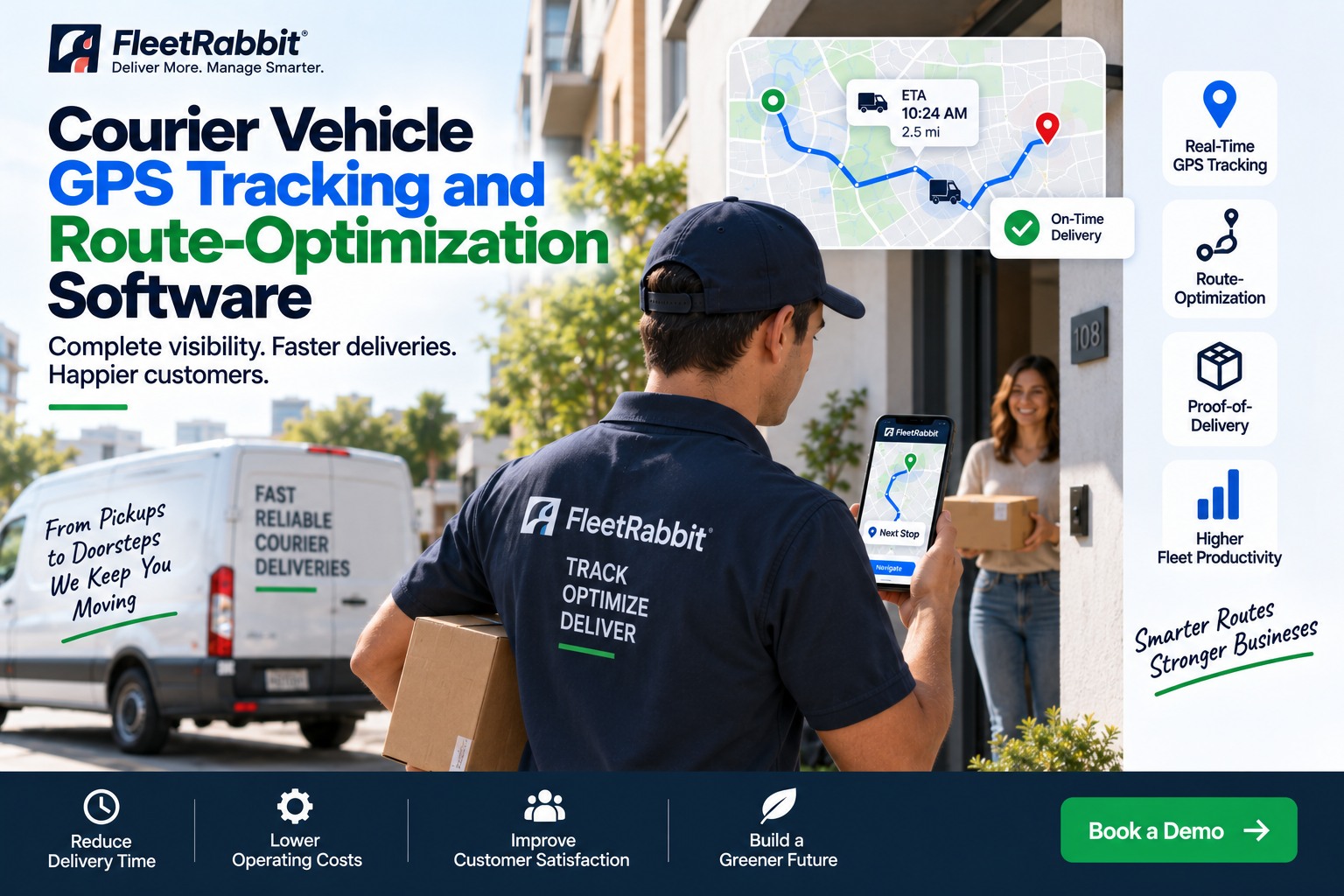
A courier route is nothing like a fixed last-mile delivery run, because a courier vehicle rarely knows its full day in advance. A new pickup request can land while a driver is three stops into a completely different job, and the vehicle has to go collect from one address and hand off at another, sometimes twice in the same hour. GPS tracking on its own just shows where that vehicle is, but a courier fleet needs routing that can absorb a brand new job mid-route without blowing up every ETA already promised to a waiting customer. This page covers what makes courier routing different from standard delivery routing, and how live tracking, dynamic re-routing, and proof-of-delivery need to work as one system instead of three separate tools.
Job 206 landing on a driver who is already mid-route with three other jobs is the exact moment a courier dispatch system either earns its keep or falls apart. The vehicle has to be matched by actual proximity and current job load, not by whoever happens to be free on a whiteboard, and the new stop has to slot into the existing route without wrecking the ETA already promised on Job 205. Dispatchers ready to see that matching happen automatically can sign up and connect their courier fleet without changing how drivers already take jobs.
Connect your courier fleet and let live location and current job load decide who takes the next pickup.
That fourth step matters as much as the first three, because a courier job is not finished until there is proof it was actually handed off, not just marked complete by a driver in a hurry. Signature capture, a delivery photo, and a timestamp tied to GPS location are what make a completed job defensible if a customer ever disputes it, which is exactly why proof-of-delivery has to live in the same system as the routing, not in a separate app a driver opens after the fact. Fleets that book a demo of that combined flow usually notice how much dispute-handling time disappears once the two are connected.
- New jobs assigned by who happens to answer the radio
- Route changes handled by memory, not live data
- Proof of delivery is a driver's word after the fact
- ETAs given to customers are best guesses
- New jobs matched by live location and current load
- Routes recalculate automatically as jobs are added
- Proof of delivery captured with photo, signature, and GPS
- ETAs update continuously and stay accurate
The gap between those two columns is the gap between a courier fleet that can promise a real ETA and one that is guessing every time a dispatcher answers the phone. Courier work runs on speed and trust, and both depend on a system that can absorb a new job the moment it comes in instead of forcing a driver to work it out on the fly. If your fleet is still coordinating pickups over the radio, this is a good time to sign up and see what live matching actually looks like.
Book a demo and see GPS tracking, dynamic routing, and proof-of-delivery running together, live in days, not months.