A box truck running local delivery routes for a carrier does not fail the way people expect. It rarely just stops. It gives warning signs for weeks first, a slightly softer brake pedal, a lift gate that hesitates, a door seal starting to wear, and most fleets never catch any of it because nobody is tracking those signals against a real schedule. Delivery box truck preventive maintenance software exists to close exactly that gap, and this breakdown walks through what a route-optimized, PM-tiered system looks like when it is built for carriers instead of adapted from a generic shop tool.
Why Box Trucks on Delivery Routes Wear Differently Than Line-Haul Trucks
A box truck making twenty to forty stops a day lives a different life than a truck running steady highway miles. Local delivery duty means constant braking, frequent door and lift gate cycles, and an engine that spends more time idling at the curb than cruising. That pattern wears brakes and door hardware far faster than mileage alone would suggest, which is exactly why carriers who sign up for tiered, condition-aware scheduling stop getting surprised by a truck that "seemed fine yesterday."
The PM-A Through PM-D Tier Structure, Built for a Delivery Fleet
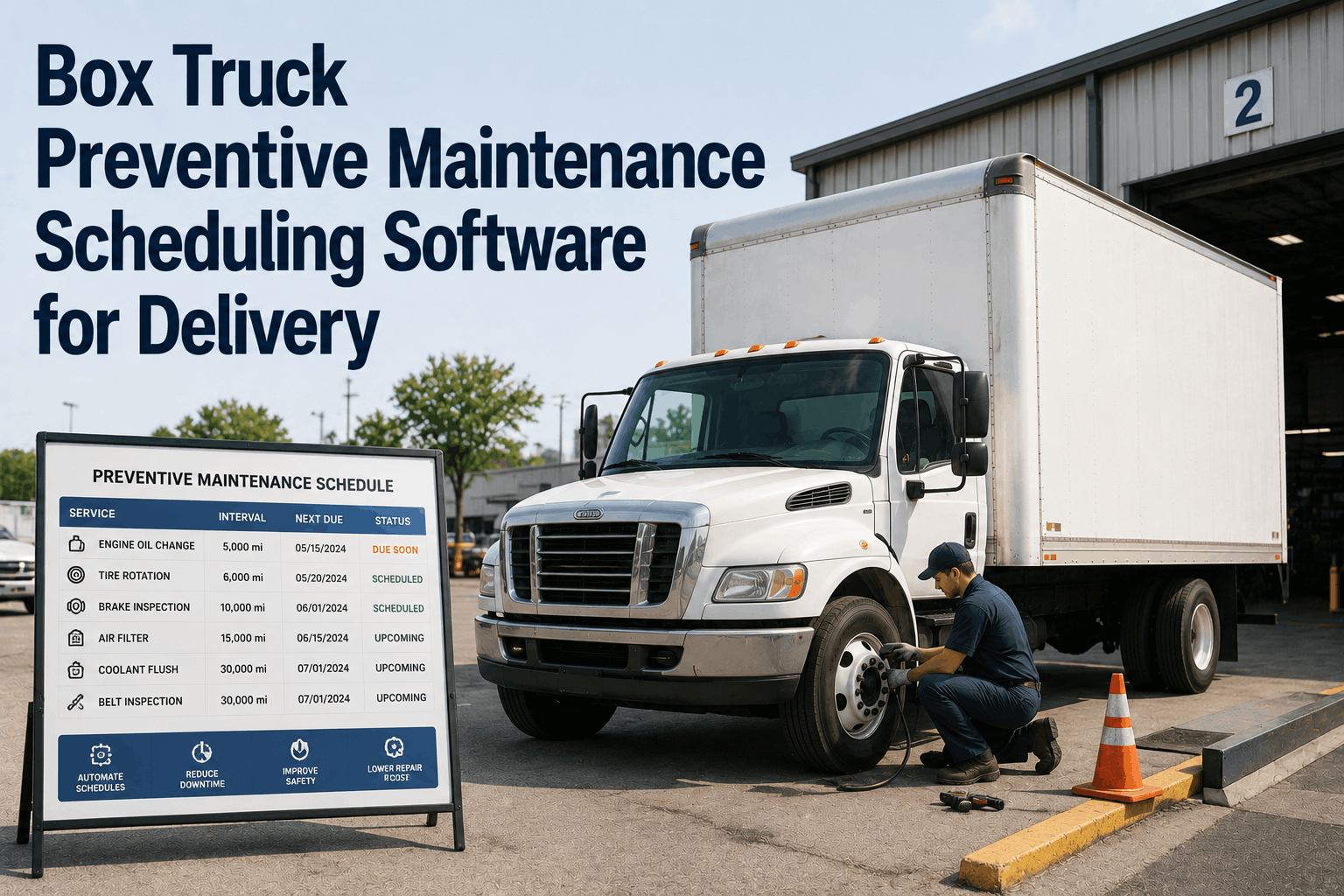
Most fleet maintenance programs are organized into four tiers, each catching a different depth of wear. Applied to a local delivery box truck, the intervals below reflect how carriers typically compress these windows to match stop-and-go duty cycles rather than highway averages.
Basic service: oil, fluid levels, brake pad check, tire pressure and tread, lights and wipers.
Intermediate service: everything in PM-A plus brake system inspection, suspension check, and door and lift gate hardware.
Comprehensive service: drivetrain inspection, cooling system, steering components, and a full undercarriage review.
Major service, aligned with the annual DOT inspection window and full documentation refresh.
See your entire fleet's PM-A through PM-D status in one view
Route-optimized scheduling that flags the right truck, the right tier, before it turns into downtime.
The Wear Zones a Local Delivery Box Truck Actually Stresses
Not every part of a box truck ages at the same rate. Local delivery duty puts disproportionate stress on a specific set of zones, and a good preventive maintenance program weighs its inspection depth accordingly instead of treating every truck like it drives the same route.
Frequent stop-start delivery driving wears pads and rotors far faster than highway duty, making this the single most common early-failure point.
Repeated cycling at every stop stresses hinges, seals, and hydraulic lift components well before mileage alone would suggest service is due.
Long idle periods between stops mean engine hours often outpace mileage as the more accurate wear signal for a delivery-duty truck.
Uneven load distribution and constant curb starts accelerate tire wear and suspension fatigue compared to a steady highway run.
Where Preventive Maintenance Overlaps With DOT Compliance
Preventive maintenance for a carrier is not only about avoiding breakdowns, it is also a documented requirement. Federal regulation 49 CFR 396.3 requires carriers to maintain proof of a systematic inspection and maintenance program, and DVIRs must be kept on file for a minimum of three months, with annual inspection records held for fourteen months. A scheduling system that generates this paper trail automatically turns an audit from a scramble into a formality, which is one of the most overlooked reasons carriers book a demo before their next DOT review window comes up.
Route-Optimized Scheduling: Servicing Trucks Without Stalling Delivery Volume
The hardest part of running a preventive maintenance program on a delivery fleet is not deciding when a truck is due. It is fitting that service window into a schedule without pulling a truck off its route on a heavy delivery day. Route-optimized scheduling solves this by flagging upcoming PM windows seven to fourteen days ahead, giving dispatch enough runway to slot the visit into a lighter volume day instead of scrambling to reroute stops at the last minute. That single change is often what convinces a fleet manager to finally sign up instead of continuing to track service dates on a spreadsheet.
Proof-of-delivery data plays a quiet but important role here too. Every completed stop feeds real mileage and engine-hour data back into the scheduling system, so PM windows are calculated from how the truck is actually being driven that week, not a rough monthly estimate that can drift out of sync with reality.
Keep every box truck compliant, documented, and out of the shop unexpectedly
Automated PM-A through PM-D scheduling with built-in DVIR and inspection recordkeeping.
Frequently Asked Questions
What are the PM-A through PM-D tiers and how do they apply to box trucks
PM-A is a basic service around every 10,000 to 15,000 miles, PM-B is an intermediate service around 25,000 to 30,000 miles, PM-C is a comprehensive service around 50,000 to 60,000 miles, and PM-D is a major service tied to roughly 100,000 miles or an annual cycle. Local delivery box trucks often compress these windows given their stop-and-go duty cycle.
Why do box trucks on delivery routes need service sooner than the mileage suggests
Frequent stops, constant braking, repeated door and lift gate cycling, and long idle periods all put stress on components faster than steady highway mileage would. Engine hours often become a more accurate wear signal than odometer readings alone for this duty cycle.
What documentation does a carrier actually need to keep for compliance
Under 49 CFR 396.3, carriers must maintain proof of a systematic inspection and maintenance program. DVIRs need to be kept on file for at least three months, and annual periodic inspection records must be retained for fourteen months.
How much does preventive maintenance actually save compared to reactive repairs
Fleets running structured PM schedules typically see 40 to 60 percent lower maintenance costs and can reach 95 percent or higher uptime, with industry estimates suggesting every dollar spent on preventive maintenance saves roughly four to eight dollars in emergency repair and downtime costs.
Can maintenance scheduling be automated without slowing down dispatch
Yes. Route-optimized scheduling flags upcoming PM windows seven to fourteen days in advance using live mileage and engine-hour data, so dispatch can slot a truck's service into a lower-volume day instead of pulling it off an active route.