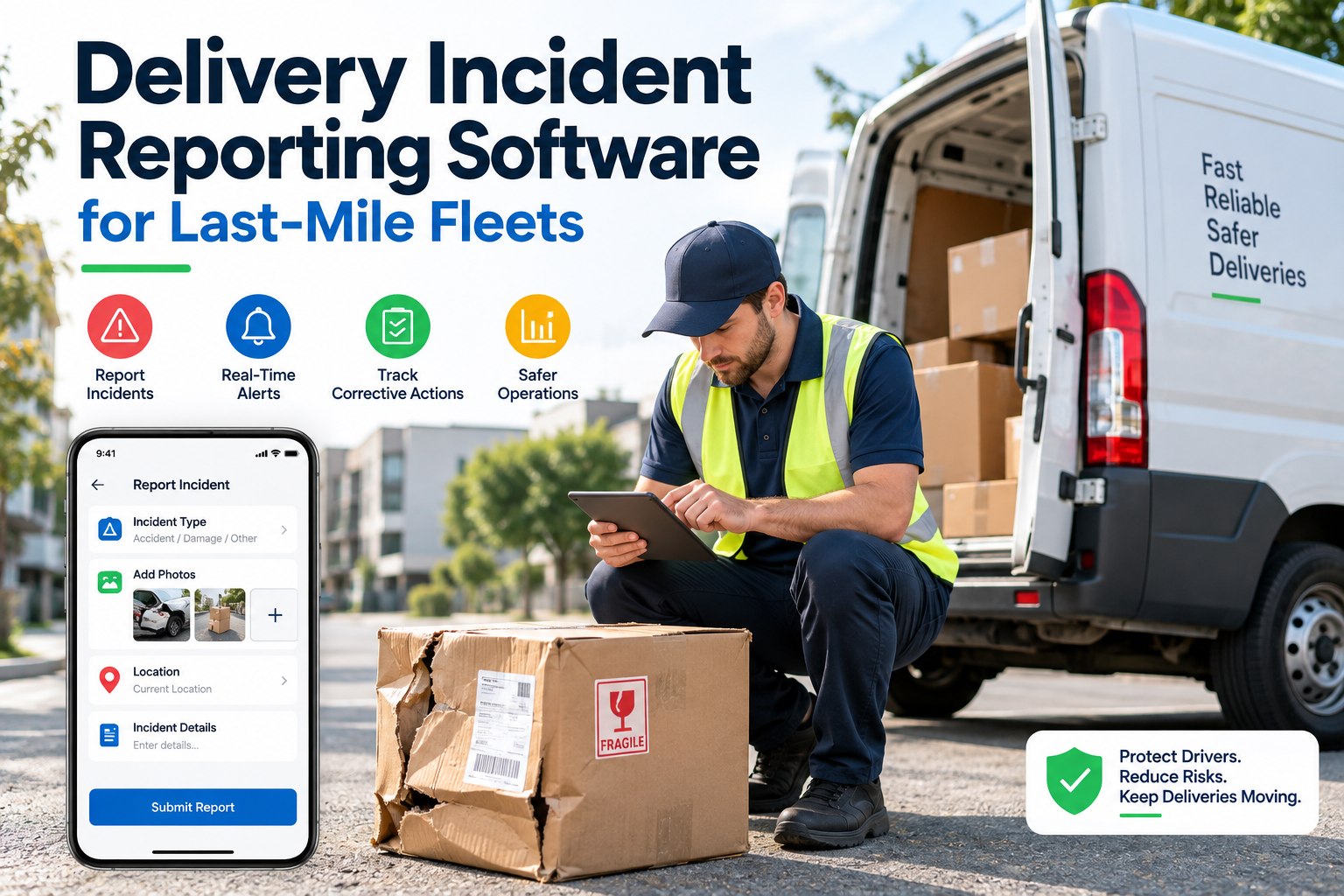
Last-mile delivery executives, safety compliance coordinators, and fleet risk managers know that the critical minutes immediately following an on-road incident dictate the operational and financial aftermath. Whether dealing with a low-speed backing collision in a crowded residential cul-de-sac, a pedestrian close-call, damaged customer property, or cargo theft, manual paper incident reporting creates expensive liabilities. When drivers rely on memory hours after the event, critical evidence vanishes: photos go untaken, witness details are lost, police report numbers are forgotten, and commercial insurance claims drag on for months. Fleet Rabbit provides dedicated delivery incident reporting software that turns smartphones into frontline risk management portals. Couriers complete guided, step-by-step incident reports right at the scene, capturing timestamped photos, GPS coordinates, third-party insurance data, and digital witness statements that immediately sync to dispatch and safety review boards. Close claims faster, track automated corrective action plans, and safeguard your carrier margins against bloated insurance reserves. Book a Demo to see our mobile delivery incident reporting platform in action.
Digital Incident Response & Fleet Risk Mitigation
Delivery Incident Reporting Software for Last-Mile Fleets
Empower delivery couriers with structured on-scene digital accident reporting: capture high-resolution damage photos, record witness statements, automate supervisor triage, and maintain an audit-ready digital accident register.
< 4 min
On-Scene Report Capture
Drivers submit guided mobile accident packets before leaving the scene.
65%
Faster Claims Resolution
Structured photographic and telematics proof speeds up insurer reviews.
100%
Corrective Action Tracking
Automated driver re-training assignments linked directly to incident files.
$5
Per Asset / Month
Full access to mobile incident workflows, route tracking, and maintenance.
Standardize Roadside Accident & Property Damage Response
Eliminate missing crash details, capture cryptographic photo evidence, and protect your commercial insurance loss runs with standardized mobile incident reporting.
The Costly Dangers of Delayed & Paper Incident Reporting
In last-mile logistics, an accident is not just a damaged fender—it is a legal, operational, and customer relationship crisis. Relying on loose paper forms, phone calls, or end-of-shift verbal summaries exposes delivery operations to severe liabilities. Sign up to digitize roadside incident management.
01
Disputed Liability & Nuclear Verdict Exposure
Without time-stamped, wide-angle photos of lane markings, skid signs, and vehicle positioning immediately after impact, third parties can distort facts, turning minor fender benders into catastrophic civil payouts.
02
Unreported Customer Property Damage
Delivery step-vans frequently back into residential mailboxes, scrape driveway gates, or crack decorative retaining walls. When drivers fail to log incidents immediately, homeowners submit inflated property damage claims.
Book a demo to inspect our property damage intake modules.
03
Inflated Insurance Loss Reserves
Insurance carriers set high financial loss reserves when claim documentation is sparse or delayed. Prolonged claim cycles damage your carrier loss ratio, resulting in steep commercial auto premium hikes.
04
Lacking Documented Corrective Actions
During commercial safety audits or post-crash litigations, failing to prove that an incident triggered formal driver retraining or vehicle mechanical safety reviews exposes companies to charges of negligent entrustment.
Sign up to automate closed-loop corrective action tracking.
The 5-Step Guided Mobile Incident Response Architecture
Fleet Rabbit’s mobile driver application replaces confusion with a step-by-step intake protocol that guides drivers through scene safety, emergency notifications, and evidence collection. Book a demo to test the mobile driver incident intake flow.
Step 01
Scene Safety & Emergency Dispatch Notification
The app prompts the driver to confirm safety, check for injuries, activate hazard flashers, and place safety triangles. A single tap initiates an emergency call to 911 and simultaneously alerts fleet dispatch of a critical event.
Step 02
Cryptographic Photo & Video Documentation
Drivers are guided through an interactive photo capture checklist: vehicle damage points, license plates, traffic signals, road conditions, and panoramic scene context. The app attaches immutable GPS coordinates and UTC timestamps to every image.
Sign up to enable cryptographic on-scene photo capture.
Step 03
Third-Party & Witness Information Exchange
Couriers scan third-party driver licenses, photograph insurance cards, and record audio or written statements from independent eyewitnesses, avoiding scribbled, illegible handwriting on scrap paper.
Step 04
Police Report & Citation Logging
The driver inputs responding police department details, investigating officer badge numbers, and collision exchange slips, ensuring central dispatch has immediate reference numbers for official records retrieval.
Step 05
Triage, Vehicle Red-Tagging, & Shop Work Orders
If the vehicle sustained structural, brake, or steering damage, the platform automatically flags it as out-of-service in dispatch, routes remaining parcel stops to backup drivers, and creates a repair work order in the maintenance garage.
Book a demo to see our vehicle red-tag and parcel reroute tools.
Incident Classification & Response Severity Matrix
Classify delivery events systematically to ensure proportionate operational, legal, and maintenance actions are executed immediately. Sign up to configure custom fleet incident severity workflows.
| Severity Level |
Incident Classification |
Automated Operational Trigger |
Required Safety Action |
Regulatory & Legal Scope |
| Level 1: Critical |
Injury collision, multi-vehicle crash, major tow-away |
Instant SMS/Call to Safety Director; Vehicle Out-of-Service lock |
Immediate drug/alcohol screening; on-scene supervisor dispatch |
DOT Recordable Accident Register / FMCSA Part 390 |
| Level 2: Major |
Residential property damage, driveable body collision |
Dispatch parcel re-route alert; priority shop inspection order |
Comprehensive telematics review; formal driver coaching session |
Internal loss prevention / Commercial insurance notification |
| Level 3: Moderate |
Curb scrape, mirror clip, cargo package damage, minor scrape |
Automated photo upload to claims queue; shop work order log |
Digital safety refresher module assigned to driver mobile app |
Internal fleet maintenance & preventative records |
| Level 4: Near-Miss |
Harsh swerve avoiding pedestrian, sudden stop close-call |
Telematics G-force spike alert; driver debrief notification |
Driver self-review of event clip; proactive behavior coaching |
Proactive OSHA safety management & trend analysis |
Closed-Loop Corrective Action Tracking & Driver Safety Coaching
Documenting a collision is only the first step. Preventing repeat accidents requires structured, auditable corrective action workflows that demonstrate rigorous safety oversight. Book a demo to inspect our corrective action tracking engine.
Action Module A
Automated Root-Cause Categorization
Classify each incident using standard root-cause tags: distracted driving, following too closely, tight-space backing, blind-spot misjudgment, or road surface conditions, exposing actionable fleet-wide hazard trends.
Action Module B
Targeted Mobile Micro-Training Modules
Action Module C
Supervisor 1-on-1 Debrief Documentation
Provide operations managers with standardized debrief interview templates. Record root causes, driver commitments, and supervisor sign-offs in an immutable audit trail.
Action Module D
One-Click Insurance Dossier Exports
Compile complete claim packets—including scene photos, telematics speed graphs, driver statements, police exchange slips, and repair estimates—into an unalterable PDF ready for insurers in seconds.
Incident Management Comparison: Manual Paper vs. Fleet Rabbit
Evaluate how digital roadside reporting eliminates claims friction and liability exposure compared to traditional methods. Sign up now to explore all platform features.
| Management Capability |
Fleet Rabbit Mobile Software |
Paper Accident Packets in Glovebox |
Generic Fleet GPS Trackers |
| Subscription Rate |
$5 / asset / month |
High claim payouts & admin labor |
$25 – $45 / vehicle / month |
| On-Scene Report Speed |
< 4 minutes on smartphone |
Delayed hours or days |
No mobile driver intake portal |
| Evidence Integrity |
Cryptographic time & GPS watermark |
Unverified driver memory |
Telematics GPS pins only; no photos |
| Dispatch & Shop Linkage |
Automated red-tag & work order |
Disconnected verbal phone calls |
Separate maintenance software needed |
| Corrective Action Auditing |
Integrated driver retraining logs |
Manual binder filing cabinets |
Not available |
| Free Trial & Rollout |
14-day free trial, self-serve |
Not applicable |
1 to 3-year locked contracts |
Fleet Case Study: Velocity Parcel Logistics
Learn how an independent regional parcel delivery contractor eliminated unverified property damage claims across 36 delivery step-vans. Book a demo to see how Velocity Parcel standardized their incident workflows.
Delivery Carrier Resolves Claims Faster and Halts Inflated Property Payouts
Operating 36 step-vans delivering over 4,000 residential packages daily, Velocity Parcel Logistics faced frequent homeowner claims alleging drivers backed into driveways, damaged lawns, and scraped brick mailboxes. Drivers routinely failed to complete paper accident forms stored in vehicle gloveboxes, leaving safety supervisors unable to prove or disprove third-party accusations.
By deploying Fleet Rabbit, the company mandated mobile on-scene reporting for all vehicle contacts, property disputes, and near-misses. Drivers photograph damage points, road conditions, and mailbox clearance immediately. Disputed payout claims dropped by $52,000 in the first year, insurance claim resolution cycles were cut from 42 days to under two weeks, and driver safety compliance reached 100%.
Frequently Asked Questions
Can drivers complete incident reports in areas without cellular service?
Yes. Fleet Rabbit features an offline-first mobile architecture. Drivers can photograph vehicle damage, capture third-party driver information, and record statements in rural cul-de-sacs, underground parking decks, or remote areas without internet connectivity. All data is cryptographically cached on the phone and auto-syncs to dispatch the instant connectivity is re-established.
How does digital incident reporting help lower commercial insurance premiums?
Commercial insurance underwriters evaluate risk based on loss runs and fleet operating controls. By submitting complete, photographic incident dossiers within hours of an event, claims settle faster, preventing insurers from posting inflated financial loss reserves. Furthermore, documented corrective actions prove your fleet operates with structured risk governance, qualifying you for preferred underwriting rates.
What happens if a vehicle is too damaged to safely continue customer deliveries?
When a driver logs critical steering, suspension, or safety system damage, Fleet Rabbit automatically flags the asset as red-tagged and out-of-service on the central dispatch board. The system prompts dispatchers to re-route remaining stops to nearby backup vehicles and opens a prioritized repair work order in the maintenance shop.
Does the software track non-vehicle incidents like package theft or slip-and-fall injuries?
Yes. Fleet Rabbit includes modular incident intake categories covering vehicle collisions, third-party property damage, driver slip-and-fall personal injuries, dog bites, and cargo theft. Each category prompts the driver for specific required evidence, such as medical treatment details or police report numbers.
What are the pricing details and contract terms for Fleet Rabbit's software?
Fleet Rabbit is priced at a flat rate of $5 per delivery asset per month billed annually. This includes full access to mobile incident reporting, driver safety scorecards, route sequencing, vehicle maintenance, and 12-month audit archives. We provide a 14-day free trial on up to 3 vehicles with zero setup fees or locked long-term contracts.
September 21, 2026
By Mark
All Posts