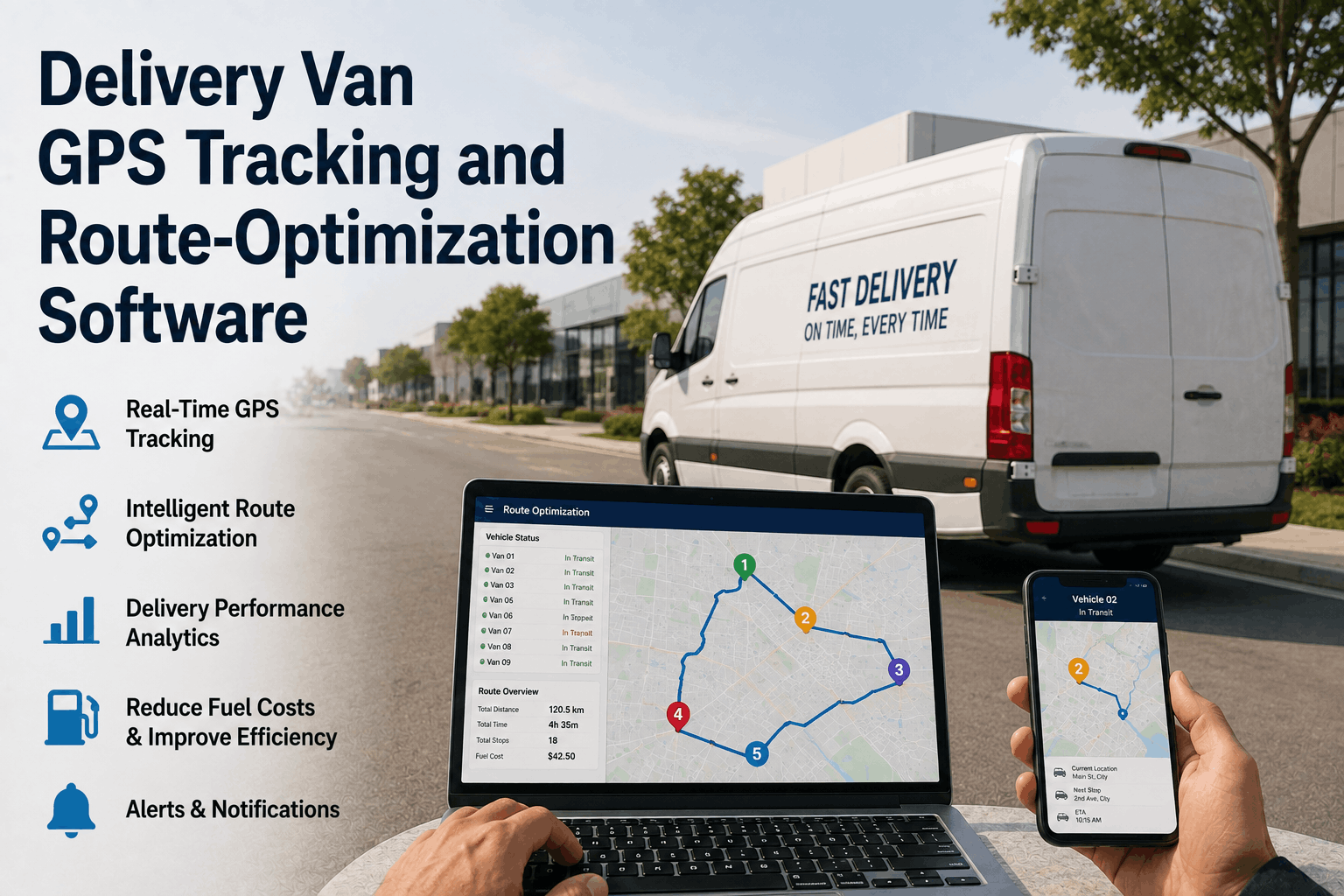
Every delivery van that leaves the depot without a route optimization software behind it is running on guesswork. Dispatchers estimate arrival windows by memory, drivers pick their own shortcuts, and customers call in asking where their package went. Delivery van GPS tracking software closes that gap by turning every vehicle into a live data point on a map, and by feeding that data into an engine that keeps rebuilding the day's route as conditions change. If you want to see exactly how much time that gap is costing your fleet, you can sign up for a free FleetRabbit workspace and connect your first van in minutes.
Why "we know roughly where the van is" isn't good enough anymore
Most delivery operations don't fail because drivers are careless. They fail because the tools around the driver are blind. A dispatcher without live GPS tracking is planning tomorrow's routes using yesterday's traffic patterns. A support team without real-time ETAs is telling customers "sometime this afternoon" and hoping that's close enough. Neither of those is a driver problem — they're a visibility problem, and visibility is exactly what delivery van GPS tracking software for fleets is built to fix.
Those numbers compound fast across a fleet of even ten vans. A dispatcher who used to spend an hour sequencing stops by hand can hand that work to software and spend the time on exceptions instead. Teams that want to see this against their own stop counts usually find it faster to book a demo and walk through a real route side by side with an optimized one.
One route, five checkpoints your dispatcher can act on
Live location
Vans report position at short intervals so dispatch always knows where a vehicle is, not where it was ten minutes ago.
Dynamic ETA
Arrival estimates recalculate automatically against live traffic, so the time a customer sees actually holds up.
Geofenced stops
Arrival and departure at each address is logged automatically, no manual check-ins required from the driver.
Proof of delivery
A timestamped photo or signature ties every drop to a GPS coordinate, so disputes get resolved in one lookup.
Maintenance alerts
Mileage and engine data trigger service reminders before a breakdown turns into a missed route.
Each checkpoint feeds the next one. Location data sharpens the ETA, the ETA drives the geofence trigger, and the geofence event closes the loop with proof of delivery. Connect a van and watch the checkpoints fill in live once you sign up free and add your first route.
See your fleet's route waste in one afternoon
Import your current stops, let the engine resequence them, and compare the two routes side by side before you commit to anything.
Route optimization is a scheduling problem, not a mapping problem
A basic map app can find the fastest way between two points. Route-optimized scheduling has to solve a much harder problem at once: sequence every stop for every van, respect delivery windows, account for vehicle capacity, and still leave room to adjust when a driver calls in sick or an order gets cancelled at the last minute. That's why delivery van GPS tracking software built for route optimization treats the whole day as one puzzle instead of a string of individual directions.
The practical effect shows up as fewer "spaghetti routes" — the backtracking, crisscrossing paths that happen when stops get assigned by convenience instead of geography and timing. A van that used to zigzag across a service area can instead move through it in a clean loop, cutting both drive time and fuel spend without adding a single extra vehicle. The fastest way to feel the difference for your own delivery zones is to book a demo and run your actual addresses through it.
- Stops sequenced by habit, not distance
- Delays discovered after the fact
- ETAs are a rough guess shared by phone
- Proof of delivery scattered across texts and photos
- Stops sequenced by live traffic and geography
- Delays flagged the moment they happen
- ETAs recalculate automatically, shared instantly
- Proof of delivery stored, timestamped, and audit-ready
Matching the software to the size of your delivery fleet
A three-van bakery route and a hundred-van regional delivery network don't need the same tooling, even though both benefit from delivery van GPS tracking software. Smaller fleets usually get the most value from fast setup, simple driver apps, and route-optimized delivery scheduling that just works out of the box. Larger fleets start caring more about API integrations, multi-depot planning, and reporting that rolls up performance across dozens of vans at once. FleetRabbit is built to scale between the two without forcing a re-platform later, which is worth walking through directly — talk to our team and describe your current stop volume.
Small fleets
Prioritize quick onboarding, driver-friendly apps, and route optimization that doesn't need a dedicated dispatcher to run it.
Growing fleets
Look for dynamic rerouting, geofenced proof of delivery, and maintenance alerts that protect uptime as van count climbs.
Large fleets
Weigh multi-depot scheduling, open APIs into your existing systems, and fleet-wide analytics for continuous improvement.
Whatever the size, the underlying question is the same: does the software shrink drive time, sharpen ETAs, and leave a clean paper trail for every stop. If a platform can't answer yes to all three, it's tracking software without the optimization that actually moves the needle. You can test that against your own routes the moment you create a free account.
Put your delivery vans on a route that plans itself
Connect your fleet, import today's stops, and watch route optimization, live tracking, and proof of delivery run from one dashboard.
Delivery van GPS tracking software, answered plainly
How is this different from a basic GPS tracker on the van
A basic tracker shows you a dot on a map. Delivery van GPS tracking software uses that same location data to build and rebuild routes, calculate ETAs, trigger geofence events, and log proof of delivery, so the location feed becomes an operational tool instead of a screen you glance at occasionally.
Will route optimization actually change my drivers' habits
It changes the plan they start with, not their judgment on the road. Drivers still make real-time calls, but they begin the day with a sequence that already accounts for traffic, delivery windows, and vehicle load, instead of one built from memory.
How accurate are the ETAs customers actually see
Because the ETA recalculates against live location and traffic data rather than a fixed estimate set at dispatch, it stays close to reality even when a route shifts mid-day, which is what cuts down on inbound "where is my order" calls.
What counts as audit-ready proof of delivery
A timestamped photo or signature paired with GPS coordinates, driver identity, and the exact arrival and departure time at the address. That combination holds up in a dispute far better than a GPS ping alone.
Do I need a large fleet for this to be worth it
No. Fleets with just a handful of vans often see the fastest payback, since even a small amount of daily route waste is a large share of a small fleet's total drive time. Setup is designed to take minutes, not a full onboarding project.
How do I see it working with my own delivery zones
The quickest path is to sign up and import a real day of stops, or book a walkthrough where our team runs your addresses through the optimization engine live.