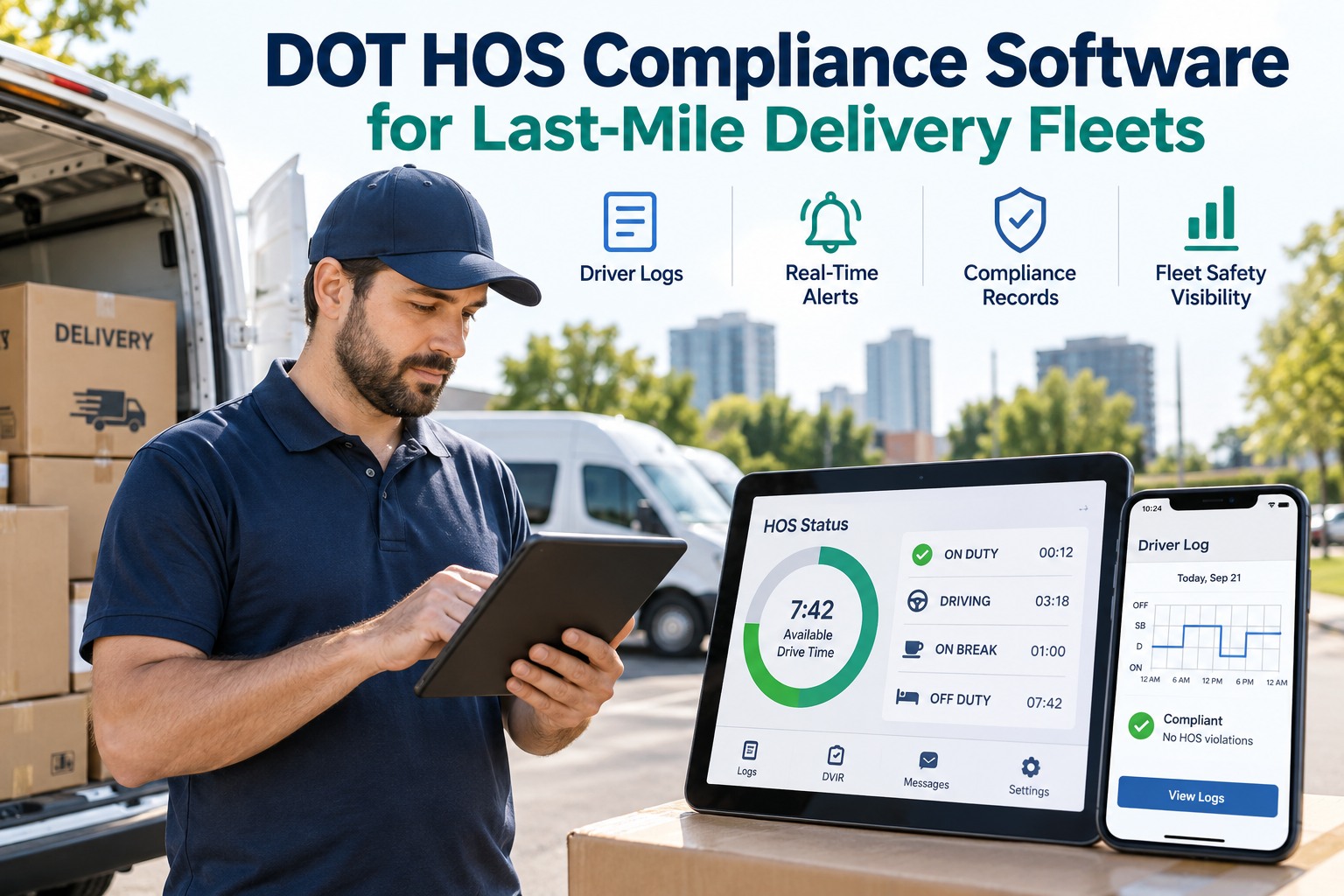
Last-mile distribution networks, parcel carrier executives, and regional delivery fleet operators navigate strict federal safety oversight where duty-status errors directly trigger crippling fines and vehicle out-of-service orders. Under Federal Motor Carrier Safety Administration (FMCSA) and Department of Transportation (DOT) mandates, managing Hours of Service (HOS) compliance across mixed delivery fleets demands real-time synchronization between in-cab telematics and mobile driver workflows. Urban step-van couriers, regional box truck operators, and sprinter delivery drivers constantly transition between driving time, curbside parcel scanning, customer signature dwell, and mandatory 30-minute rest breaks. When delivery operations rely on manual paper logbooks, unlinked routing tools, and disjointed driver spreadsheets, dispatchers remain blind to approaching 11-hour driving limits and 14-hour duty windows. A single HOS violation exposes delivery fleets to FMCSA safety rating downgrades, elevated commercial insurance premiums, and audit citations during roadside state patrol inspections. Purpose-built last-mile compliance software integrates automated electronic logging device (ELD) telematics, dynamic break alerts, real-time duty status clocks, and digital inspection records into a unified fleet management console. To evaluate how automated compliance tracking safeguards your delivery schedules and lowers audit exposure, book a live demonstration with our DOT compliance engineering team or launch active driver logging immediately through our free platform sign up.
DOT HOS Compliance Software for Last-Mile Delivery Fleets
An executive compliance and telematics blueprint for final-mile delivery operations. Master electronic driver logging, automate dynamic rest-break prompts, manage 100/150 air-mile short-haul exemptions, and eliminate roadside out-of-service violations.
Automate DOT & HOS Compliance Without Derailing Delivery Velocity
Eliminate form-and-manner violations, automate short-haul exemption timecards, and synchronize driver rest stops directly into delivery sequences starting from $3/vehicle/month with no hardware lock-in.
The Regulatory Anatomy of Last-Mile Hours of Service Compliance
Operating a high-density delivery fleet requires navigating overlapping federal regulations that dictate how long commercial drivers can operate behind the wheel. The Federal Motor Carrier Safety Administration (FMCSA) enforces four primary pillars of Hours of Service under 49 CFR Part 395: the 11-hour driving limit, the 14-hour on-duty window, the mandatory 30-minute rest break after 8 cumulative hours of driving, and the 60/70-hour multi-day rolling cycle. In final-mile operations, delivery couriers face unique compliance friction compared to long-haul truckers. A delivery driver executes 120 to 180 multi-stop residential drops per shift, repeatedly shifting between on-duty driving and on-duty not-driving status. If an e-commerce courier encounters prolonged dock delays, locked customer security gates, or congested metropolitan gridlock, the continuous 14-hour window ticking in the background cannot be paused. Failing to track duty clocks in real time leads to severe regulatory violations, roadside vehicle impoundments, and steep safety audit downgrades. Logistics directors can evaluate live duty-status tracking by scheduling an interactive HOS compliance demonstration or initialize driver timecard profiles directly through our quick platform sign up.
The 11-Hour Driving Rule & 14-Hour Shift Horizon
Commercial drivers are restricted to a maximum of 11 cumulative hours of driving following 10 consecutive hours off-duty. Crucially, all driving must be completed within a strict 14-hour window from the moment the driver signs on duty. Once the 14-hour clock runs out, a courier cannot legally move the commercial motor vehicle, even if they have only driven for 6 hours.
The 30-Minute Rest Break Intervention
Drivers must complete a continuous 30-minute off-duty or on-duty non-driving break after accumulating 8 hours of driving time without an interruption of at least 30 minutes. FleetRabbit correlates real-time drive time with dynamic route scheduling, automatically inserting the 30-minute break into the driver's turn-by-turn sequence near accessible parking amenities.
The 150 Air-Mile Short-Haul Exemption (§ 395.1(e)(1))
Many local parcel couriers and regional food distributors qualify for the short-haul exemption if they operate within a 150 air-mile radius of their home terminal, report off-duty within 14 consecutive hours, and take 10 consecutive hours off between shifts. FleetRabbit monitors vehicle geofences, automatically maintaining compliant digital timecards without requiring complex ELD logging.
The 60/70-Hour Rolling Limit & 34-Hour Restart
Couriers cannot drive after accumulating 60 on-duty hours in 7 consecutive days (or 70 hours in 8 consecutive days). During peak holiday fulfillment waves, delivery fleets operate at maximum capacity. FleetRabbit tracks multi-day driver duty trends, projecting rolling cycle run-outs days in advance so dispatchers can plan replacement shift schedules smoothly.
Direct Technical Matrix: Manual Paper Logs vs. FleetRabbit Compliance Engine
Managing last-mile fleet compliance using paper logbooks, magnetic dispatch boards, and static spreadsheet timecards leaves carriers vulnerable to severe regulatory liability. A single missing date, incorrect terminal address, or mathematical error on a paper log constitutes a federal form-and-manner violation. Review how traditional compliance tracking compares directly against FleetRabbit's automated, telematics-driven HOS management system across essential operational criteria. Transportation vice presidents can evaluate custom compliance audit tools by arranging an executive software evaluation demo or explore driver mobile logging workflows via our self-service sign up.
| Compliance & Operational Dimension | Manual Paper Logs & Static Spreadsheets | FleetRabbit Automated Compliance Engine | Carrier & Dispatch Advantage |
|---|---|---|---|
| Duty Status Tracking Precision | Rounded 15-minute graph lines; prone to errors | Sub-second automated CAN-bus / mobile capture | Eliminates 100% of clerical logging mistakes |
| Rest-Break Scheduling | Driver relies on memory; frequent violations | Predictive prompts inserted into delivery sequence | Guarantees break compliance without route disruption |
| Short-Haul Boundary Monitoring | Guessed on highway maps; unmonitored radius | Geofenced 150 air-mile radius alerts in real time | Defends short-haul exemption during state DOT audits |
| Roadside DOT Inspection Mode | Driver hands paper binder to officer; high friction | FMCSA eRODS web transfer & clean on-screen mode | Clears roadside DOT inspections in under 3 minutes |
| Dispatch Capacity Integration | Dispatch blind to remaining driver hours | Route optimizer stops assigning stops to expiring drivers | Prevents mid-route driver timing-out emergencies |
| Audit Ledger Retention | Boxes of physical paper logs stored in archives | Encrypted 5-year cloud vault with 1-click export | Instant compliance defense during federal safety reviews |
4-Stage Daily Compliance & Dispatch Sequence
FleetRabbit synchronizes federal safety compliance across every phase of the working shift, ensuring legal adherence from initial morning terminal sign-on to evening vehicle wrap-up.
Sign-On & Mobile eDVIR Pre-Trip
The driver logs into the mobile app, verifying previous off-duty rest hours. The system engages the on-duty clock and guides the courier through a mobile photo-verified pre-trip inspection.
Automated Motion & Route Telematics
As the vehicle exceeds 5 MPH, telematics automatically switch the driver's duty status to "Driving." Real-time clocks track 11-hour driving and 14-hour shift limits against active traffic conditions.
Dynamic Break & Geofence Interception
When the driver approaches 7.5 hours of continuous duty, the routing engine guides the van to an authorized rest stop, locking delivery manifests until the mandatory 30-minute break clears.
Terminal Return & Electronic Certification
Upon return to the depot, the driver reviews the automated daily log, signs electronically on glass to certify accuracy, and completes a post-trip inspection before transitioning to off-duty status.
Financial Capital Stewardship: The Hidden Cost of HOS Non-Compliance
Failing to maintain strict DOT Hours of Service compliance results in compounding financial penalties that quickly cripple a delivery operation. Beyond federal civil fines, which can exceed $15,000 per willful violation, HOS non-compliance directly degrades carrier safety scores under the FMCSA Safety Measurement System (SMS). Poor BASIC percentiles increase commercial auto insurance premiums, trigger mandatory federal audits, and lead enterprise shippers to disqualify carriers from lucrative dedicated delivery contracts. Review the primary operational cost drivers and see how automated compliance management protects fleet balance sheets. Calculate your fleet's exact risk recovery by booking an executive consultation demo or get started directly via our rapid platform sign up.
Top Causes of Operational Budget Waste from HOS Penalties
Compliance Platform Capabilities
Seamlessly toggles between digital short-haul timecards and full FMCSA-registered ELD mode if a vehicle exceeds 150 air-miles.
Transfers certified electronic logs directly to safety enforcement officers via Web Services during roadside audits in seconds.
Connects via open OBD-II / J1939 telematics gateways, factory OEM modems, or standalone mobile devices without black-box markups.
ROI & Scalability Framework for Compliant Delivery Fleets
When investing in fleet compliance technology, executive leadership must evaluate both immediate fine avoidance and long-term operating scalability. FleetRabbit delivers quantifiable financial return across insurance savings, clerical automation, asset utilization, and shipper contract retention.
Insurance Premium Protection
Maintaining a clean FMCSA HOS compliance history and zero out-of-service violations protects carrier safety profiles, lowering annual commercial fleet insurance premiums by up to 18%.
Clerical Log Audit Savings
Automated telematics logging eliminates manual paper log reviews, timesheet math corrections, and filing labor, freeing safety coordinators to focus on proactive driver safety coaching.
Zero Service Disruptions
Preventing roadside driver out-of-service orders ensures delivery packages arrive on schedule, eliminating expensive emergency courier route swaps and customer service chargebacks.
Frequently Asked Questions: Last-Mile DOT & HOS Compliance
Are last-mile delivery drivers required to maintain Hours of Service logs?
Yes. Commercial motor vehicle drivers operating vehicles with a Gross Vehicle Weight Rating (GVWR) of 10,001 pounds or more in interstate commerce—or transporting hazardous materials requiring placarding—must comply with FMCSA Hours of Service regulations. Intrastate carriers must comply with corresponding state DOT HOS rules.
How does the 150 air-mile short-haul exemption work for local delivery fleets?
Under 49 CFR § 395.1(e)(1), drivers qualify for the short-haul exemption if they operate within a 150 air-mile radius of their normal reporting terminal, return to the work reporting location and are released within 14 consecutive hours, and take at least 10 consecutive hours off-duty between shifts. Qualifying short-haul drivers are exempt from maintaining formal ELDs and 30-minute rest breaks, provided the employer maintains accurate true time records.
What happens if a short-haul delivery driver unexpectedly exceeds the 150 air-mile limit?
If a driver exceeds the 150 air-mile radius or fails to return to the terminal within 14 hours, they forfeit the exemption for that day. If this occurs more than 8 times in any 30-day period, the driver must maintain a fully compliant electronic logging device (ELD). FleetRabbit detects proximity breaches in real time, alerting dispatch before the exemption is broken.
How does the software assist drivers during a roadside DOT safety inspection?
FleetRabbit includes a dedicated, secure Roadside Inspection Mode within the mobile app. The driver simply locks the screen into inspection mode, allowing the officer to review certified duty logs without accessing personal messages or sensitive company manifest data. The app can transfer encrypted eRODS data directly to the FMCSA safety portal in under 30 seconds.
Upgrade Your Delivery Fleet to Automated DOT Compliance Today
Eliminate HOS violations, streamline driver timecards, and clear roadside inspections with complete confidence. Deploy FleetRabbit today with zero proprietary hardware lock-in.