Growing regional couriers, e-commerce delivery carriers, and multi-van dispatch operations frequently attempt to scale operations by duct-taping standalone route planning tools, consumer navigation apps, and basic GPS dongles together. While stitching together a free route planner for stop sequencing, a standalone vehicle tracker for fleet dots-on-a-map, and driver messaging chats seems budget-friendly during the first five vans, this fragmented setup breaks down when fleets expand toward 15, 30, or 50 delivery vehicles. Standalone route tools compute static driving directions in a vacuum: they cannot detect real-time driver roadside dwell delays, lack two-way synchronization with vehicle package loading shelves, cannot capture legally defensible geofenced proof-of-delivery (e-POD), and leave end-customers stranded with stale estimated time of arrival (ETA) estimates. When delivery companies scale with fragmented software, operations bleed margin through customer service call spikes, missed retail delivery service level agreements (SLAs), and chaotic driver phone tag. To explore how integrated delivery intelligence replaces disjointed tracking tools, book a technical walkthrough demo with our delivery logistics engineers or start streamlining your fleet workflow directly through our free platform sign up.
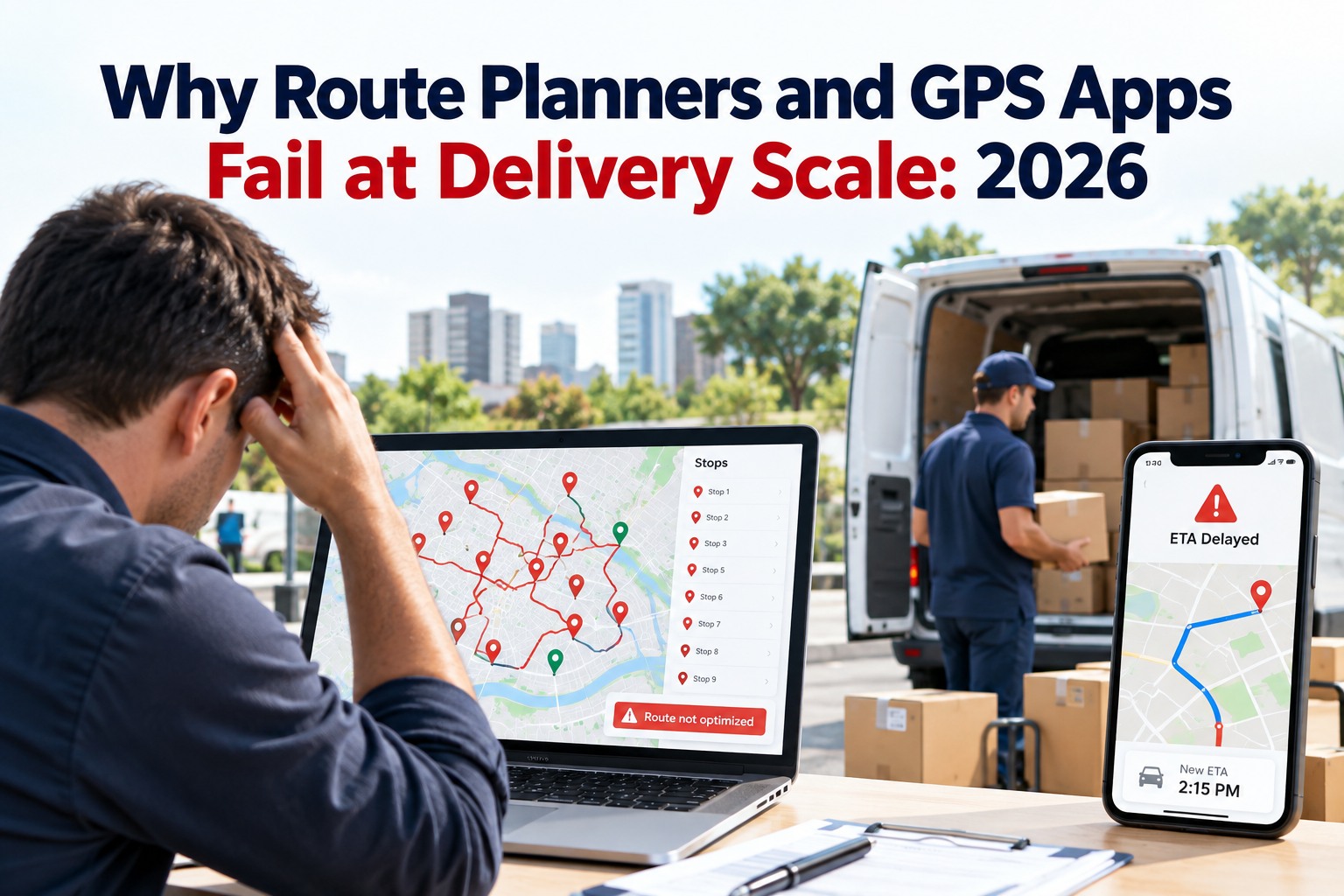
Why Route Planners and GPS Apps Fail at Delivery Scale: 2026
An unsparing operational teardown of the "duct-tape" trap. Discover why combining standalone routing plug-ins with basic vehicle GPS apps breaks down past 10 vans, and how integrated fleet platforms eliminate delivery friction.
Simulating multi-app workflow friction across 24 delivery vans executing 2,880 daily urban stops.
Escape the Fragmented Telematics Trap and Build for Scale
Replace disconnected route planners, standalone vehicle trackers, and driver chat groups with a unified last-mile operations engine starting from $3/vehicle/month with no hardware lock-in.
The 4 Breakdown Points of the "Duct-Tape" Delivery Stack
Operating a delivery operation using piecemeal tools creates an illusion of economy during early stages. In the beginning, dispatchers plan stops in a routing spreadsheet, export addresses into a free navigation tool, monitor trucks via an aftermarket GPS tracker portal, and verify drop-offs through messaging groups. However, this workflow introduces severe operational friction as order volumes grow. Disparate systems fail to share real-time context: when a van is immobilized by a blown tire or stalled by a locked security gate, the routing tool remains unaware, the GPS tracker merely records an idling engine, and the customer portal shows an outdated arrival time. Discover why piecemeal delivery stacks break down under commercial pressure by arranging a tailored system comparison demo or explore our unified platform immediately via quick platform sign up.
Static Routing Dies at the First Curb Delay
Standalone route planning apps compute driving routes based on static speed limits and ideal distances. They fail to account for parcel delivery dynamics: navigating multi-floor high-rises, finding commercial loading docks, or locating gate codes. Once a courier falls 20 minutes behind on stop 15, the remaining 85 stops inherit compound delays that static planners cannot recalculate mid-shift.
GPS Tracking Dots Do Not Equal Delivery Progress
Basic commercial vehicle tracking devices report latitude, longitude, speed, and ignition status. However, a GPS dot moving down Main Street does not tell a dispatcher whether parcel #482 was delivered to the customer's hands, dropped on the porch, or returned to the van shelf. Unlinked GPS dongles leave dispatchers blind to order-level delivery fulfillment.
The "Proof of Delivery" Black Hole
Piecemeal setups rely on drivers texting drop-off photos to group chats or collecting signatures on paper forms. These files lack cryptographic GPS geofence locking, order barcode pairing, and timestamps. When an e-commerce buyer files a non-delivery dispute, merchants reject unverified chat photos and deduct chargebacks directly from carrier settlements.
Customer Support Overload and Stale ETAs
When route planners and tracking software operate in silos, recipient tracking links show broad 8-hour windows or frozen delivery estimates. Frustrated consumers flood customer service phone lines with "Where Is My Order" inquiries, pulling dispatchers away from managing field exceptions and slowing down daily wave launches.
Direct Technical Matrix: Fragmented Point Solutions vs. FleetRabbit
When evaluating the transition from cobbled-together point tools to an integrated delivery fleet management system, operations executives must analyze total system cost, manual labor overhead, and customer retention metrics. Review how fragmented setups compare directly against FleetRabbit's unified delivery operating platform. Transportation directors can evaluate custom scale benchmarks by requesting an executive software evaluation demo or explore driver mobile workflows directly through our self-service sign up.
| System Operational Parameter | Duct-Taped Stack (Route App + GPS Dongle + Chats) | FleetRabbit Unified Delivery Platform | Commercial Fleet Advantage |
|---|---|---|---|
| Route Optimization Logic | Static waypoint ordering; zero live traffic awareness | Dynamic real-time re-sequencing & time windows | Cuts daily fleet driving miles by up to 18% |
| Dispatch Context Level | Only vehicle location; zero parcel visibility | Live parcel progress, shelf zones, and van status | 100% visibility into every package status |
| Proof of Delivery (e-POD) | Unverified chat photos or paper signature slips | Geofence-locked barcode scan + photo timestamp | Eliminates 92% of disputed customer claims |
| Customer ETA Communication | Static tracking numbers with wide day-of windows | Live interactive countdown map + automated SMS | Cuts inbound "where is my order" calls by 72% |
| Vehicle Preventative Care | Isolated spreadsheet or forgotten maintenance | Integrated mobile eDVIR walkarounds & shop tickets | Reduces unscheduled roadside van breakdowns by 34% |
| Subscription & Hardware Cost | Multiple subscriptions ($40-$60/van) + $800 scanners | Starting at $3/van/month; runs on driver phones | Saves up to 85% in operating software and gear fees |
4-Stage Unified Last-Mile Delivery Architecture
FleetRabbit consolidates delivery execution into a single automated operational flow, eliminating the manual file exports and disjointed communications that cause fragmented stacks to fail.
Unified Order Ingestion
Orders flow from e-commerce, TMS, or CSV uploads directly into one central dispatch board. The platform cleans addresses, formats time windows, and assigns stops to specific vehicle shelf zones.
Dynamic Real-Time Sequencing
Rather than exporting static routes, the optimization engine continuously evaluates live traffic, curbside dwell averages, and package priorities, pushing updated sequences to driver smartphones.
Geofenced Execution & e-POD
Drivers execute doorstep drops using standard mobile cameras for high-speed barcode scanning and photo confirmation, strictly validated within a 20-meter perimeter of the customer address.
Automated Dispatch & Shop Sync
Completed delivery tokens, recipient signatures, and vehicle health metrics sync back to central dispatch instantly, closing customer tickets and generating preventative garage work orders.
Financial Capital Stewardship: The Hidden Cost of Piecemeal Software
Operating a delivery business on disjointed tools creates compounded financial drains across wasted dispatcher hours, customer dispute write-offs, and unnecessary vehicle maintenance. Analyzing these systemic cost drivers helps logistics managers justify transitioning to an integrated platform. Calculate your delivery fleet's exact cost recovery by booking a personalized cost assessment demo or get started directly via our rapid platform sign up.
Top Causes of Financial Waste in Disjointed Delivery Fleets
Unified Platform Architectural Strengths
Drivers use standard iOS and Android smartphones for barcode scanning, navigation, and geofenced photo e-POD.
Real-time SMS alerts and live delivery countdown maps minimize missed drops and eliminate inbound customer calls.
Connects daily driver inspection walkarounds and engine trouble codes directly to garage mechanics for overnight service.
Enterprise Return on Investment & Fleet Scalability
When replacing piecemeal delivery apps with an integrated fleet management engine, logistics leadership must evaluate both immediate cost reductions and long-term operating scalability. FleetRabbit delivers quantifiable financial return across fuel, labor, vehicle maintenance, and customer retention metrics.
Fuel & Mileage Savings
Dynamic street-level route optimization reduces circuitous driving by up to 18%, while curbside idle alerts coach drivers toward fuel conservation, saving an average of $620 in fuel per delivery van annually.
Failed Drop Prevention
Automated SMS pre-arrival notifications alert customers when their courier is two stops away, boosting first-attempt delivery success to 98.8% and preventing costly return-to-hub re-delivery handling.
Predictive Van Care
Automated engine-hour tracking and diagnostic trouble code monitoring generate proactive work orders for brake pads, tires, and sliding doors, extending delivery vehicle service life by 2+ years.
Frequently Asked Questions: Route Planners and GPS Tracking at Scale
Why do basic route planning apps stop working effectively as a delivery fleet grows?
Basic route planning apps generate static route sequences without accounting for dynamic real-world factors like curbside parcel search time, vehicle shelf organization, loading dock delays, and fluctuating urban traffic. When a fleet expands beyond 5 to 10 vans, manual address management across separate apps causes compound delivery delays and high dispatcher overtime.
How does standalone GPS vehicle tracking differ from an integrated delivery management platform?
Standalone GPS tracking devices report vehicle speed, location, and engine idling. However, they lack order context: they cannot confirm whether a specific package was successfully delivered, cannot capture customer signatures or photos, and cannot communicate live delivery countdowns to recipients. An integrated delivery platform unifies vehicle telemetry with package-level chain-of-custody tracking.
Does switching to an integrated platform require buying expensive handheld scanners?
No. Modern platforms like FleetRabbit leverage standard smartphone cameras on iOS and Android devices for high-speed 1D and 2D barcode scanning. Couriers can scan packages, capture photo proof-of-delivery, collect electronic signatures, and navigate routes using their existing smartphones, eliminating upfront hardware capital outlays.
How does integrated delivery software reduce customer service phone inquiries?
By synchronizing driver location with package order records, FleetRabbit provides recipients with automated SMS arrival notifications and live interactive tracking countdown maps. Customers see exactly when their delivery is two stops away, cutting "Where Is My Order" inbound customer service calls by up to 72%.
Upgrade from Fragmented Route Planners to Scalable Delivery Intelligence
Eliminate missed delivery windows, optimize delivery routes, and equip your couriers with intuitive mobile tools. Experience FleetRabbit today with zero proprietary hardware lock-in.