Modern e-commerce logistics leaders, warehouse fulfillment directors, and transportation heads operate in a high-velocity fulfillment landscape where disconnected software silos directly destroy operational profitability. When warehouse management systems (WMS) handle inventory picking and pallet staging in isolation from transportation management systems (TMS) and field delivery fleet platforms, cross-dock operations suffer from severe data latency. Scribes manually re-key order data between portals, wave dispatch schedules lag behind cross-dock packing rates, and couriers depart with mismatched carton manifests. Establishing an end-to-end e-commerce WMS and TMS fleet integration bridges the gap between SKU bin allocations, dock wave scheduling, dynamic route optimization, and doorstep electronic proof-of-delivery (e-POD). By deploying bi-directional REST APIs and real-time webhook listeners, distribution enterprises automate order-to-dispatch pipelines, eliminate manual manifest re-entry, and deliver instantaneous tracking updates to waiting consumers. To see how our integration framework harmonizes supply chain data, book a technical walkthrough demo with our logistics integration team or launch your developer sandbox immediately through our free platform sign up.
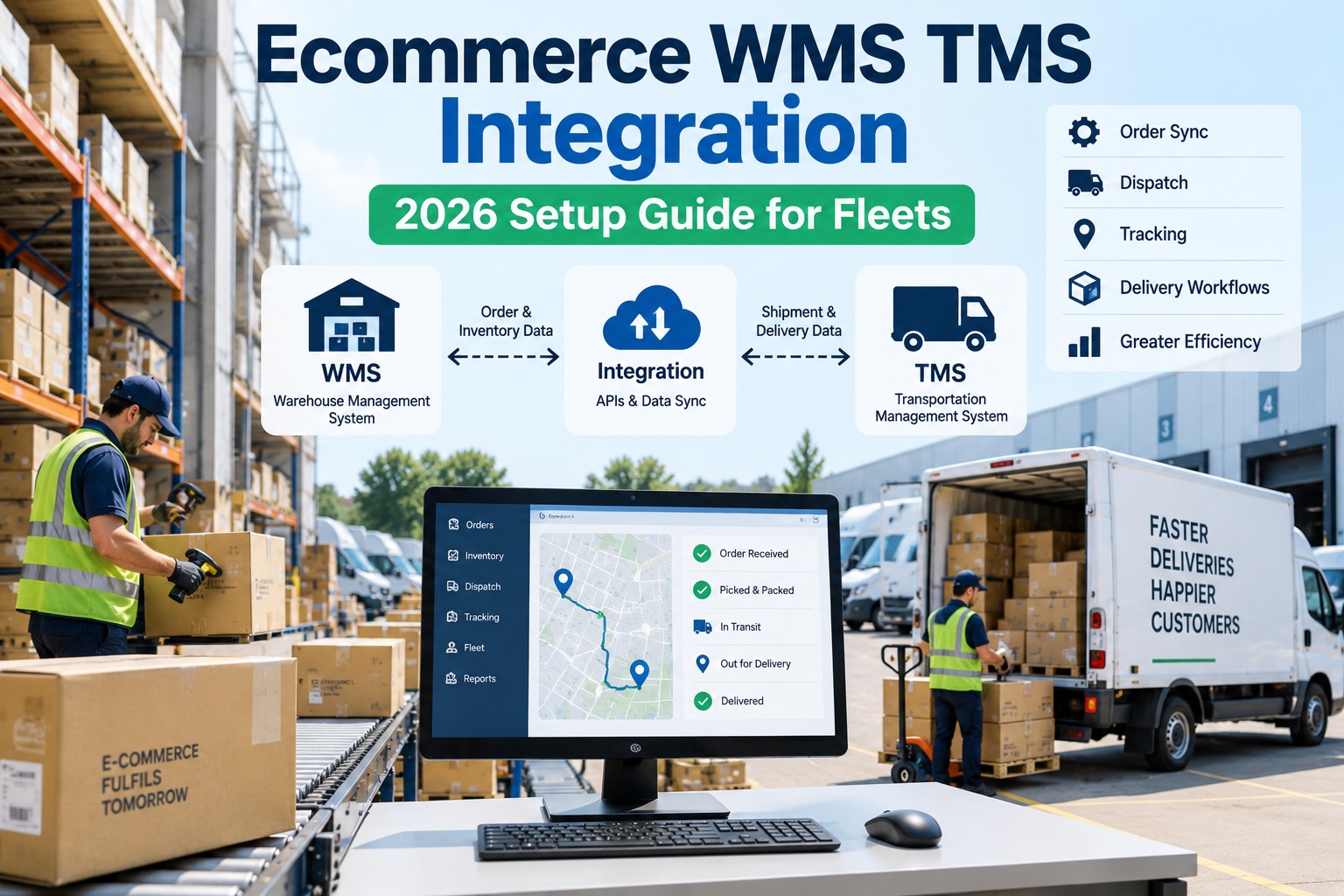
Ecommerce WMS TMS Integration: 2026 Setup Guide for Fleets
The definitive technical integration blueprint for logistics operators. Discover how to harmonize warehouse order picking, transportation planning, live carrier dispatch, and customer notifications into one synchronized digital workflow.
WMS Fulfillment Engine
Order batching, tote sorting, SKU picking, and cross-dock pack station staging.
order.pack_completed
TMS & Fleet Execution
Dynamic cube compaction, 3D van loading, route sequencing, and dispatch gating.
manifest.wave_dispatched
Final-Mile Carrier App
Turn-by-turn mobile guidance, geofenced barcode scan, photo e-POD, and customer SMS.
shipment.delivered_epod
Synchronize Your Warehouse, Transportation, and Delivery Fleets
Eliminate manual spreadsheet imports, accelerate warehouse wave departures, and deliver real-time supply chain transparency starting from $3/vehicle/month with no hardware lock-in.
The Systemic Friction of Disconnected Supply Chain Architectures
When high-volume e-commerce distribution brands operate WMS, TMS, and delivery fleet applications in isolation, operational bottlenecks multiply rapidly. In typical disconnected environments, warehouse management software tracks picked inventory into physical staging totes, but has zero visibility into real-time delivery vehicle availability, driver shift hour limits, or box truck cubic cargo capacity. Simultaneously, dispatchers in the transportation office manually export static CSV files from the WMS to assemble routing manifests, introducing formatting errors, mismatched package counts, and outdated customer delivery time windows. By the time couriers receive route manifests on clipboards, urban traffic conditions have shifted, morning departure windows have lapsed, and customer service desks face endless "Where Is My Order" (WISMO) phone calls. Logistics architects can review our API synchronization models by scheduling a tailored WMS-TMS integration demo or configure test webhook listeners through our quick platform sign up.
Order Schema Normalization & Auto-Ingestion
Modern platforms eliminate manual CSV manipulation by using standard JSON schemas. When an order reaches the "packed" status in Manhattan, Blue Yonder, HighJump, or Shopify Plus, an automated webhook securely posts dimensions, carton weights, SKU serials, and customer delivery instructions directly to the dispatch queue.
3D Cubic Load Balancing & Wave Sequencing
Synchronizing WMS carton data with TMS fleet scheduling enables dynamic cubic optimization. The system models package volume against individual step-van and box-truck cargo bays, generating reverse-stop loading plans so warehouse pickers stage totes in exact delivery order.
Real-Time Bi-Directional Status Reconciliation
Integration must flow both ways. As couriers complete doorstep drops with geofenced barcode scans and photo verification, completed delivery timestamps and signature tokens update the central WMS and ERP ledgers instantly, closing inventory fulfillment records in real time.
Automated Exception & Reroute Orchestration
When couriers encounter locked access gates, missing suite numbers, or damaged packaging, the mobile application triggers an instant exception webhook. The WMS automatically flags customer service, adjusts inventory reserves, and issues customer notification updates.
Direct Architectural Comparison: Manual CSV Handoffs vs. Unified REST API Pipelines
Operating an enterprise supply chain using manual spreadsheet exports, batch nightly scripts, and unlinked delivery drivers drains fulfillment velocity and customer retention. Review how legacy data handoffs compare directly against FleetRabbit's real-time API-driven integration architecture across critical enterprise categories. Engineering vice presidents can inspect sample webhook payloads by arranging a technical consultation demo or explore our developer documentation via self-service platform sign up.
| Integration Dimension | Legacy Manual & Batch CSV Handoffs | FleetRabbit Bi-Directional API Fabric | Enterprise Logistics Advantage |
|---|---|---|---|
| Data Latency | Hours of delay; batch updates run at midnight | Sub-second event-driven webhooks & REST APIs | Real-time visibility across warehouse and curb |
| Cross-Dock Manifest Staging | Manual re-typing across multiple browser tabs | Automated ingestion into vehicle load plans | Dispatches courier waves 35 minutes earlier |
| Exception Handling | Discovered only when van returns to hub at night | Instant webhook alerts trigger re-attempts | Cuts failed delivery attempts by 40% |
| Proof-of-Delivery Sync | Paper slips filed in physical storage folders | Encrypted photo + GPS token posts to ERP ledger | Immediate customer dispute resolution |
| Development & Maintenance | Expensive custom middleware ($50k+ capex) | Pre-built connectors & standard REST schemas | Lowers custom development outlays to zero |
4-Stage Technical Implementation Blueprint for Logistics Architects
Connecting enterprise warehouse and transportation management tools requires an organized, low-friction integration roadmap that never interrupts daily order fulfillment or outbound dock schedules.
API Authentication & Webhook Registration
Generate secure OAuth 2.0 credentials and configure bi-directional webhook endpoints between your WMS (Manhattan, Blue Yonder, NetSuite) and FleetRabbit's cloud ingestion bus.
Data Schema Mapping & Payload Normalization
Map order attributes, package cubic dimensions, weight parameters, priority service windows, and customer contact fields to standard JSON schemas, ensuring validation rules pass cleanly.
Sandbox Pilot & Edge Device Validation
Run parallel staging waves in a dedicated developer sandbox. Validate that warehouse packing station triggers accurately populate driver mobile route manifests and barcode scanners.
Full Production Cutover & Telemetry Sync
Transition active cross-dock operations to the automated pipeline. Monitor webhook delivery latency, automated route execution, and live proof-of-delivery receipts across all hubs.
Supply Chain Capital Stewardship: Eliminating Hidden Operational Leaks
Operating a high-density delivery fleet without integrated warehouse and transportation software leads to compounding operational drains that quickly outstrip the cost of modern software. Analyzing these systemic cost drivers helps logistics directors build a clear business case for executive committees. Calculate your operation's exact cost recovery by booking a one-on-one consultation demo or initiate platform onboarding directly via our rapid system sign up.
Top Causes of E-Commerce Supply Chain Disconnection Loss
Integration Architecture Highlights
Native compatibility with Manhattan, Blue Yonder, HighJump, NetSuite, SAP, and Shopify Plus fulfillment hubs.
Drivers use standard iOS and Android smartphones for barcode scanning, navigation, and geofenced photo e-POD.
Real-time webhook events trigger recipient SMS alerts with interactive live delivery countdown maps.
Enterprise Return on Investment & Ecosystem Scalability
When investing in supply chain software integration, executive leadership must evaluate both immediate labor savings and long-term ecosystem scalability. FleetRabbit delivers quantifiable financial return across clerical labor, cross-dock throughput, customer service, and vehicle maintenance metrics.
Clerical Automation ROI
Automating manifest ingestion and proof-of-delivery synchronization eliminates hours of daily manual data entry per facility, allowing dispatchers and warehouse leads to focus on physical throughput.
Cross-Dock Acceleration
Automated 3D load balancing and reverse-stop sequencing stage outbound delivery vehicles 35 minutes earlier every morning, enabling drivers to beat peak urban traffic windows.
Automated Delivery Transparency
Outbound tracking webhooks trigger automated SMS alerts with live interactive approach countdowns, dramatically reducing customer support call volume and improving retention.
Frequently Asked Questions: Ecommerce WMS TMS Integration
What is the primary difference between a WMS, a TMS, and delivery fleet software?
A Warehouse Management System (WMS) optimizes inventory storage, order picking, packing, and pallet staging inside the four walls of a fulfillment center. A Transportation Management System (TMS) handles freight carrier procurement, shipment rating, and long-haul planning. Delivery fleet software manages the execution layer: dynamic street-level vehicle routing, courier mobile navigation, geofenced barcode scanning, customer text alerts, and vehicle maintenance.
How do REST APIs and webhooks differ in supply chain software integration?
REST APIs are request-response mechanisms where one system queries another for specific information (such as requesting an order's current delivery status). Webhooks are event-driven notifications where a system automatically sends data the instant an event occurs (such as pushing an order to the fleet app the exact second warehouse packing finishes), providing true real-time synchronization.
Can FleetRabbit integrate with legacy on-premise ERP and warehouse systems?
Yes. In addition to cloud-native REST APIs and webhooks, FleetRabbit supports secure SFTP data drops, automated XML and JSON polling, and hybrid database connectors to communicate with legacy on-premise enterprise platforms, ensuring smooth migration without rewriting core infrastructure.
How does proof-of-delivery data sync back to the central warehouse system?
When a driver scans a package barcode and captures a doorstep delivery photo within the geofenced delivery zone, the mobile application generates an encrypted event token. This token, along with timestamps, GPS coordinates, and customer signatures, immediately posts back to the WMS and TMS via webhooks, closing the order record instantly.
Modernize Your Supply Chain Integration Fabric Today
Eliminate warehouse data silos, accelerate delivery wave departures, and empower your drivers with unified mobile tools. Experience FleetRabbit today with zero proprietary hardware lock-in.