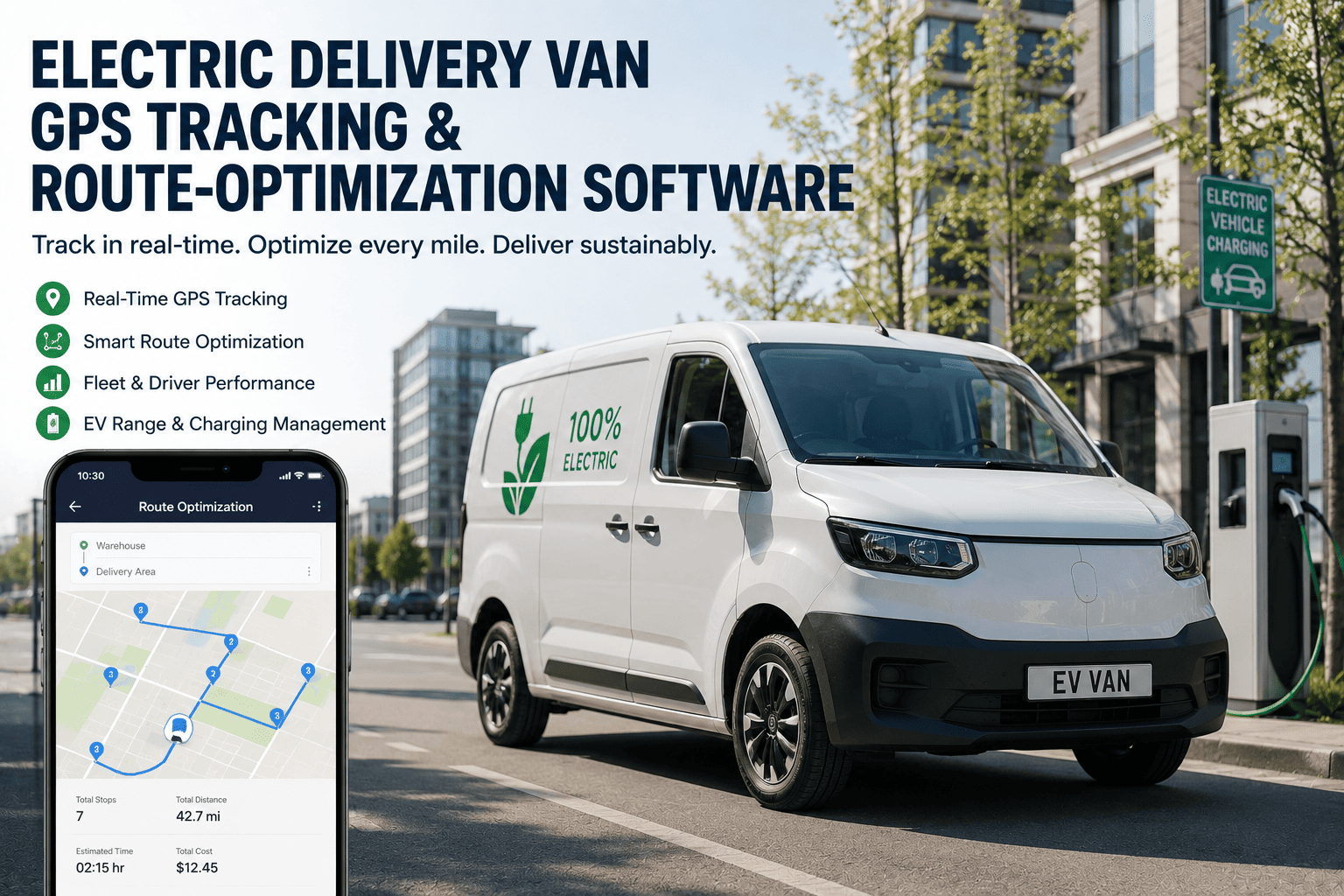
An electric delivery van does not just need to be found on a map, it needs to be tracked against a battery that is quietly counting down with every stop, every idle minute, and every mile of detour. Electric delivery van GPS tracking software has to do more than plot a dot on a screen, it has to combine live location with real-time charge data so dispatchers can trust the estimated time of arrival they are giving to a customer and the route they are giving to a driver. For carriers running electric last-mile fleets, that combination of location, charge, and route intelligence is what keeps a van from running a route it cannot finish.
Why electric vans need a different kind of tracking
A diesel van has a fuel gauge and a nearby gas station on almost every block. An electric van has a battery that drains differently depending on load, temperature, traffic, and even how often the door opens at a stop. Standard GPS tracking built for combustion fleets was never designed to factor any of that in, which is exactly the gap carriers close when they sign up for tracking software built around electric duty cycles instead of retrofitted from a diesel platform.
Real-time GPS tracking for electric delivery vans pairs location data with battery state of charge, so a route that looks fine on distance alone can still be flagged if the charge curve says otherwise.
How charge tracks against a real route
Charge-aware tracking maps the battery drop against each stop on the route in real time, not just a distance estimate calculated at the start of the day. When a van is running lower than the plan expected, dispatch sees it the moment it happens instead of finding out when the driver calls in.
Track your electric fleet by charge and location together
Give dispatch a live view that accounts for what the battery is actually doing.
What live GPS tracking actually shows a dispatcher
Live location per van
Every van's position updates continuously across the full route map, not on a delayed refresh.
State of charge overlay
Battery percentage is layered directly onto the route view, tied to each upcoming stop.
Dynamic ETA updates
Estimated arrival times adjust automatically as traffic, stop delays, or charge levels shift.
Charging stop alerts
Dispatch gets flagged before a van risks running short, with nearby charging options surfaced early.
Route optimization built around a battery, not just a map
Route optimization software for diesel fleets solves for distance and traffic. Route optimization for electric delivery vans has to solve for a third variable, remaining range, which changes the math on almost every decision. A shorter route that includes a steep grade or heavy stop-and-go traffic can drain more charge than a longer, smoother one, and a route planner blind to that will send a van out with a plan it cannot physically complete. Carriers testing this for the first time often book a demo just to see how differently a charge-aware route looks compared with a standard distance-based plan.
This is also where delivery fleet uptime and delivery fleet tracking start to overlap directly. A van that finishes its route without an unplanned charging stop stays productive for the full shift, and that reliability compounds across a fleet running the same routes every day. Carriers who sign up for this kind of tracking typically see the biggest gains on their tightest, most stop-heavy routes, exactly where charge variability matters most.
Standard GPS tracking versus charge-aware tracking
| What it tracks | Standard GPS tracking | FleetRabbit charge-aware tracking |
|---|---|---|
| Location updates | Yes, periodic pings | Yes, continuous updates |
| Battery state of charge | Not included | Tracked live per van |
| ETA calculation | Based on distance and traffic only | Adjusted for charge and route conditions |
| Charging stop planning | Manual, driver-initiated | Flagged proactively by the system |
| Route optimization | Distance based | Distance and range based |
Give every electric van a route it can actually finish
Charge-aware GPS tracking and route optimization, live on one dashboard.
Frequently asked questions
How is electric van GPS tracking different from standard fleet tracking.
Standard GPS tracking shows location and speed. Electric van tracking adds live battery state of charge on top of that, so dispatchers can see not just where a van is but whether it has enough range left to complete its remaining stops.
Why do ETAs matter more for electric delivery vans.
Charge levels can shift an ETA in ways distance alone will not predict, since load, terrain, and stop frequency all affect range differently. Charge-aware ETA calculations account for this instead of assuming a flat average speed.
Can this software prevent a van from running out of charge mid-route.
It cannot guarantee it, but it flags a van's charge trend early enough for dispatch to reroute toward a charging point or adjust the remaining stops before range becomes a problem.
Does route optimization work differently for electric fleets.
Yes. Optimization has to weigh remaining range alongside distance and traffic, since the shortest route is not always the one that uses the least charge, particularly on routes with steep grades or heavy stop-and-go driving.
Is this useful for carriers running a mixed fleet of electric and combustion vans.
Yes. The dashboard tracks both van types side by side, applying charge-aware logic only where it is relevant, so dispatchers get one consistent view across the whole fleet regardless of vehicle type.