Cold Chain Logistics: Fleet Management Challenges and Software Solutions
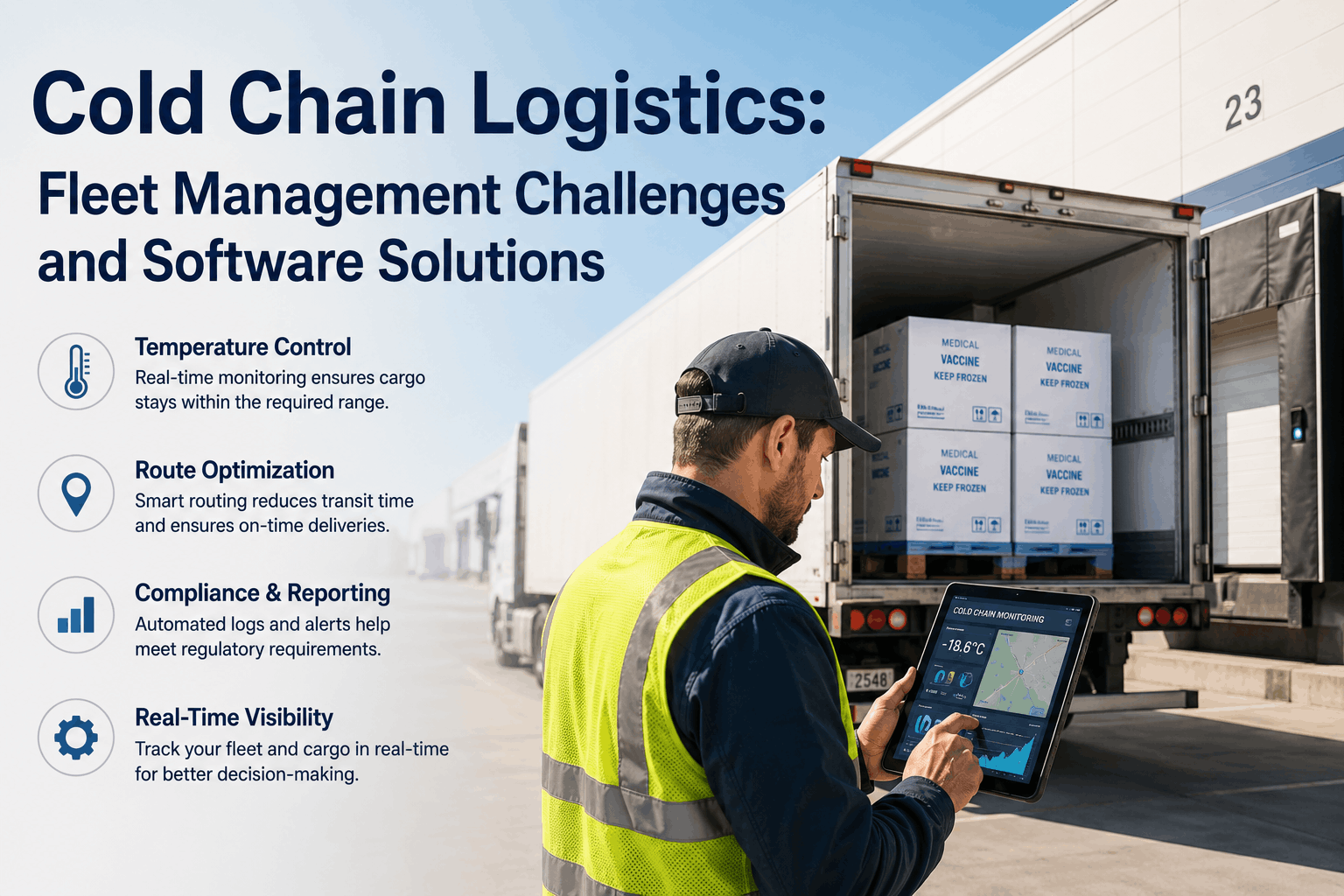
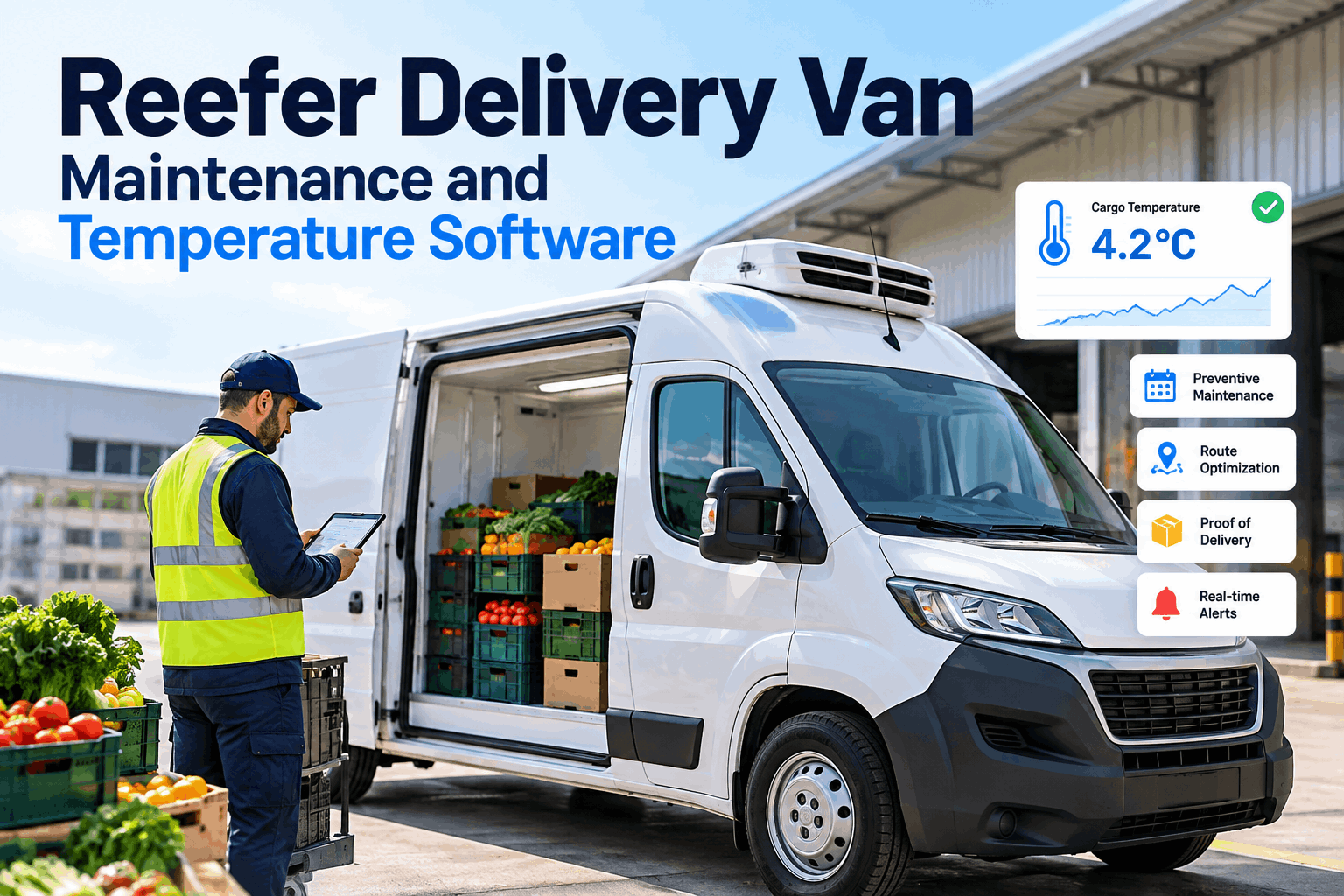
Every refrigerated truck idling outside a Los Angeles distribution hub, every reefer van losing two degrees on a Sacramento freeway, every last-mile delivery van in Phoenix running a failed cold chain because no one caught the compressor fault at dispatch — each is a compliance risk, a spoilage event, and a customer churn moment happening in real time. Cold chain fleet management software closes that gap: IoT temperature sensors, real-time location tracking, and predictive fault detection combine on one dashboard to give logistics operators in California, Oregon, Washington, Nevada, and Arizona full visibility over every temperature-sensitive shipment. Fleet Rabbit's OEM-agnostic cold chain platform connects refrigerated trucks, reefer vans, and mixed cold-fleet vehicles — on-premise or cloud — without replacing existing assets. Book a demo to see Fleet Rabbit's cold chain platform applied to your temperature-sensitive fleet.
Quick Answer
Cold chain fleet management software connects refrigerated trucks, reefer vans, and last-mile delivery vehicles with IoT temperature sensors delivering real-time zone monitoring, predictive refrigeration fault detection, route-optimized delivery scheduling, FSMA compliance documentation, and driver behavior scoring — from one OEM-agnostic dashboard. Western US cold chain operators using Fleet Rabbit reduce spoilage losses 38–52%, cut refrigeration downtime 44%, lower fuel cost 20–28%, and recover full ROI within 75 days — regardless of vehicle brand mix.
The $220,000 Spoilage Problem Hiding in Your Cold Chain Right Now
The average Western US logistics company operating 20 refrigerated vehicles loses $220,000–$290,000 annually to temperature excursions, undetected refrigeration faults, route inefficiency, and regulatory non-compliance — without ever seeing it on a single dashboard. A reefer van in Seattle losing half a degree per hour because a door seal is failing, a refrigerated truck in Los Angeles rerouted through a 90-minute delay with no proactive temperature compensation, a Phoenix last-mile driver leaving the cargo door open three minutes too long during a 112°F summer afternoon. Fleet Rabbit's cold chain platform makes every one of these risks visible — and preventable — within 30 days of deployment.
Spoilage & Excursions
$74K
avg annual product loss / 20-vehicle fleet
Refrigeration Downtime
$61K
breakdown + emergency reroute cost / yr
Compliance Penalties
$48K
FSMA violations + recall exposure / yr
Route Inefficiency
$37K
excess fuel + missed delivery windows
How IoT Temperature Monitoring Connects Refrigerated Fleets
OEM-Agnostic Hardware
Fleet Rabbit's temperature and telematics sensors connect to Thermo King, Carrier Transicold, Wabash, Utility, and 35+ refrigeration unit OEMs — no brand lock-in, no asset replacement. Mixed cold fleets common in California and Pacific Northwest distribution operations unify in one dashboard.
Edge AI — Works Offline
On-device AI processes sensor data locally — detecting temperature drift, compressor anomalies, and door-open events without cloud connectivity. Critical cold chain alerts fire at the vehicle even in rural Nevada desert corridors or through Oregon mountain passes. Data syncs when connectivity returns, with zero gaps in compliance logs.
On-Premise + Cloud Flexible
Government food safety contractors and healthcare logistics operators run Fleet Rabbit on-premise — full cold chain IoT with data never leaving the facility. Commercial e-commerce operators use cloud with regional data centers in US-West (Oregon) and US-West-2 (California) for low-latency temperature dashboards accessible on any device.
Capability #1: Real-Time Temperature Monitoring — Know Exactly What's Happening Inside Every Vehicle
Typical 20-Vehicle Western US Cold Chain Fleet — Daily Temperature Excursion Causes
Door Open Events
34%
Refrigeration Faults
27%
Route Delay Exposure
22%
Undetected / Unknown
17%
Fleet Rabbit platform data, Western US cold chain fleets 2024–2025. Refrigeration faults + undetected = primary recovery opportunity.
1
Multi-Zone Temperature Scoring Per Vehicle
Every connected vehicle gets a real-time temperature compliance score — monitoring up to 4 independent cargo zones simultaneously. Fleet managers in Los Angeles, Portland, and Phoenix see instantly which vehicles are maintaining spec and which are drifting toward excursion thresholds, with time-stamped audit trails for every delivery.
Washington state grocery distributor, 16 reefer vans: Pre-IoT excursion rate 8.4% of deliveries → Post-Fleet Rabbit 1.1%. Product loss reduction: $187,400 recovered over 12 months in eliminated spoilage claims.
2
Geofence + Delivery Window Compliance
Fleet Rabbit geofences every delivery stop and distribution hub — alerting dispatchers when vehicles deviate from approved cold chain routes or miss temperature-critical delivery windows. For California CDFA and FSMA-regulated shipments, geofence and temperature logs provide compliance documentation automatically.
Real-time zone breach alertsDelivery window trackingFSMA audit logs
3
Fleet Right-Sizing with Cold Chain Utilization Data
After 90 days of IoT data, Fleet Rabbit generates a right-sizing analysis — identifying refrigerated vehicles below 45% utilization as candidates for disposal or rental replacement. Western US cold chain operators reduce owned fleet size 12–18% on average while maintaining full delivery capacity and temperature compliance across remaining assets.
An Arizona pharmaceutical distributor eliminated 2 owned reefer vans (saving $210K annually in ownership + refrigeration maintenance cost) after Fleet Rabbit data confirmed consistent sub-38% usage across both units.
Cold Chain Fleet Management Software
Connect Your Refrigerated Fleet — Free Trial, No Hardware Commitment
OEM-agnostic. Installs on any refrigerated vehicle in hours. Real-time temperature monitoring, predictive refrigeration fault detection, and FSMA compliance documentation from day one across your Western US cold chain fleet.
Capability #2: Predict Refrigeration Failures Before They Happen — Cut Downtime 44%
The breakdown math: A refrigeration unit failure mid-route on an I-5 California corridor haul costs $3,800–$7,200 in emergency repair, $4,400 in product loss, and $9,000–$18,000 in retailer penalty fees — occurring 3–6 times per vehicle per year without predictive monitoring.
Fleet Rabbit predicts: Compressor vibration anomaly detection identifies bearing wear 10–18 days before failure. Refrigerant pressure trends flag seal degradation and leak risk. Evaporator coil temperature differentials catch frosting issues before they cascade. Alerts route to the maintenance team with severity rating and recommended action window.
Western US impact: Remote delivery corridors in Eastern Washington, Nevada highways, and rural Arizona make mid-route refrigeration failures catastrophically expensive — predictive maintenance eliminates the highest-cost incidents before they start.
Cold chain fuel context: A refrigerated Class 6 truck burns 7–11 gal/hr at highway load — and the reefer unit adds 0.6–1.2 gal/hr continuously. At $5.10/gal (California diesel average), a refrigerated truck idling with unit running for 2 hours wastes $26–$40 per shift — $6,500–$10,000 annually, per vehicle. A 20-vehicle fleet loses $130K–$200K annually to preventable idle and inefficient refrigeration run cycles alone.
Fleet Rabbit tracks: Fuel per vehicle per hour, traction vs. refrigeration unit burn split, driver-level efficiency comparison, and route-level benchmarks identifying outlier vehicles needing mechanical or behavioral attention.
Driver scorecards: Side-by-side fuel comparison across California and Pacific Northwest routes identifies training opportunities where technique-driven waste is recoverable without vehicle changes.
The behavior gap: Aggressive driving — hard braking, excessive idling, improper door management, and non-standard refrigeration setpoint overrides — accelerates both vehicle component wear and cold chain excursion risk 2–4x versus compliant operation. The top vs. bottom driver quartile on a 10-vehicle fleet often represents $55,000–$85,000 in annual combined spoilage and maintenance cost.
Fleet Rabbit scores: Door-open duration per stop, setpoint override frequency, idle engine discipline, hard braking events, and refrigeration unit cycling behavior. Weekly scorecards give dispatch supervisors specific coaching data — not general reminders.
Outcome: Driver scoring programs reduce cold chain risk events 25–35% within 6 months — the highest-ROI behavioral intervention available to Western US temperature-sensitive logistics operators.
05
Regulatory Compliance
Capability #5: FSMA & Cold Chain Compliance — $2.1B in Annual US Recall Exposure
Western US compliance risk: FDA FSMA Sanitary Transportation rules, California CDFA cold chain mandates, and major retailer SLAs (Costco, Kroger, Whole Foods) require continuous temperature documentation across every leg of delivery. A single undocumented excursion can trigger a full pallet rejection — or initiate a recall investigation carrying six-figure liability.
Fleet Rabbit's compliance layer: Automated time-stamped temperature logs generate PDF-ready reports for every shipment. Chain-of-custody documentation covers every handoff from cold storage to final delivery. FSMA-ready audit exports available on demand for any time window.
Insurance benefit: Documented IoT cold chain monitoring reduces perishable cargo insurance premiums 10–18% with major US carriers — offsetting significant platform cost while strengthening compliance posture.
Before vs. After Fleet Rabbit Cold Chain — 20-Vehicle Western US Fleet
Without Cold Chain IoT
Temperature visibility: Manual spot checks
Excursions per 100 deliveries: 7–11 events
Refrigeration breakdowns/yr: 3–6 per vehicle
Compliance documentation: Paper logs only
Spoilage recovery: ~18%
Annual avoidable losses: $220K–$290K
With Fleet Rabbit Cold Chain IoT
Temperature visibility: Real-time per zone, per vehicle
QDoes Fleet Rabbit work with older refrigerated trucks that have no factory telematics?
Yes. Fleet Rabbit's IoT sensors mount directly to refrigeration unit data ports, cargo zone temperature probes, and vehicle CAN bus interfaces available on virtually all refrigerated vehicles manufactured after 1996. For older units, external wireless sensor kits attach to refrigeration lines, cargo door circuits, and ignition systems — providing full temperature, location, and utilization data without internal diagnostic access. A 1998 Thermo King unit and a 2025 Carrier Transicold TRU run side-by-side in the same dashboard.
QHow does Fleet Rabbit maintain temperature log continuity on remote Western US delivery corridors?
Fleet Rabbit's edge AI stores and processes temperature data locally when cellular is unavailable — maintaining continuous logs and delivering alerts when connectivity returns. For permanently remote distribution routes through Nevada desert highways, Eastern Oregon, or rural Central California, Fleet Rabbit supports Iridium satellite modem integration for continuous cold chain reporting with no cellular dependency. Zero gaps in compliance documentation, regardless of route.
QHow does Fleet Rabbit support FSMA Sanitary Transportation compliance documentation?
Fleet Rabbit automatically generates time-stamped temperature records for every shipment leg, formatted for FDA FSMA Sanitary Transportation requirements. Every temperature reading, door-open event, setpoint change, and delivery handoff is logged with GPS coordinates and driver ID. Audit-ready PDF exports are available on demand for any date range — reducing compliance audit preparation from days to minutes for California and Pacific Northwest food logistics operators.
QHow long does installation take across a mixed refrigerated fleet?
A trained Fleet Rabbit technician installs sensors on 3–5 refrigerated vehicles per day, including multi-zone temperature probe placement, refrigeration unit data port connection, and vehicle telematics pairing. A 20-unit mixed fleet (reefer vans, refrigerated Class 6 trucks, last-mile cold vehicles) is fully connected in 4–7 days. Fleet Rabbit's Western US installation teams cover California, Nevada, Arizona, Oregon, Washington, and Colorado. Vehicles operate normally throughout — no downtime required for sensor installation.
The four AI capabilities transforming fleet operations — real-time GPS, predictive health monitoring, dynamic route optimization, and delivery performance analytics — with ROI data for each.
AI-driven fault prediction and automated maintenance scheduling that prevents mid-route breakdowns — the reliability layer IoT sensor data powers across refrigerated trucks, reefer vans, and last-mile cold vehicles.
Real-time utilization tracking, idle reduction analytics, and fleet right-sizing data that reduce total refrigerated fleet operating cost for Western US cold chain logistics operators.
How GPS hardware, IoT sensors, and cloud analytics combine to deliver real-time cold chain visibility, predictive refrigeration maintenance, and FSMA compliance documentation.
Connect Your Refrigerated Fleet — See Fleet Rabbit Cold Chain IoT in Action
Fleet Rabbit's OEM-agnostic cold chain platform delivers all five temperature-sensitive logistics capabilities through one system — real-time multi-zone monitoring, predictive refrigeration fault detection, fuel analytics, driver scoring, and FSMA compliance documentation across your Western US cold chain fleet. On-premise or cloud. Any brand. Full ROI in 75 days.