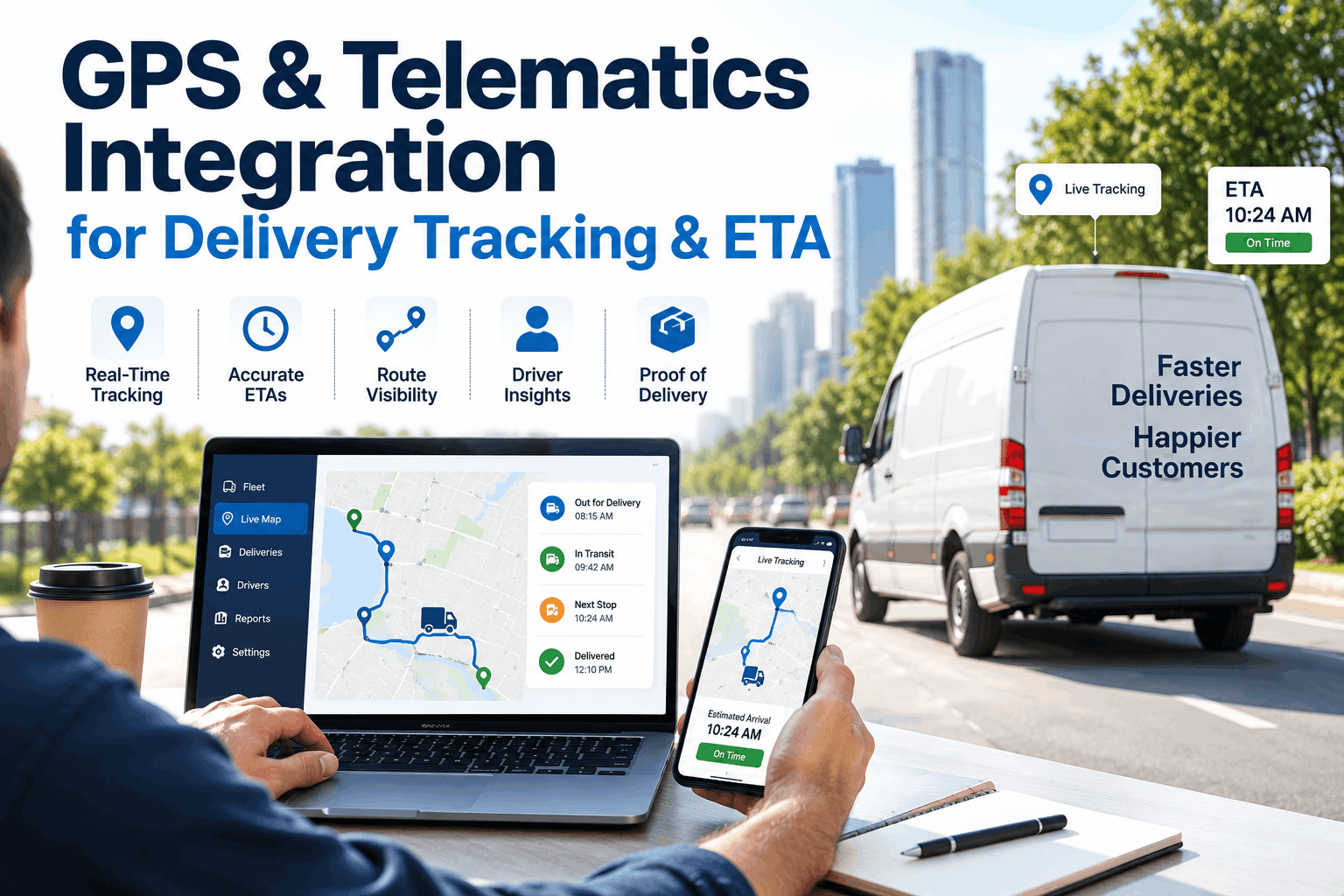
GPS & Telematics Integration for Delivery Tracking & ETA
E-commerce delivery operations leaders, courier dispatch superintendents, and last-mile logistics managers understand that customer retention in parcel distribution depends entirely on real-time transparency and dynamic Estimated Time of Arrival (ETA) accuracy. When vehicles navigate urban density, road construction, and multi-stop package handoffs without unified GPS telematics integration, dispatch boards operate in the dark. Traditional tracking methods rely on delayed five-minute breadcrumbs or standalone driver smartphone pings that drop out in concrete urban canyons. Without continuous OBD-II vehicle diagnostics, live spatial geofencing, and automated stop recalculations, dispatchers cannot predict arrival delays, customer service desks are flooded with "Where is My Order?" (WISMO) calls, and couriers waste valuable minutes backtracking. Fleet Rabbit delivers a purpose-built GPS and telematics integration platform engineered for high-velocity last-mile delivery fleets. By pairing sub-second satellite vehicle positioning with engine diagnostic telemetry, dynamic traffic-aware route recalculation, and mobile electronic proof-of-delivery (ePOD), our platform provides unmatched operational visibility. Eliminate delivery time-window breaches, streamline vehicle preventative maintenance, and elevate consumer delivery trust. Book a Demo to explore our real-time GPS telematics and ETA engine.
Real-Time Spatial Intelligence & Fleet Telematics
GPS & Telematics Integration for Delivery Tracking & ETA
A comprehensive systems integration framework for last-mile delivery teams: pair high-frequency satellite GPS tracking with vehicle OBD-II diagnostics, stream dynamic live ETAs to consumers, automate geofenced milestone notifications, and secure digital proof of delivery.
Sub-Second Satellite PollingDynamic Traffic RecalculationContinuous OBD-II Health Sync
Bi-Directional Telematics & Predictive ETA Architecture
Stop Losing Customer Trust to Inaccurate Delivery Windows
Equip dispatchers with live spatial tracking, provide consumers with accurate sub-minute arrival estimates, and eliminate WISMO support requests effortlessly.
Legacy GPS tracking devices update locations only every 2 to 5 minutes to conserve data. In urban last-mile delivery where drivers complete drops every 90 seconds, delayed breadcrumbs leave dispatchers and customers looking at obsolete van coordinates. Book a demo to inspect our sub-second live tracking polling.
02
Static, Flawed Arrival Windows (WISMO Spikes)
Standard routing calculators estimate ETAs based purely on free-flow highway speeds, ignoring curbside parking search time, high-rise elevator delays, and shifting traffic bottlenecks. Customers receive inaccurate windows, triggering expensive support inquiries.
03
Disputed Deliveries Lacking Spatial Proof
When a customer claims a package was not delivered, paper delivery logs lack cryptographic defensibility. Without satellite coordinates watermarked directly into the doorstep photo at the exact second of delivery, carriers absorb non-receipt chargebacks. Sign up to automate geofenced photo proof-of-delivery.
04
Unmonitored Vehicle Faults Stranding Routes
Basic GPS trackers show where a van is located but remain blind to underlying engine health. A dead alternator, failing starter motor, or depleted battery leaves a courier stranded curbside, disrupting customer delivery schedules across the entire route.
The 4 Components of Connected Delivery Tracking Architecture
Connect directly to cargo van diagnostic ports to capture live odometer readings, engine runtime hours, fuel consumption, diagnostic trouble codes (DTCs), and battery voltage. Vehicle preventative maintenance triggers automatically based on actual mechanical load. Sign up to connect your fleet OBD-II telematics.
Component B
Continuous Multi-GNSS Satellite Tracking
Utilize high-precision multi-constellation satellite receivers (GPS, GLONASS, Galileo) that maintain lock even in dense urban street corridors. Live vehicle coordinates, heading, and speed update on the dispatch radar every few seconds.
Component C
Dynamic Machine-Learned ETA Engine
Our predictive ETA algorithm continuously recalibrates arrival times based on live traffic congestion, driver velocity, and historical curbside dwell durations by building type. Customers receive automated, highly accurate SMS arrival notifications. Book a demo to test our dynamic ETA calculation engine.
Component D
Driver Mobile App & Offline Geofencing
Drivers execute turn-by-turn routes, complete barcode scans, and capture doorstep delivery photos on their smartphones. Automated geofences detect when the courier arrives within 50 meters of the stop, pre-loading delivery instructions. Sign up to equip couriers with offline-first mobile apps.
Predictive ETA Calculation: How Fleet Rabbit Outperforms Static Tools
Static mapping tools calculate ETAs using generic highway speed limits. Fleet Rabbit analyzes the complex physical variables of final-mile parcel delivery to generate accurate arrival windows. Book a demo to inspect our machine-learned routing calculations.
Predictive ETA Formula
Dynamic ETA = Current UTC + (Transit Distance ÷ Real-Time Congestion Velocity) + Historical Curbside Dwell Time + Building Access Factor ± Dynamic Route Buffer
Notice the inclusion of curbside dwell and building access factors: our system accounts for the time required to park, navigate security desks, and ride elevators in commercial towers, ensuring arrival estimates remain accurate throughout the driver's shift.
Platform Comparison: Generic GPS vs. Fleet Rabbit Telematics
Urban Delivery Fleet Cuts Fuel Waste and Eliminates Late Arrival Disputes Across 28 Vans
Operating in a dense metropolitan area delivering over 3,200 residential e-commerce packages daily, MetroPulse Express struggled with inaccurate arrival estimates. Drivers used standard smartphone navigation apps that failed to account for commercial building access times, causing customer delivery windows to drift by over an hour. Customer support was inundated with hundreds of angry tracking calls each afternoon, and couriers frequently ran into expensive overtime.
By deploying Fleet Rabbit, the company connected vehicle OBD-II telematics directly to our dynamic ETA engine and driver mobile app. Real-time traffic recalculations and historical curbside dwell adjustments improved delivery window accuracy to 99.4%, customer tracking inquiries plunged by 84%, and optimized route sequencing reduced daily fleet driving distance by 18%, saving $54,000 annually in fuel and overtime.
Frequently Asked Questions
What is the difference between simple GPS tracking and telematics integration?
Simple GPS tracking only records a vehicle's geographic latitude and longitude. Telematics integration connects directly to the vehicle's onboard diagnostic computer (OBD-II or J1939 CAN-Bus) to capture operational data—including engine running hours, vehicle speed, fuel consumption, battery health, and active diagnostic fault codes—uniting location tracking with proactive mechanical health monitoring.
How does Fleet Rabbit calculate accurate delivery ETAs in heavy city traffic?
Our predictive ETA algorithm factors in real-time road traffic patterns, historical vehicle speed, dynamic routing stops, and curbside dwell times. By accounting for the time drivers take to park, scan packages, and deliver to specific building types (single-family homes vs. commercial high-rises), the system maintains accurate arrival estimates throughout the delivery shift.
Can drivers capture proof of delivery in underground parking garages without cell service?
Yes. Fleet Rabbit features an offline-first mobile architecture. Couriers can scan barcodes, collect customer signatures, and photograph doorstep packages inside concrete basement parking structures or remote rural dead zones. The app records the exact timestamp and satellite coordinates, automatically synchronizing to dispatch as soon as cellular service returns.
How does vehicle telematics help prevent roadside breakdown delays?
Fleet Rabbit continuously monitors engine hours and diagnostic trouble codes (DTCs). Instead of relying on static calendar schedules, the platform automatically generates preventive maintenance work orders for brake pad wear, battery degradation, and engine oil flushes before unexpected roadside failures disrupt active delivery routes.
What are the pricing details and contract terms for Fleet Rabbit's software?
Fleet Rabbit is priced at a transparent rate of $5 per delivery asset per month billed annually. This includes complete access to GPS telematics integration, real-time vehicle tracking radar, dynamic ETA engines, mobile driver ePOD tools, and vehicle maintenance scheduling. We provide a 14-day free trial on up to 3 vehicles with zero setup fees or locked long-term contracts.
Ready to Transform Your Delivery Tracking & ETA Precision?
Deploy sub-second GPS telematics, provide customers with live arrival estimates, and eliminate delivery disputes for just $5/asset/month.