High-density last-mile delivery fleets, e-commerce parcel couriers, and contracted urban delivery service partners (DSPs) in 2026 operate under relentless mechanical strain: vehicles endure over 150 daily curb stops, extended stop-and-go idling, rapid brake wear, and continuous door cycling while maintaining strict compliance with DOT 49 CFR Part 396 commercial vehicle roadworthiness mandates. Traditional preventive maintenance that relies on static odometer intervals or calendar schedules frequently fails high-velocity delivery fleets because component degradation in urban delivery does not follow a linear path. When a starter motor experiences heavy cranking voltage drop, an alternator diode develops excessive ripple, or an exhaust gas recirculation (EGR) valve begins sticking, standard scheduled maintenance cannot catch the warning signals in time. The vehicle experiences a midday breakdown during a 140-stop route, requiring emergency towing, freight transloading, and hundreds of dollars in lost delivery margins. Connecting connected Internet of Things (IoT) sensors, OBD-II and J1939 CAN-bus telematics gateways, Bluetooth Low Energy (BLE) thermal probes, and tire pressure monitoring systems (TPMS) directly to your fleet management platform transforms maintenance from a reactive repair cycle into an automated predictive defense. FleetRabbit delivers dedicated IoT sensor integration and predictive fleet maintenance software engineered specifically for commercial delivery operations. By fusing sub-second sensor telemetry, automated diagnostic trouble code (DTC) severity triage, mobile driver pre-trip eDVIR walkarounds, and digital maintenance work orders into a unified platform priced at $5 per asset per month, FleetRabbit intercepts mechanical breakdowns before vehicles leave terminal gates. Keep vehicles on the road, reduce unscheduled garage downtime by up to 34%, and conduct inspections completely offline inside reinforced concrete loading bays, underground parcel concourses, and rural delivery hubs with zero cellular connectivity. Learn how our connected sensor platform protects your vehicle health when you book a demo or start tracking your delivery assets immediately when you sign up for our platform.
Stop reacting to sudden roadside mechanical failures. Connect plug-and-play IoT sensors and vehicle CAN-bus gateways directly to your operations dashboard to analyze real-time battery cranking health, alternator ripple, brake lining wear, and cooling slopes before small mechanical defects become route-halting breakdowns.
The 5 Core IoT Sensors Transforming Commercial Delivery Maintenance
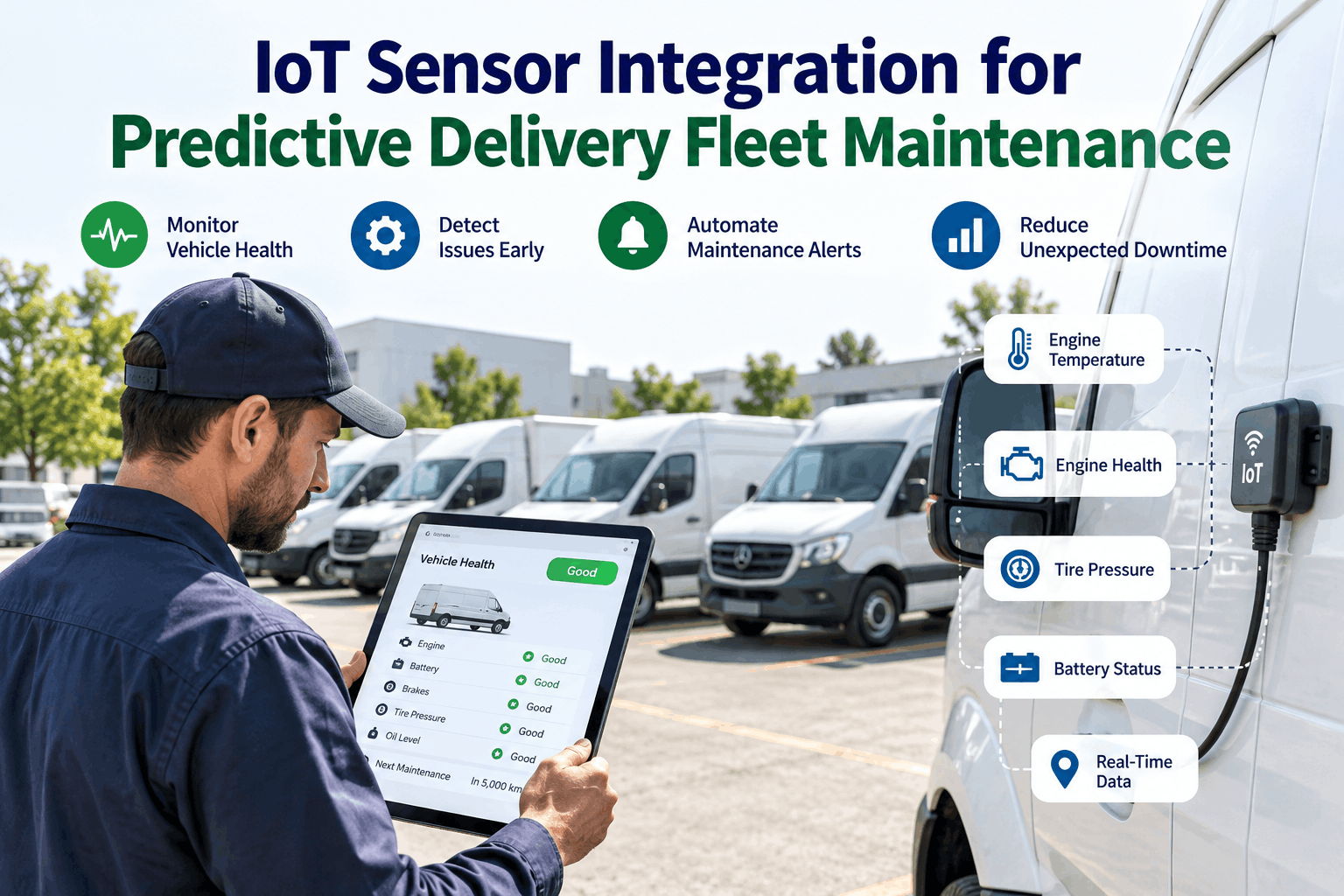
Predictive fleet maintenance relies on a network of connected vehicle sensors that stream continuous operational parameters to detect microscopic component fatigue before catastrophic mechanical failures occur.
CAN-Bus Microprocessor Gateway
Plugs directly into the vehicle's diagnostic port (OBD-II / J1939) to stream engine RPM, coolant temperature slopes, fuel trim ratios, transmission fluid temperatures, and real-time Diagnostic Trouble Codes (DTCs).
Battery & Electrical System Radar
Monitors starter cranking voltage sag during every ignition cycle and measures alternator AC ripple voltage in real time to catch dying batteries and failing alternators weeks before vans stall on delivery runs.
Wireless TPMS Pressure & Temp Probes
Valve-stem mounted BLE sensors broadcast continuous tire pressure and internal air temperature data, alerting shop mechanics to slow puncture leaks and under-inflated tires that increase fuel consumption.
Brake Wear & Ultrasonic Friction Sensors
Measures brake caliper pad thickness and acoustic friction signatures, projecting exact remaining pad mileage to schedule garage brake replacements during scheduled evening maintenance windows.
Cargo Door & Dwell Cycle Triggers
Wireless reed switches and accelerometer sensors track door-open durations, rear roll-up latch cycles, and curbside dwell intervals to identify cargo security breaches and hinge mechanical wear.
The 4 Hidden Operational Costs of Reactive Delivery Fleet Repairs
Relying on scheduled calendar servicing or waiting for dashboard check-engine lights creates severe financial liabilities for commercial delivery operators. Review our predictive ROI models when you book a demo or start testing our cloud tools directly when you sign up for immediate platform access.
Midday Electrical Failures and Delivery Stalls
Delivery step-vans start and stop up to 150 times per shift, putting extreme strain on starter motors and batteries. A battery that passes a passive static voltage test at the depot can still fail under dynamic cranking load mid-route, stranding 130 customer packages on the road and requiring $450+ in emergency roadside service calls.
Undetected Coolant Leaks and Engine Seizures
Small pinhole radiator leaks or loose hose clamps cause slow coolant loss during dense urban driving. Drivers focused on high-speed package delivery frequently miss analog temperature needles creeping upward until the engine overheats, warping cylinder heads and resulting in $8,000+ replacement engine rebuilds.
Premature Tire Degradation from Chronic Under-Inflation
Delivery vans running just 10 PSI below recommended tire pressure suffer rapid shoulder tread scrubbing and increased rolling resistance. Unmonitored tire pressure wastes 3% to 5% in auxiliary fuel burn and cuts tire casing lifespans in half, forcing premature tire purchases across the fleet.
Subterranean Garages & Urban Concrete Dead Zones
Delivery vehicles operate inside concrete basement garages, underground commercial loading bays, and multi-story parking structures with zero cellular connectivity. Cloud-only telematics portals drop telemetry packets, blinding fleet managers to active fault codes until vehicles leave the facility.
Built Specifically for Predictive Commercial Fleet Governance
FleetRabbit connects real-time IoT diagnostic feeds, mobile driver inspections, automated shop work orders, and parts inventory into an integrated command platform. Discover how our software streamlines your maintenance operations when you book a demo with our predictive engineering specialists.
Automated DTC Fault Code Triage
Instantly ingests and decodes J1939 and OBD-II trouble codes, categorizing faults into minor maintenance alerts or critical safety defects that trigger automated work orders.
Cranking & Alternator Health Analytics
Evaluates battery cranking voltage drop and alternator rectifier diode ripple on every ignition cycle, flagging dying electrical components days before in-service vehicle stalls occur.
Defect-Driven Dispatch Safety Gating
Vehicles tagged with critical mechanical defects—such as active brake hydraulic faults, critical tire pressure loss, or severe engine fault codes—are automatically locked on the dispatch board.
Basement Dock Offline Mobile Sync
Drivers conduct pre-trip walkarounds and shop mechanics log repairs inside concrete depot bays with zero cellular reception; all diagnostic data and inspection records auto-sync upon departure.
Automated Work Order Generation
Converts predictive IoT sensor alerts directly into garage repair work orders, allocating mechanic labor hours, reserving shop parts, and tracking repairs down to the vehicle VIN.
1-Click DOT Compliance Dossiers
Compile search-indexed compliance binders containing complete driver eDVIR walkaround histories, sensor diagnostic traces, and mechanic repair sign-offs in under 60 seconds.
Direct Mapping to Federal Motor Carrier Safety Directives
Operating a predictive maintenance program for commercial delivery vehicles maintains strict compliance with federal motor carrier safety standards and vehicle maintenance rules.
Standardizes daily pre-trip and post-trip eDVIR walkarounds (§ 396.11), qualified mechanic corrective action signatures (§ 396.13), and statutory 90-day electronic maintenance record retention across commercial delivery vans.
Governs mandatory operational readiness of commercial vehicle safety systems: service brakes, emergency stopping systems, tire inflation integrity, commercial lighting, and electrical wiring protection.
Automates documentation and scheduling for mandatory annual commercial vehicle inspections, tracking certified inspector sign-offs and maintaining digital inspection decals in an auditable database.
Maintains empirical vehicle roadworthiness histories, roadside inspection results, and defect remediation records to protect your carrier Safety Measurement System (SMS) maintenance score from federal penalties.
Fleet Maintenance & IoT Telematics Software Comparison
A feature-level comparison evaluating predictive maintenance depth, dispatch safety gating, and offline resilience as of 2026. Schedule a personalized walkthrough when you book a demo with our technical engineering team.
| Maintenance Capability | FleetRabbit | Legacy Enterprise Fleet CAD | Basic GPS Trackers | Manual Garage Spreadsheets |
|---|---|---|---|---|
| Pricing (per asset/month) | $5/month flat | $35–$70/month | $15–$30/month | High emergency breakdown costs |
| Predictive Cranking & Electrical Radar | Dynamic cranking voltage & ripple analytics | Requires expensive add-ons | Basic battery voltage only | None (Battery dies on road) |
| Automated Defect Dispatch Lockout | Instant block on critical defect | Manual supervisor note | Not supported | None (Compromised vans roll) |
| Native Shop CMMS Work Orders | Closed-loop parts & labor tracking | Separate costly software module | Not available | Paper shop work orders |
| Basement Dock Offline Mobile Sync | Full store-and-forward | Network dependent | Data dropped offline | Paper logs only |
| Free Trial Access | 14 days, up to 3 assets | Sales demonstration only | Limited sandbox demo | None |
| Contract Commitment | Monthly or annual (No lock-in) | 3 to 5-year lock-in | 2 to 3-year contract | None |
5-Step IoT Predictive Maintenance Implementation Pathway
FleetRabbit embeds cleanly into your delivery fleet operations, maintenance bays, and driver mobile devices in under two weeks without shipping disruptions. Begin testing immediately when you sign up for our free trial.
Fleet Roster & Vehicle Hardware Mapping
Import delivery vans, cargo vans, step-vans, box trucks, engine models, and existing telematics hardware serial numbers via automated CSV tools or direct API.
Diagnostic Gateway & IoT Sensor Pairing
Connect plug-and-play OBD-II or J1939 telematics dongles and pair wireless BLE TPMS sensors to begin streaming real-time vehicle health telemetry to FleetRabbit.
Predictive Threshold & Lockout Rule Setup
Configure automated diagnostic alert thresholds: establish battery cranking voltage limits, coolant temperature slopes, tire pressure bands, and dispatch lockout triggers.
Drivers & Garage Mechanics Mobile Rollout
Equip commercial drivers and shop mechanics with the offline-first mobile app on standard iOS or Android smartphones for digital pre-trip eDVIR walkarounds and work order tracking.
Predictive Command Go-Live
Activate live vehicle diagnostic telemetry, automated shop work order queues, parts reorder triggers, and 1-click DOT compliance audit archives across all maintenance desks.
2-Week Deployment Plan & Milestones
A structured timeline designed to transition delivery operations to automated IoT predictive maintenance with zero disruption to scheduled package manifests. Review our full onboarding plan when you book a demo today.
Week 1: Hardware Integration & Diagnostic Setup
- Audit historical repair orders, recurring roadside breakdown logs, and telematics hardware feeds
- Connect OBD-II and J1939 diagnostic dongles to verify real-time CAN-bus diagnostic streams
- Configure mobile pre-trip eDVIR walkaround checklists and predictive fault threshold rules
- Assign user access permissions for Maintenance Directors, Shop Foremen, and Route Couriers
Week 2: Depot Rollout & Live Verification
- Distribute mobile app to drivers and conduct 15-minute training on digital pre-trips and e-POD
- Validate store-and-forward offline syncing inside concrete maintenance bays and underground depots
- Simulate an elevated electrical diode ripple alert to verify automated work order generation
- Launch live fleet health dashboard, predictive maintenance alerts, and DOT compliance archives
Real-World Predictive Fleet Maintenance Results
Operational improvements documented by commercial delivery fleets who connected vehicle IoT sensors to predictive maintenance software. Review the complete delivery case study when you book a demo with our team.
34% Reduction in Roadside Breakdowns Across 70 Delivery Vans
A regional parcel carrier operating 70 delivery vans suffered frequent midday battery and alternator failures that caused missed customer delivery windows. FleetRabbit deployed cranking voltage analytics and automated work orders, cutting in-service roadside stalls by 34% and saving $76,000 in emergency towing and transloading labor in year one.
Zero Catastrophic Engine Failures and 100% DOT Compliance
An urban delivery contractor managing 45 step-vans struggled with unnoticed engine coolant leaks and tire pressure scrubbing. FleetRabbit connected CAN-bus coolant slope monitoring and wireless TPMS sensors, catching six thermal anomalies early and preventing costly engine overhauls.
When you run a delivery fleet of seventy vans making thousands of package stops every day, an unscheduled vehicle breakdown during the afternoon rush is the most expensive operational disaster you can face. Your driver is stuck on the side of a busy street, you have to dispatch a relief van, transfer a hundred packages by hand, and your on-time delivery rate takes a massive hit. Before FleetRabbit, we serviced our vehicles every five thousand miles on a garage spreadsheet, but that never caught a dying battery or an alternator that was burning out. FleetRabbit changed our entire maintenance operation. It reads our vehicle CAN-bus data in real time, alerts our shop foreman when a van has an abnormal battery cranking drop three weeks before it actually fails, and automatically schedules the replacement during our regular evening garage shift. It eliminated our midday tow calls, saved our company over seventy thousand dollars, and kept our delivery vans on the road where they belong.
Frequently Asked Questions
Take Control of Your Fleet's Predictive Maintenance in Less Than 2 Weeks
Connect IoT vehicle sensors, eliminate roadside breakdowns, and ensure 100% DOT compliance at $5/asset/month with a 14-day free trial.