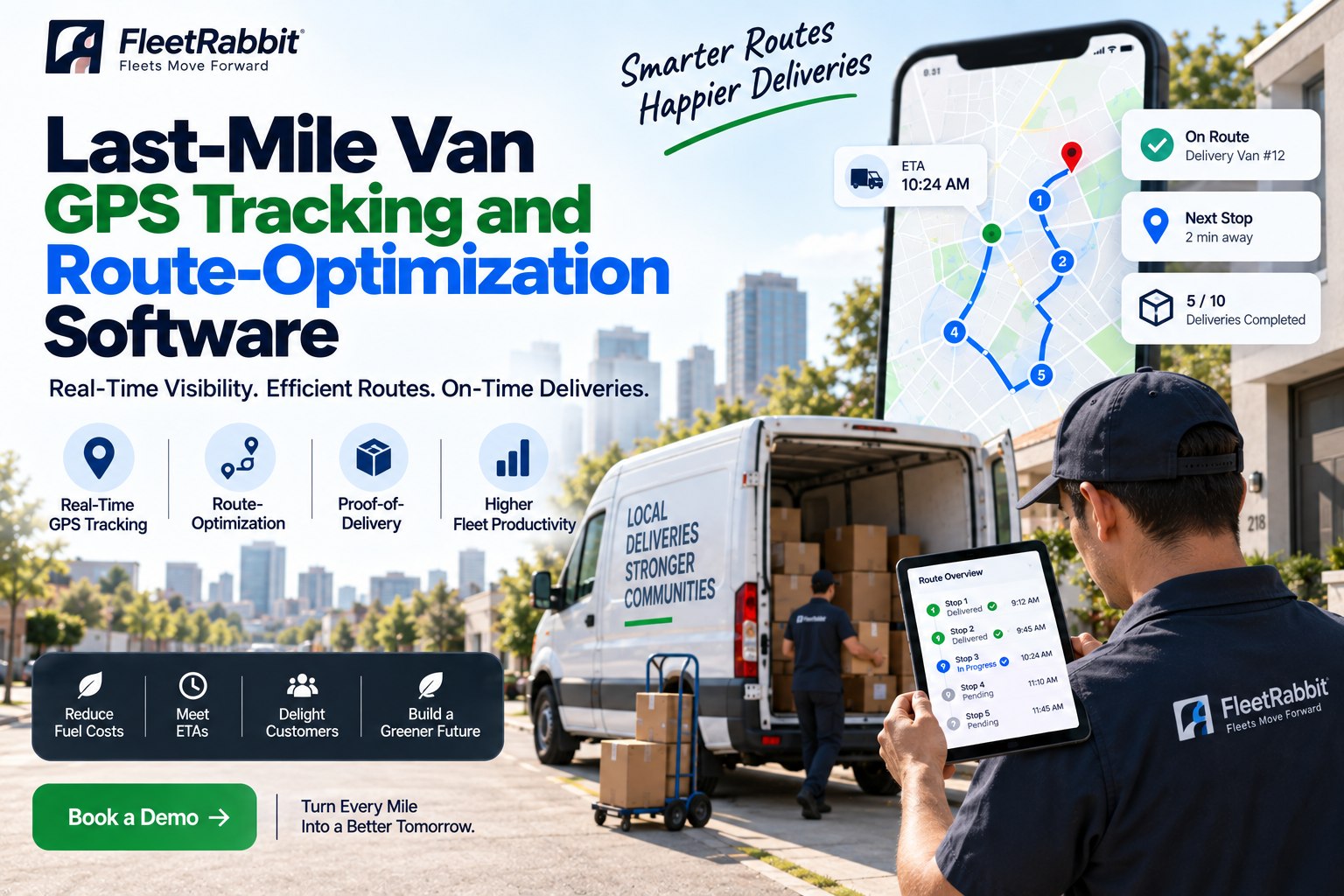
A customer waiting for a last-mile delivery does not care about your fleet's total mileage or your dispatcher's spreadsheet, they care about one number: when is it actually going to arrive. GPS tracking without route optimization just tells you where a van is right now, while route optimization without live GPS is a plan that goes stale the moment traffic or a missed stop throws it off. The two only become useful together, feeding each other in real time so an ETA updates the moment something changes instead of staying wrong for the rest of the day. This page covers how live van tracking and route optimization actually work together, and what that combination does to delivery accuracy once it is running.
That live position feeding straight into the next two ETAs is the entire point of pairing GPS with route optimization. The moment the van leaves a stop a few minutes late, every downstream ETA on that route recalculates automatically instead of staying frozen at a number a dispatcher typed in that morning. Fleets that want their customers seeing that same accurate countdown can sign up and get their vans connected without touching a single delivery process already in place.
Route optimization is not just about shaving miles, it is about sequencing stops so a van is never doubling back across its own morning while a live GPS feed keeps that sequence honest against real traffic instead of a static map. Fleets running the same stop list every day without resequencing it are almost always the ones leaving stops per hour on the table, which is exactly what a fleet manager sees the moment they book a demo of route optimization against their own delivery zone.
Connect your last-mile fleet and see GPS position and route sequencing working together instead of two separate tools.
None of those four features do much on their own, but stacked together they turn a delivery map from a static snapshot into something dispatch can actually act on mid-shift. An idle alert paired with a live ETA means a dispatcher catches a van stuck at a locked gate before three downstream customers start calling to ask where their delivery is, and that kind of early catch is what teams are really booking a demo to see.
Most ETA tools lean entirely on the top factor, live position, and ignore the second one, which is a mistake, because a stop that reliably takes twelve minutes to complete throws off every ETA behind it if the system assumes a flat average instead. Combining position data with real stop-level history is what closes the gap between an ETA that is usually close and one that is actually trustworthy enough to text a customer.
- Shows where a van is, not when it will arrive
- Route sequence set once in the morning and left alone
- ETAs go stale the moment traffic changes
- Idle time and detours discovered after the fact
- Live position feeds directly into every downstream ETA
- Route sequence adjusts as stops complete or run late
- ETAs recalculate continuously through the shift
- Idle and detour alerts fire while dispatch can still act
The difference between those two approaches shows up in every customer text that says the delivery is running late without an updated time attached to it. Last-mile fleets compete on precisely that kind of accuracy now, and the ones treating GPS tracking and route optimization as two separate tools are the ones customers notice falling behind. If your fleet is still running one without the other, this is a good time to sign up and see both working together on your own routes.
Book a demo and see live GPS tracking and route optimization running together, live in days, not months.