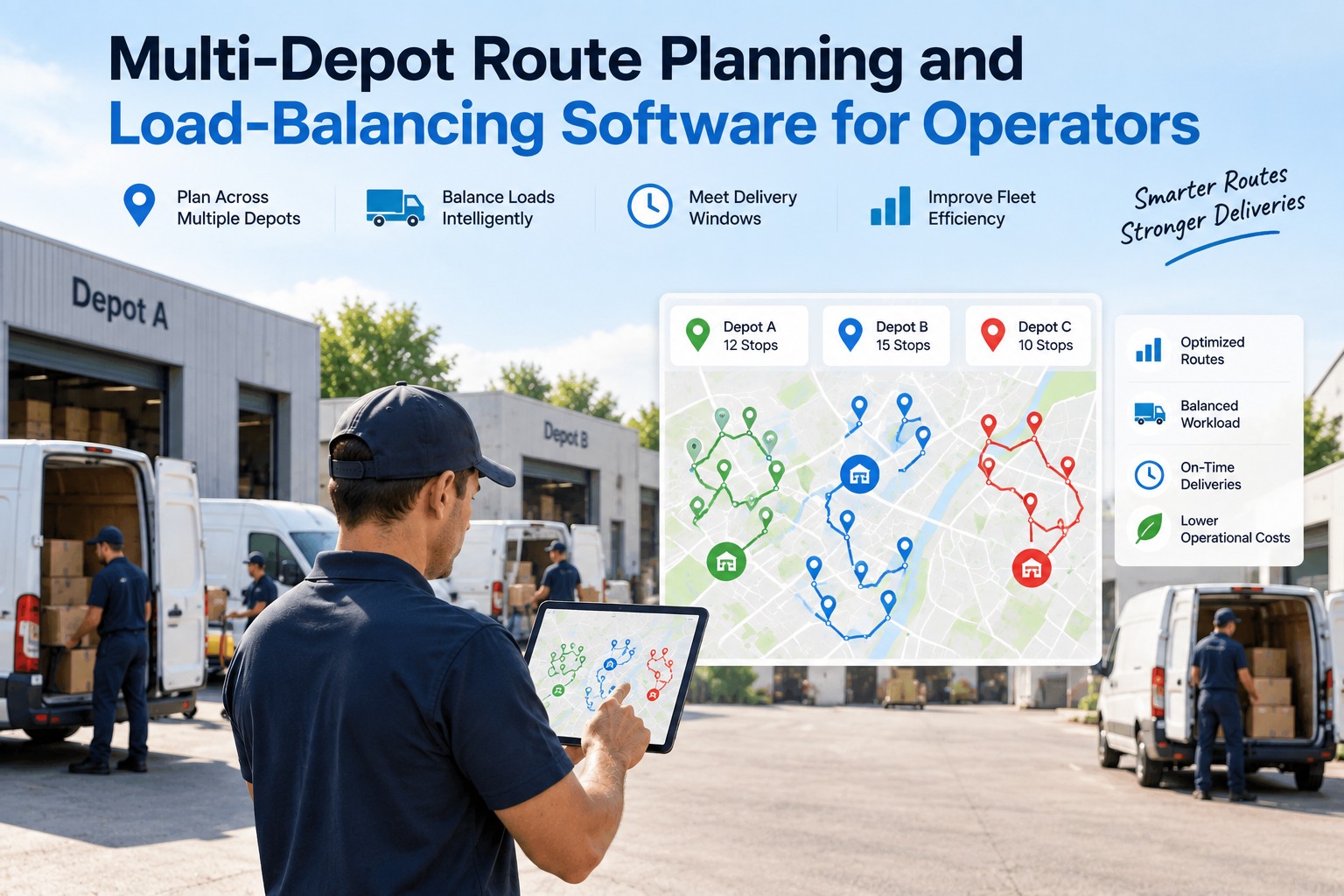
Distributed fulfillment networks, regional e-commerce carriers, and enterprise courier operators running out of multiple fulfillment hubs face compounding dispatch friction: cross-hub route overlaps, unbalanced vehicle payload utilization, depot capacity bottlenecks, and volatile delivery-window constraints. When multi-facility operations depend on siloed dispatchers, disconnected spreadsheet schedules, or single-hub routing tools, vehicles drive unnecessary cross-town stem miles, drivers exceed shift hours, and hubs become starved or overloaded. FleetRabbit delivers advanced multi-depot route planning and load-balancing software engineered specifically for multi-facility e-commerce logistics. Featuring global cross-depot load allocation, sub-second dynamic re-routing, predictive SLA risk scoring, and multi-depot reverse logistics ingestion, FleetRabbit automates facility-to-door execution across your entire regional network. Eliminate territory friction, harmonize fleet capacity across all hubs, and achieve audit-proof delivery-window compliance on every run. Book a demo to see FleetRabbit multi-depot route planning software in action.
Multi-Depot Route Planning and Load-Balancing Software for Operators
Coordinate cross-facility vehicle dispatching, balance order payloads across regional distribution centers, eliminate hub-to-hub stem miles, and enforce strict delivery-window constraints in real time.
Why Single-Hub Dispatch Tools Fail Distributed Networks
Operating several fulfillment nodes without shared dispatch algorithms leads to duplicated street coverage, inefficient depot departures, and spiraling carrier costs.
Uncoordinated Hub Overlap & Redundant Mileage
Without unified multi-depot optimization, vehicles dispatched from separate fulfillment centers cross each other’s paths on the same city streets, wasting thousands in fuel and labor.
Unbalanced Hub Capacities & Dock Stoppages
Rigid geographic dispatch rules overwhelm primary urban hubs while secondary regional centers sit underutilized, causing outbound dock gridlock and late carrier departures.
Delivery-Window Violations on Cross-Town Drops
Dispatching from the wrong origin depot forces long travel legs right through morning traffic peaks, leading to catastrophic SLA failures on tight 1-hour customer delivery windows.
Reverse Logistics Fragmentation
Midday returns and pickups are routed back to the departing vehicle's home depot instead of the nearest regional hub, adding unnecessary return miles to driver shifts.
Built for Scalable Multi-Node Fulfillment
FleetRabbit balances inventory, payload capacities, and destination density across your entire warehouse footprint in real time. Request a multi-depot platform walkthrough.
Multi-Origin Stop Allocation
Assign customer delivery stops to optimal origin hubs automatically, analyzing real-time road distances, depot dock staging schedules, and driver availability.
Cross-Facility Fleet Equalization
Harmonize vehicle payloads and shift workloads across multiple warehouses to eliminate idle fleet assets at one facility while another is overbooked.
Multi-Node Time-Window Solver
Calculate optimal dispatch sequences factoring in variable morning dwell times and strict afternoon customer delivery windows across all network nodes.
Sub-Second Dynamic Re-Routing
Recalculate running multi-hub manifests around highway closures or midday traffic gridlock in seconds, pushing updated routes straight to drivers' smartphones.
Nearest-Depot Return Drops
Direct drivers collecting customer returns to drop items at the closest regional facility rather than returning all the way to their origin morning terminal.
SLA Risk Scoring & Inter-Hub Offload
Identify late-running deliveries 45 minutes ahead and alert control dispatchers to reassign pending drops to neighboring depot routes with open capacity.
Multi-Facility Constraints Reconciled in Seconds
FleetRabbit evaluates complex operational trade-offs across your entire warehouse grid to achieve peak carrier efficiency.
Maintains specific bay loading constraints, outbound release windows, and staging capacities for every individual warehouse in the regional network.
Optimizes stops across step-vans, cargo sprinters, and regional box trucks, respecting individual vehicle cubic limits and gross weight ratings across all locations.
Enforces depot-specific driver start windows, mandatory rest breaks, and localized maximum overtime policies across diverse facility contracts.
Guarantees that cross-hub load balancing never compromises hard customer appointments, morning enterprise dock slots, or VIP express deliveries.
Multi-Depot Routing Platform Comparison
How FleetRabbit compares to legacy routing engines, siloed dispatch CAD, and manual spreadsheets across multi-facility networks. Request full technical data.
| Capability | FleetRabbit | Legacy Multi-Stop Tools | Siloed Fleet Telematics | Manual Dispatch Sheets |
|---|---|---|---|---|
| Pricing (per asset/month) | $5/month | $40–$90/month | $25–$60/month | Excessive labor overhead |
| Cross-Depot Load Allocation | Automated network-wide solving | Requires manual split | Not available | Independent depot silos |
| Delivery-Window Constraint Engine | Hard & soft dynamic gating | Basic batch check | Not supported | Driver guesswork |
| Real-Time Re-Routing & Offloading | Sub-3 second live response | 10–25 minute re-run lag | Manual driver radio calls | Static route failure |
| Cross-Facility Reverse Logistics | Nearest-depot return routing | Home-depot return only | Not supported | Unorganized spreadsheets |
| Free Trial | 14 days, up to 3 assets | Demo only | Demo only | None |
| Deployment Speed | Live in days | 3–6 months | 1–2 months | None |
5 Steps to Centralized Multi-Depot Operations
FleetRabbit connects directly into your existing WMS and dispatch infrastructure without disrupting scheduled carrier operations.
Hub Geocoding & Fleet Ingestion
Import depot locations, loading dock schedules, vehicle payload ratings, and driver domicile assignments via REST API or CSV sync.
Delivery-Window & Load-Balancing Rules
Define customer SLA tiers, target hub capacity limits, cross-depot service radii, and return pickup prioritization policies.
Driver Mobile Navigation Rollout
Deploy the FleetRabbit mobile application to all last-mile couriers for cross-depot turn-by-turn wayfinding, barcode tracking, and e-POD capture.
Simulated Cross-Hub Re-Routing Drills
Run simulated volume surges and midday vehicle breakdown drills to validate automated inter-depot stop offloading and route recalculation speed.
Full Multi-Facility Network Go-Live
Activate centralized multi-depot optimization, cross-hub map visualization, and automated customer ETA alerts across all distribution hubs.
Deployment Milestones: Live in Days, Not Months
Centralize your regional route planning with zero interruption to active carrier deliveries. Request an onboarding plan.
Week 1: Setup & Multi-Depot Data Sync
- Sync WMS/TMS order feeds and geocode all hub staging and loading bay docks
- Configure vehicle volumetric limits, hub shift buffers, and customer SLA tiers
- Set up automated alerts for hub capacity thresholds and driver hour limits
- Establish user roles for Regional Logistics Directors, Hub Managers, and Drivers
Week 2: Operations Rollout & Dynamic Optimization
- Deploy turn-by-turn mobile navigation to all active regional delivery drivers
- Activate real-time multi-depot re-routing around traffic and midday delays
- Validate nearest-depot returns logic for midday reverse logistics pick-ups
- Review fuel savings, mileage reductions, and hub capacity utilization gains
Unify Your Multi-Depot Logistics and Eliminate Overlap
Coordinate regional warehouses, automate dynamic cross-facility re-routing, and enforce strict delivery windows. Start today at $5/asset/month with a 14-day free trial.
Proven Multi-Depot Logistics Outcomes
Real performance gains recorded by multi-facility regional carriers and omni-channel fulfillment operations. Request the multi-depot case study.
31% Reduction in Inter-Depot Transit Miles
A regional parcel carrier managing four distribution hubs struggled with territory overlap and vehicle overloading at its central depot. FleetRabbit automated cross-depot load allocation and dynamic re-routing, slashing deadhead stem miles by 31% and equalizing vehicle fill rates across all four facilities.
100% Nearest-Depot Return Efficiency
A high-velocity direct-to-consumer delivery network operating three urban hubs lost hundreds of driver hours returning customer pickups back to origin depots. FleetRabbit implemented nearest-facility return routing, saving 40 minutes per shift and reducing total fleet fuel expenses by 21%.
Operating five distribution centers across a single metropolitan area used to be a scheduling nightmare. Each hub manager acted independently, which meant vans from separate warehouses frequently passed each other on the exact same road. FleetRabbit changed our entire operational framework. It treats our five depots as a unified logistics network, balancing workloads, assigning drops to the nearest facility, and recalculating routes when highway traffic snarls. It gave us complete control over our regional fleet and cut our fuel overhead dramatically.
Frequently Asked Questions
Harmonize Your Multi-Depot Fleet in Days
Eliminate cross-facility stem miles, balance warehouse payloads, and enforce strict delivery-window constraints at $5/asset/month with a 14-day free trial.