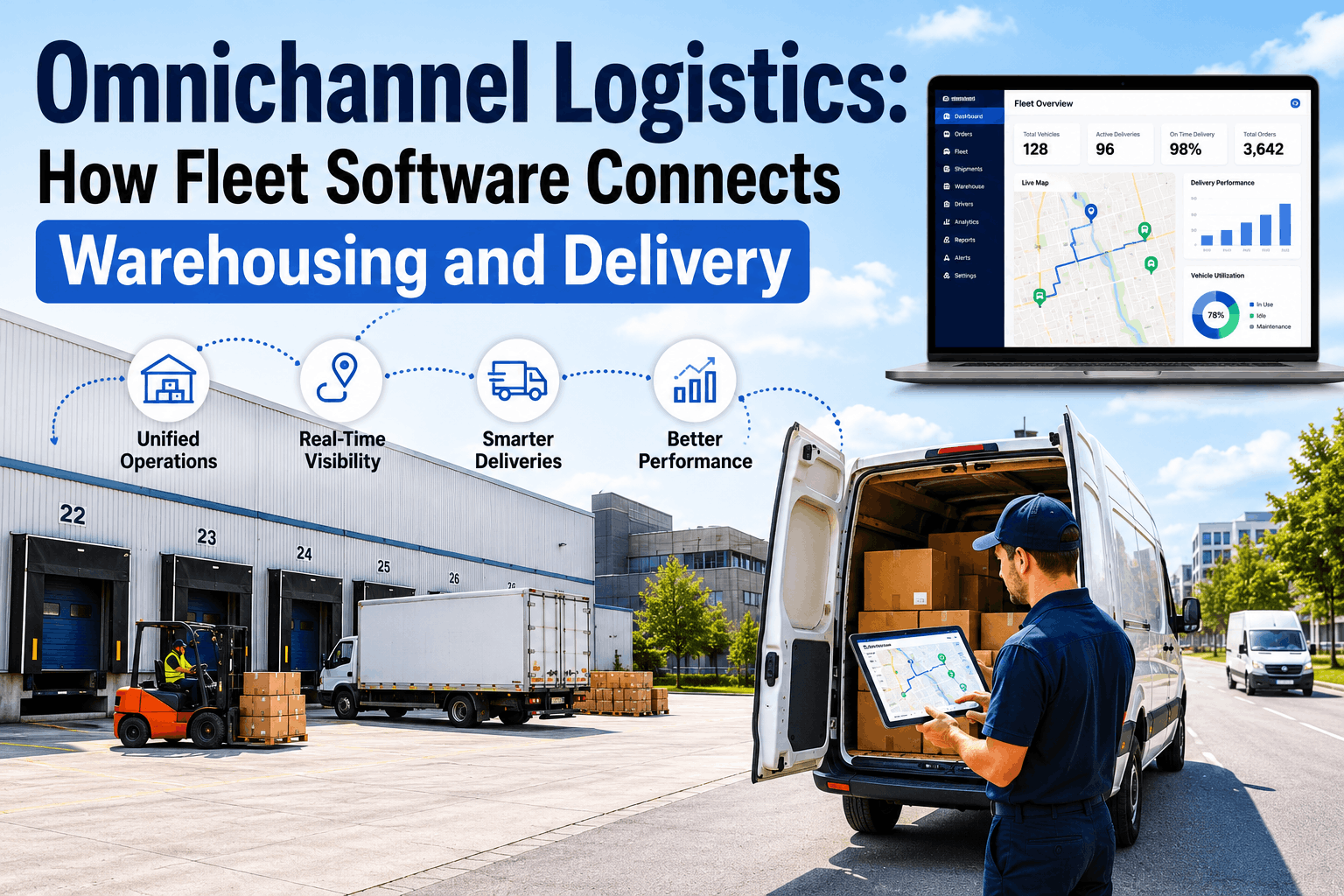
Omnichannel Logistics: How Fleet Software Connects Warehousing and Delivery
Omnichannel retail growth is creating a new pressure point for Western US logistics operators — a Seattle 3PL managing same-day fulfillment across six distribution centers, a Los Angeles retailer routing orders between brick-and-mortar and e-commerce channels, a Phoenix distributor whose warehouse picks are disconnected from last-mile dispatch. Fleet software that bridges warehouse management and delivery execution isn't a nice-to-have for these operations — it's the infrastructure gap costing them $3,000–$9,000 per month in misrouted loads, failed SLAs, and manual coordination overhead. Book a demo to see Fleet Rabbit's omnichannel logistics platform in action for your operation.
Quick Answer
Omnichannel logistics platforms connect warehouse management systems (WMS) with fleet dispatch, route optimization, and last-mile delivery execution — eliminating the manual handoff gap that costs Western US operators 6–11% of total logistics spend. Fleet Rabbit integrates live inventory signals, dock scheduling, and carrier dispatch into a single operational layer across California, Nevada, Arizona, Oregon, and Washington distribution networks.
The Gap Between Warehouse and Delivery: What Disconnected Logistics Costs Western US Operators
A 15-vehicle regional carrier running delivery routes out of three California DCs touches 180–320 delivery stops per day. When warehouse pick signals don't feed dispatch in real time — when route optimization runs on yesterday's inventory snapshot — that gap surfaces as missed windows, partial loads, and customer escalations that no amount of driver overtime recovers.
SLA Failures
$4.1K
avg monthly penalty / 15-vehicle fleet
Manual Coordination
$2.7K
dispatcher overhead per month
Failed Deliveries
$1.9K
redelivery cost from dock-dispatch lag
Inventory Mismatch
$1.1K
routes built on stale WMS data
How Fleet Rabbit Connects Warehousing and Delivery Execution
Live WMS Integration
Fleet Rabbit connects directly to warehouse management systems — Manhattan Associates, Blue Yonder, Deposco, and 30+ WMS platforms — pulling live pick completion, dock door assignment, and load manifest data into dispatch in real time. Route builds reflect actual inventory state, not a snapshot from two hours ago.
Dock-to-Route Automation
When a pick is confirmed in the WMS, Fleet Rabbit automatically queues the load in the dispatch module — assigning vehicle, driver, and optimized route without dispatcher intervention. For California DCs running 80+ daily shipments, this eliminates the manual dispatch bottleneck entirely.
Multi-Channel Order Routing
Fleet Rabbit's routing engine handles same-day e-commerce, scheduled B2B, and curbside pickup orders simultaneously — consolidating multi-channel demand into optimized runs. Oregon and Washington 3PLs managing Shopify, EDI, and marketplace fulfillment run all three channels through a single dispatch layer.
Capability #1: Real-Time Warehouse-to-Dispatch Signal — Eliminate the Handoff Delay
Warehouse-to-Dispatch Lag — Fleet Rabbit vs. Manual Coordination Methods
Fleet Rabbit Sync
<45s
Email / Phone Handoff
35–90 min
Manual WMS Export
2–4 hrs
No Integration
Next-day routes
Fleet Rabbit platform data, Western US distribution operations 2024–2025. Manual handoff methods miss same-day delivery windows in 55–70% of late-start events.
1
Pick Completion Triggers Dispatch Queue
Fleet Rabbit monitors WMS pick confirmation events in real time. The moment a load is staged at the dock door, Fleet Rabbit creates a dispatch job — vehicle matched by capacity and current location, driver assigned by availability and hours-of-service status, route optimized against live traffic and delivery window constraints.
Los Angeles 3PL, 22 vehicles: Fleet Rabbit reduced average dock-to-depart time from 54 minutes to 11 minutes after WMS integration — recovering 3.1 additional delivery stops per vehicle per day.
2
Dynamic Load Consolidation Across Channels
Fleet Rabbit consolidates same-day e-commerce, next-day B2B, and store replenishment orders into optimized multi-stop runs — preventing the partial-load departures that waste fuel and driver time when channels are dispatched independently. A Seattle omnichannel retailer's DC no longer dispatches three separate vehicles for orders that fit in one.
When a delivery exception occurs — damaged goods, access restriction, failed delivery attempt — Fleet Rabbit fires an escalation back to both the dispatch system and the originating WMS, updating inventory availability and triggering re-dispatch logic without manual intervention from either warehouse or fleet operations.
Phoenix regional distributor, 11 vehicles: Exception re-dispatch time dropped from 2.4 hours to 9 minutes — reducing failed delivery rate from 8.3% to 1.1% within 60 days of integration.
Omnichannel Logistics Platform
Connect Your Warehouse and Delivery Operations — Free Trial, No Long-Term Commitment
WMS-agnostic integration. Live pick-to-dispatch sync. Multi-channel order consolidation and real-time delivery visibility from day one.
Capability #2: Omnichannel Route Optimization — One Engine for All Delivery Types
The multi-channel routing problem: A 20-vehicle California operation running same-day, next-day, and scheduled B2B deliveries from one DC can't route-optimize manually across three order streams. Dispatchers build partial routes and miss load-consolidation opportunities worth $1,800–$3,400 per month in avoidable fuel and driver cost.
Fleet Rabbit solves: A single route optimization engine ingests all order types simultaneously — applying time-window constraints, vehicle capacity, driver HOS, and real-time traffic to build consolidated runs that manual routing can't replicate.
Western US impact: Nevada and Arizona distributors with long inter-stop distances see the highest consolidation savings — average fuel reduction of 14–19% after omnichannel route unification.
03
Carrier Visibility
Capability #3: End-to-End Carrier and Last-Mile Visibility — One Tracking Layer
The visibility gap: Western US retailers using a mix of owned fleet, regional carriers, and last-mile partners (OnTrac, LSO, regional couriers) lose shipment visibility the moment freight leaves the DC. Customer service teams field 40–80 "where is my order" escalations per day that a unified tracking layer eliminates.
Fleet Rabbit integrates: Owned fleet GPS, carrier EDI feeds, and last-mile partner APIs aggregate into a single shipment visibility layer — one interface for warehouse, dispatch, and customer service regardless of which carrier is handling the last mile.
Outcome: Oregon 3PLs running mixed-carrier networks reduced customer escalation volume 68% within 30 days of Fleet Rabbit visibility integration.
04
Returns Management
Capability #4: Reverse Logistics Integration — Close the Returns Loop
The returns blind spot: For California omnichannel retailers processing 300–600 returns per week, the reverse logistics flow is invisible to both the WMS and the fleet system until a driver physically returns merchandise to the DC. This lag delays inventory restocking by 1–3 days — costing availability on fast-moving SKUs.
Fleet Rabbit connects: Driver return scan events feed directly into the WMS inventory update — so returned merchandise is available for re-pick before the vehicle reaches the dock. Fleet Rabbit also consolidates return pickups with outbound delivery routes, reducing empty-leg miles.
Outcome: Washington state e-commerce operators reduced returns restocking lag from 2.8 days to same-day in 85% of cases after Fleet Rabbit reverse logistics integration.
05
Analytics
Capability #5: Cross-Channel Logistics Analytics — Operational Intelligence Across Warehouse and Fleet
The reporting gap: Warehouse KPIs and fleet KPIs live in separate systems for most Western US operators. DC managers track pick rates; fleet managers track on-time delivery. Neither sees the full handoff chain — making it impossible to identify where the 4–8% logistics efficiency gap actually lives.
Fleet Rabbit delivers: A unified analytics layer spanning dock dwell time, load consolidation rate, per-channel delivery cost, on-time performance by order type, and driver utilization — all in one dashboard accessible to warehouse ops and fleet management simultaneously.
Premium benefit: Arizona and Nevada logistics directors using Fleet Rabbit analytics identify $2,000–$5,000/month in avoidable cost within the first 60 days — most commonly in partial loads and manual re-dispatch events.
Before vs. After Fleet Rabbit Omnichannel Integration — 20-Vehicle Western US Operation
QWhich warehouse management systems does Fleet Rabbit integrate with?
Fleet Rabbit connects with Manhattan Associates, Blue Yonder, Deposco, HighJump, Fishbowl, and 30+ additional WMS platforms via native API or EDI integration. For operations running custom-built WMS systems, Fleet Rabbit's open API layer accommodates direct integration — typically live within 5–10 business days depending on WMS configuration. No WMS replacement is required.
QCan Fleet Rabbit handle both owned fleet and third-party carrier last-mile delivery?
Yes. Fleet Rabbit's carrier visibility layer integrates owned fleet GPS telematics with third-party carrier EDI feeds and last-mile partner APIs — including OnTrac, LSO, regional Western US couriers, and national carriers. All shipment status updates aggregate into a single interface, giving warehouse, dispatch, and customer service teams one tracking view regardless of which carrier handles each delivery.
QHow does Fleet Rabbit handle same-day e-commerce versus scheduled B2B delivery routing?
Fleet Rabbit's route optimization engine applies different constraint profiles to each order type simultaneously. Same-day e-commerce orders carry tight time windows and high SLA priority; scheduled B2B orders optimize for load consolidation and cost efficiency. The engine treats both types into shared runs where delivery windows allow — reducing total vehicle dispatches by 18–26% for California operations running mixed-channel fulfillment.
QHow long does Fleet Rabbit take to deploy across a multi-DC Western US operation?
A standard single-DC deployment with WMS integration is live in 7–12 business days. Multi-DC operations across California, Nevada, Arizona, Oregon, or Washington typically complete full deployment in 3–5 weeks depending on the number of WMS instances and carrier integrations required. Fleet Rabbit's Western US implementation team handles all site configuration and WMS connection testing — no internal IT resources required beyond system access credentials.
The four AI capabilities transforming fleet operations — real-time GPS, predictive health monitoring, dynamic route optimization, and delivery performance analytics — with ROI data for each.
AI-driven fault prediction and automated maintenance scheduling that prevents mid-route breakdowns — the reliability layer IoT sensor data powers across delivery vans, straight trucks, and heavy equipment.
Real-time utilization tracking, idle reduction analytics, and fleet right-sizing data that reduce total operating cost for Western US logistics and distribution operators.
How GPS hardware, IoT sensors, and cloud analytics combine to deliver real-time fleet visibility, predictive maintenance, and operational intelligence for logistics and distribution operations.
Connect Your Warehouse and Delivery Operations — See Fleet Rabbit in Action
Fleet Rabbit's omnichannel logistics platform delivers live WMS integration, automated dock-to-dispatch routing, multi-channel order consolidation, end-to-end carrier visibility, and unified analytics across your Western US distribution network. Any WMS. Any carrier mix. Full ROI in 60 days.