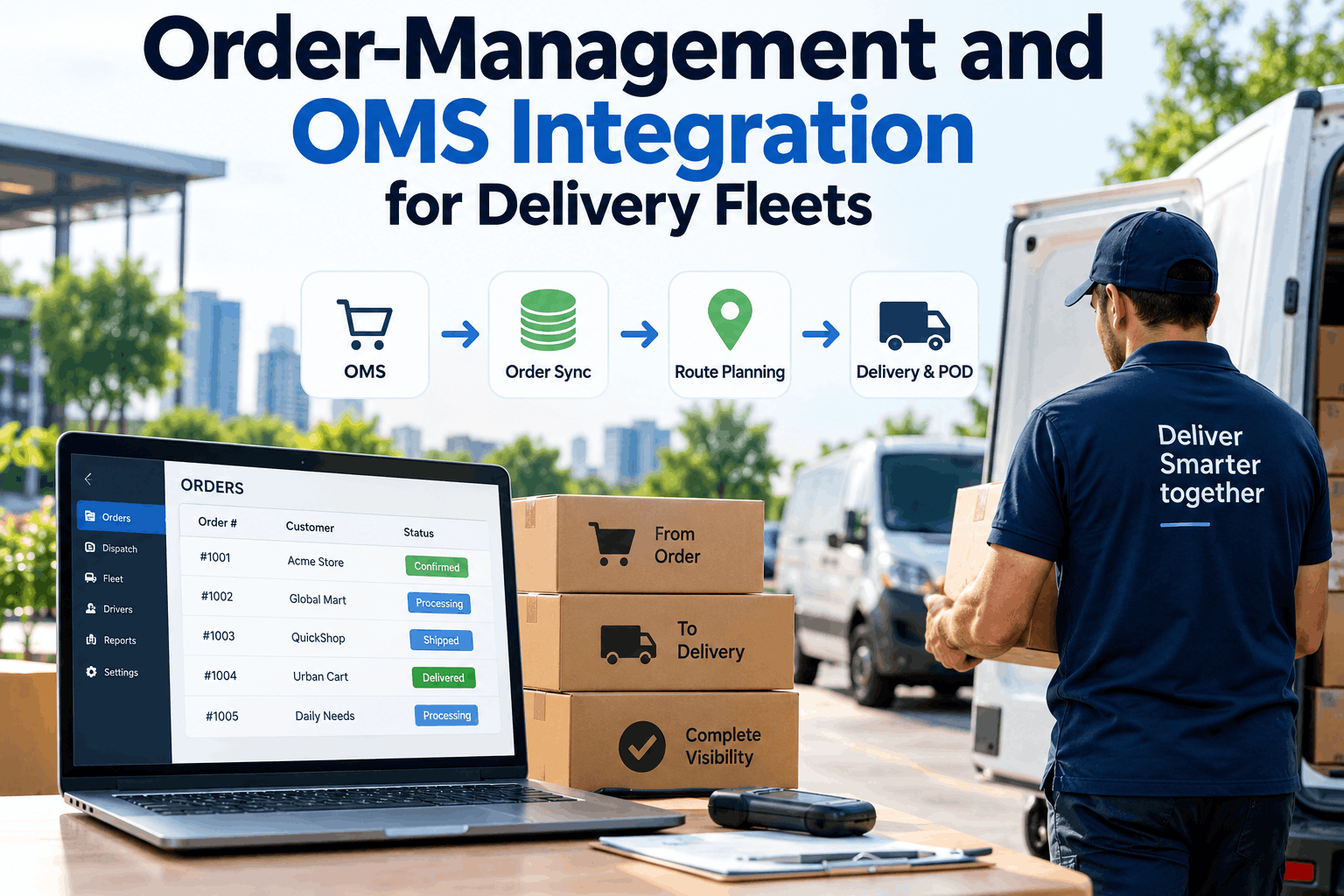
Modern omnichannel retail operations, direct-to-consumer fulfillment networks, and high-velocity last-mile courier carriers require continuous data synchronization between customer checkout carts and curbside delivery operations. When order management systems (such as Shopify Plus, Magento, NetSuite, Salesforce Commerce Cloud, or custom ERP engines) operate in isolation from fleet dispatch, order fulfillment grinds to a halt under manual spreadsheet exports, clerical re-entry errors, and disconnected driver dispatching. High customer delivery expectations for same-day delivery, scheduled delivery windows, and transparent tracking cannot be satisfied with disconnected tools. Integrating your order management system (OMS) directly with delivery fleet management software creates an automated pipeline: digital customer checkouts convert instantly into clustered route manifests, vehicle payload limits are balanced, and real-time electronic proof of delivery (ePOD) statuses loop back into customer support portals. To see how seamless OMS-to-dispatch connectivity eliminates order ingestion delays and lowers fulfillment overhead, book an executive systems integration demo with our logistics software engineering team or launch your automated API webhooks immediately via our free platform sign up.
OMS Integration Software for Delivery Fleet Management
A comprehensive technical architecture guide for e-commerce logistics leaders and operations engineers. Connect enterprise order management systems to dynamic delivery dispatch, automate street-level route clustering, and sync live delivery milestones back to customer portals.
Geocoded to 41.8781° N, -87.6298° W • Auto-Assigned to Van Route #14
Live Tracking URL & Dynamic Geofenced ETA (11:15 AM) Pushed to Customer SMS
Doorstep Photo & GPS Token Attached • OMS Inventory & Financial Ledger Closed
Bridge Your E-Commerce Store and Delivery Fleet Operations
Eliminate manual CSV imports, automate route sequencing, synchronize customer tracking links, and push completed delivery receipts back to your OMS starting from $3/vehicle/month with no hardware lock-in.
The Operational Bottleneck: Why Disconnected Order Systems Cripple Fleets
In traditional retail and wholesale distribution, the order management system handles customer checkouts, credit card payment capture, SKU inventory allocation, and order fulfillment status. However, once an order is packed at the fulfillment center, a massive digital disconnect typically occurs. Dispatchers spend hours every morning downloading static CSV files, manually sorting delivery addresses by postal codes, and assigning orders to drivers using magnetic greaseboards or consumer navigation apps. When drivers encounter road closures, delivery window delays, or missing customer security gate codes, the central order management platform remains completely unaware. Customer service representatives field hundreds of "Where Is My Order" (WISMO) telephone calls, unable to provide clear answers because driver progress is isolated inside the vehicle. Connecting your order management system directly to your delivery fleet management engine transforms this disjointed workflow into an automated data loop. Orders placed online stream into the routing engine in real time, building optimized delivery waves based on vehicle cubic capacity, time windows, and driver hours. Dispatchers and enterprise architects can review live webhook data flows by booking a personalized OMS integration demo or configure test store API credentials through our quick platform sign up.
Automated Order Ingestion & Geocoding
Orders flow from platforms like Shopify, Magento, NetSuite, or SAP via REST APIs the instant a customer completes checkout. The engine parses delivery addresses, normalizes street syntax, validates coordinates, and checks for apartment or commercial loading dock access notes.
Payload Balancing & Capacity Allocation
The system evaluates parcel cubic volume, weight, and temperature requirements against specific vehicle profiles (cargo van, box truck, sprinter, or reefer). Orders are batched into balanced delivery manifests without overloading axles or exceeding driver shift limits.
Real-Time Customer Notification Webhooks
As couriers depart the depot, cross geofences, and approach customer stops, automated webhook triggers dispatch personalized SMS and email updates containing live interactive tracking maps, estimated arrival countdowns, and driver direct-contact options.
Closed-Loop Proof of Delivery (e-POD) Sync
Upon drop-off, the mobile app captures high-resolution doorstep photos, recipient signatures, and geofence-locked GPS tokens. This proof syncs back to the order management system within seconds, updating the status to "Fulfilled" and releasing billing holds.
Direct Technical Matrix: Manual Order Batching vs. FleetRabbit Connected OMS
Operating a delivery fleet using manual CSV imports, disconnected dispatch sheets, and physical paperwork creates blind spots that delay package handoffs and inflate operational overhead. Review how manual order batching compares directly against FleetRabbit's automated OMS-to-fleet integration platform across critical logistics criteria. Operations directors and e-commerce leaders can evaluate custom API throughput benchmarks by scheduling an executive software evaluation demo or explore our pre-built e-commerce connectors through our self-service sign up.
| Order-to-Fleet Dimension | Manual CSV Exports & Disconnected Portals | FleetRabbit Automated OMS Integration | Business & Customer Advantage |
|---|---|---|---|
| Order Ingestion Velocity | Hours of manual downloading and formatting | Sub-second automated streaming via REST API / webhooks | Enables true same-day and on-demand fulfillment waves |
| Route Planning & Sequencing | Static postal-code sorting; ignores road traffic | Dynamic geographic clustering and street-level sequencing | Cuts total fleet transit mileage by up to 32% |
| Customer Delivery Window Accuracy | Broad 4 to 8-hour windows; frequent delays | Dynamic ± 5-minute geofenced ETA countdowns | Boosts first-attempt delivery success to 99.2% |
| Order Milestone Synchronization | End-of-day manual order status reconciliation | Real-time status updates pushed back to OMS instantly | Slashes inbound customer support tickets by 76% |
| Proof of Delivery & Dispute Defense | Paper carbon slips; easily lost or damaged | Geofence-locked doorstep photos and digital signatures | Eliminates 92% of fraudulent non-delivery chargebacks |
4-Stage Technical Setup: Connecting Your OMS to FleetRabbit
FleetRabbit standardizes system integration into an automated, four-stage technical sequence that connects your existing e-commerce storefront or enterprise order engine to active delivery routes in hours, not weeks. To examine our API documentation and webhook payloads, book a technical architecture walkthrough demo.
API Authentication & Connector Setup
Generate secure API tokens within FleetRabbit and authenticate with your storefront (Shopify Plus, Magento, NetSuite, or custom REST API). Configure endpoint listeners for new order placements, cancellations, and address updates.
Payload Mapping & Business Rules
Map custom JSON fields: customer delivery time windows, parcel weights, fragile handling tags, and temperature requirements. Define order cutoff times and automated dispatch waves based on service level agreements.
Fleet Capacity & Zone Balancing
Configure regional delivery territories, micro-fulfillment hubs, and vehicle profiles. The engine automatically ingests new orders, geocodes delivery coordinates, and balances routes according to driver availability.
Bi-Directional Milestone Validation
Execute end-to-end sandbox testing: confirm order ingestion, track driver mobile app manifest loading, test contactless e-POD photo capture, and verify that completed delivery tokens close orders inside your OMS.
Financial Capital Stewardship: Eliminating Disconnected Order Fulfillment Waste
Operating an e-commerce delivery fleet without integrated order management software creates compounding financial losses across clerical data entry wages, failed delivery re-delivery costs, customer support call volume, and disputed chargebacks. When an address typo goes uncorrected or an unmonitored driver drops a package at the wrong building, carriers absorb expensive replacement merchandise and freight costs. Analyzing these common operational drains helps logistics leaders build a compelling business case for automated OMS-to-fleet integration. Calculate your fleet's exact cost recovery by booking an operational assessment demo or get started directly via our rapid platform sign up.
Top Causes of E-Commerce Delivery Budget Waste
Integration Architecture Strengths
Orders flow seamlessly from the storefront into active routes, and completed delivery tokens push back to close out customer accounts instantly.
Normalizes unstructured addresses, corrects common postal errors, and extracts gate access notes for drivers automatically.
Connects cloud storefronts directly to drivers' standard iOS and Android smartphones without requiring expensive vehicle black-boxes.
ROI & Scalability Framework for High-Growth E-Commerce Fleets
When connecting order management software to delivery fleet operations, leadership must measure financial returns across customer satisfaction, dispatch efficiency, labor savings, and dispute defense. FleetRabbit delivers quantifiable financial return across all primary final-mile operating metrics. To review your customized fulfillment cost reduction model, schedule an executive consultation demo with our engineering team or start connecting your store today with a free account.
Labor Automation Savings
Automated order ingestion and dynamic route manifest creation eliminate hours of daily clerical spreadsheet management, allowing dispatchers to manage three times as many delivery vehicles.
WISMO Call Elimination
Providing automated SMS tracking links with dynamic geofenced ETAs keeps recipients informed throughout the delivery day, cutting inbound customer service inquiries by more than 75%.
Dispute Chargeback Protection
Syncing geofence-locked doorstep photos and customer signatures directly back to the OMS establishes an indisputable audit trail that refutes false non-delivery claims immediately.
Frequently Asked Questions: OMS Integration for Delivery Fleets
What is an order management system (OMS) integration for delivery fleets?
An OMS fleet integration is an automated software bridge that connects an e-commerce storefront or enterprise order management platform directly to delivery fleet dispatch software. It automatically transfers incoming customer orders into dynamic delivery manifests, calculates optimized routes, pushes assignments to driver mobile apps, and streams delivery milestones back to the storefront in real time.
Which e-commerce and ERP platforms can connect with FleetRabbit?
FleetRabbit features pre-built connectors and open REST APIs that integrate with major order management systems, e-commerce storefronts, and enterprise ERPs—including Shopify Plus, Magento, WooCommerce, NetSuite, Salesforce Commerce Cloud, SAP, and custom in-house proprietary databases.
How does real-time OMS integration reduce failed delivery attempts?
When orders are ingested, the system validates coordinates and triggers automated customer notifications. As the driver approaches the delivery destination, the system sends an automated SMS alert with a live arrival countdown, ensuring the customer is home or ready to provide gate access, boosting first-attempt delivery success to 99.1%.
Does our fleet need to install specialized hardware in our delivery vans?
No. FleetRabbit operates on a completely hardware-agnostic architecture. The integration streams orders from your cloud storefront directly into the FleetRabbit driver mobile application on standard iOS or Android smartphones, providing full GPS tracking, barcode scanning, and electronic proof of delivery without expensive vehicle hardware.
Automate Your E-Commerce Delivery Operations Today
Connect your storefront to your delivery fleet in hours, eliminate manual dispatching, and provide exceptional delivery transparency to every customer. Deploy FleetRabbit today with zero proprietary hardware lock-in.