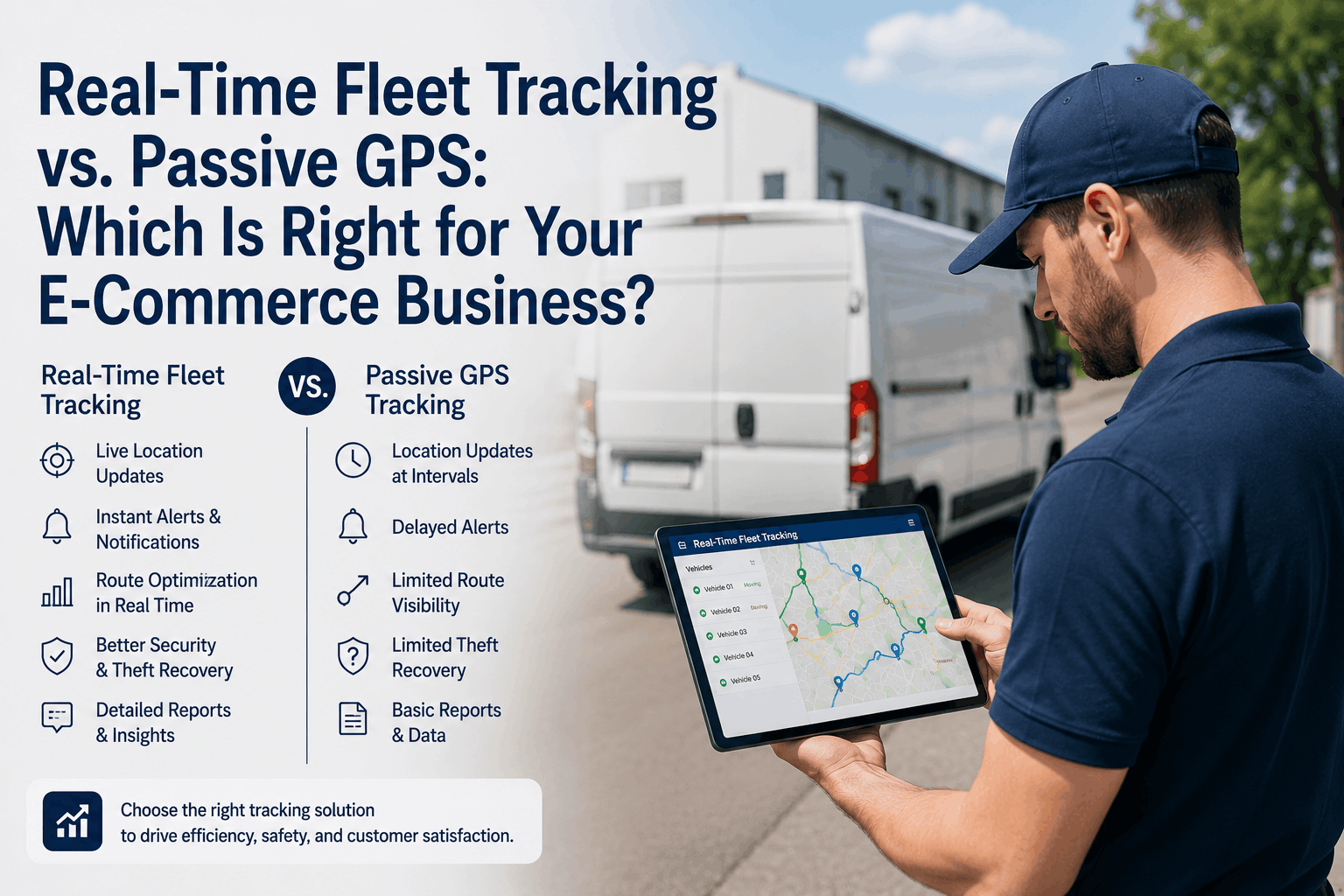
Real-time fleet tracking vs. passive GPS isn't just a technology decision — it determines whether your e-commerce delivery operation reacts to problems after they happen or prevents them before they cost you customers. For US logistics operations, the difference can mean the gap between a 94% on-time delivery rate and a 76% one. Real-time tracking gives dispatchers live vehicle positions every 10–30 seconds, dynamic rerouting capability, and instant alerts on driver behavior and vehicle health — passive GPS logs position data for post-shift review with no ability to intervene during the delivery window. Book a demo to see Fleet Rabbit's real-time tracking applied to your delivery fleet.
Quick Answer
Real-time fleet tracking wins for e-commerce operations running 10+ vehicles on daily delivery routes — live GPS, dynamic rerouting, and instant exception alerts prevent the cascade failures that passive GPS can only document after the fact. Passive GPS fits low-volume fleets (under 8 vehicles) doing predictable routes where post-shift review is sufficient. For US last-mile e-commerce delivery, real-time tracking delivers 18–24% improvement in on-time delivery rate, 22–30% fuel savings, and ROI within 45–60 days — capabilities passive systems structurally cannot provide.
The Core Difference: When the Data Reaches You
Every GPS system collects vehicle location data. The decisive difference is when that data reaches your dispatch team — and whether it arrives in time to act on it.
Passive GPS
Data Available: After the Shift
Passive GPS loggers store location onboard and upload via USB, Bluetooth, or cellular batch transfer at end of shift. Your dispatcher sees where every vehicle went — but only hours after the delivery window has closed. Exceptions and failures are documented, not prevented.
Update: End-of-shift uploadResponse: Post-event only
Real-Time Tracking
Data Available: Every 10–30 Seconds
Real-time tracking transmits live vehicle position, speed, and status to a cloud dashboard continuously. Dispatchers see every vehicle on a live map with current ETA accuracy, remaining stops, and active alerts — enabling rerouting and stop reassignment while deliveries are in progress.
Update: Every 10–30 secondsResponse: Real-time intervention
Head-to-Head: 8 Operational Dimensions
| Dimension | Passive GPS | Real-Time Tracking |
|---|
| Live Dispatch Visibility | ❌ Not available | ✅ Full live map, every vehicle |
| Dynamic Rerouting | ❌ Cannot reroute mid-shift | ✅ Instant reroute on incidents |
| Customer ETA Updates | ❌ Estimated at dispatch only | ✅ Live ETA from actual position |
| Driver Behavior Alerts | ❌ Post-shift log review | ✅ Instant harsh-brake alerts |
| Vehicle Health Monitoring | ❌ Not included | ✅ Engine fault alerts mid-route |
| Failed Delivery Prevention | ❌ Failure logged, not prevented | ✅ Reroute before window closes |
| Hardware Cost (per unit) | $30–$80 one-time | $80–$180 + subscription |
| ROI for 10+ Vehicle Fleets | ❌ Limited — data arrives too late | ✅ 45–60 day full payback |
When Passive GPS Is the Right Choice
Fleets Under 6–8 Vehicles on Predictable Routes
Owner-operators where the dispatcher has direct contact with every driver don't need continuous telemetry. Passive GPS provides compliance documentation and route review data without real-time subscription cost.
Unchanging Routes With No Customer Time Windows
Operations running identical routes daily — restocking runs, scheduled transfers — benefit from passive GPS for mileage tracking and driver accountability. When there's no need to reroute mid-shift, real-time visibility adds cost without operational value.
Insurance and IFTA Compliance as Primary Goal
For fleets where the primary GPS use case is IFTA fuel tax reporting or insurance premium reduction, passive GPS delivers the required data at lowest cost. US commercial insurers typically offer 10–15% premium discounts for GPS-tracked fleets regardless of technology type.
Non-Customer-Facing Routes Where Timing Is Flexible
Internal logistics — warehouse-to-warehouse transfers, supply runs — where delivery timing has no direct customer impact and no failure cost beyond delay. When a missed window doesn't trigger churn risk, real-time tracking's intervention capability isn't being utilized.
When Real-Time Tracking Is Non-Negotiable
For US e-commerce last-mile delivery, four operational realities make passive GPS structurally inadequate — a capability gap passive systems cannot close.
1
Customer Delivery Windows Create Real-Time Response Requirements
US e-commerce customers expect 2–4 hour delivery windows with live ETA updates. When a vehicle running 25 minutes late at stop 6 of 22 will miss windows at stops 14–18, passive GPS logs the failure post-shift. Real-time tracking enables a dispatcher to reassign those stops to a nearby vehicle completing early — preserving customer promises that static routing would have broken.
Example: Vehicle 7 hits a 40-min incident on I-405 at 2:15 PM. Real-time system alerts dispatch at 2:17 PM — 3 closing-window stops reassigned to Vehicle 12, 8 minutes away. Passive GPS logs the delay at shift end. No intervention possible.
2
Urban Traffic Volatility Requires Continuous Route Adjustment
US metro areas — Los Angeles, Phoenix, Dallas, Seattle — see 40–60% travel time variance between morning planning and afternoon peak. Routes planned at 7 AM dispatch are increasingly inaccurate by 1 PM. Real-time tracking integrates live traffic to continuously recalculate ETAs and flag routes falling behind. Passive GPS cannot update routes in progress — delay accumulates stop-by-stop.
3
Vehicle Breakdowns Mid-Route Cost 3–5x More Without Early Warning
A delivery van breaking down during the 2–6 PM peak fails 10–16 customer deliveries and triggers emergency towing at premium rates. Real-time OBD-II monitoring detects engine fault codes and developing mechanical issues 1–3 weeks before they strand vehicles. Passive GPS has no vehicle health monitoring; breakdowns are discovered when the driver calls, not before.
4
Scale Makes Manual Coordination Impossible Without Live Data
A dispatcher managing 20+ delivery vehicles cannot track route progress without live vehicle data. At 15+ vehicles, passive GPS forces reactive phone-based coordination. Real-time tracking scales dispatch capacity: one dispatcher with live visibility can manage 25–30 vehicles; without it, that number drops to 8–12 before coordination failures generate delivery failures.
Operational threshold: 10+ delivery vehicles on dynamic urban routes = real-time tracking is required, not optional.
Real-Time Fleet Tracking Platform
Live GPS + Route Optimization + Driver Analytics — One Platform for US E-Commerce Fleets
Fleet Rabbit combines real-time GPS visibility, AI-driven route planning, vehicle health monitoring, and delivery performance analytics — giving dispatch teams live data to prevent failures instead of just documenting them.
18–24%
On-Time Rate Improvement
The Real Cost Comparison: Total Ownership
Hardware price comparisons consistently underestimate total cost of ownership — and fail to account for the revenue impact of the capability gap.
Passive GPS: Lower Hardware, Higher Hidden Cost
A 20-vehicle fleet pays ~$60/unit = $1,200 one-time hardware. But passive GPS produces no fuel savings (no rerouting), no failed delivery reduction (no intervention), and no overtime elimination. On a 20-vehicle fleet with 8% failed delivery rate, the annual hidden cost of passive GPS's capability gap exceeds $180,000. The cheap logger is often the expensive choice.
Real-Time Tracking: Higher Subscription, Measurable Return
Fleet Rabbit on a 20-vehicle US fleet costs ~$140/vehicle/month — $33,600/year. Against that: 22–30% fuel savings ($28,000–$38,000/year), 28–35% fewer failed deliveries ($42,000–$58,000/year), and 15–20% more stops per shift ($31,000–$44,000/year). Total annual benefit: $101,000–$140,000 against $33,600 subscription. Full payback in 45–60 days.
The Unquantified Cost: Customer Churn From Delivery Failures
US e-commerce research shows 84% of consumers won't return after two bad delivery experiences. At a $180 average customer lifetime value on a 500-delivery/day operation, passive GPS's inability to prevent failed deliveries costs an estimated $52,000–$78,000/year in lost lifetime value — above and beyond direct re-delivery expense. Real-time tracking protects repeat purchase revenue that passive GPS cannot.
Decision Framework: Which Technology Fits Your Operation?
Choose Passive GPS If:
Your fleet has fewer than 8 vehicles. Routes are fixed and unchanging. Delivery timing is flexible with no customer-facing windows. Primary need is mileage documentation or insurance discount. Budget constraint is overriding.
Choose Real-Time Tracking If:
You operate 10+ delivery vehicles on dynamic daily routes. Customers receive delivery window commitments. Failed deliveries generate re-dispatch cost and churn risk. Dispatchers need visibility to intervene in route exceptions. Growth is planned.
The Upgrade Trigger:
If your fleet uses passive GPS and you experience dispatchers calling drivers for status updates, failed delivery rates above 5%, overtime on more than 20% of routes, or customer complaints about inaccurate ETAs — your operation has outgrown passive GPS.
Performance Results: Real-Time vs. Passive GPS
22–30%
Fuel Cost Reduction (Real-Time Only)
28–35%
Fewer Failed Deliveries
18–24%
On-Time Delivery Improvement
45–60
Days to Full Platform ROI
15–20%
More Stops Per Vehicle/Shift
18–25%
Lower Total Last-Mile Cost
Frequently Asked Questions
QCan I upgrade from passive GPS to real-time tracking without replacing hardware?
Most passive GPS hardware is not upgradeable to real-time cellular transmission — the architecture for store-and-upload logging differs from always-on cellular telemetry. Upgrading typically requires replacing devices entirely. For fleets planning to scale beyond 10 vehicles within 18 months, starting with real-time tracking avoids a second hardware investment and delivers ROI from day one.
QDoes real-time GPS tracking work reliably across the US where cellular coverage varies?
Fleet Rabbit's hardware stores location data locally during cellular dead zones and syncs automatically when connectivity resumes. For the vast majority of US urban and suburban delivery routes, cellular coverage is sufficient for continuous 10–30 second position updates. The dashboard shows last-known position during brief interruptions, distinguishing signal loss from vehicle stops to prevent false alerts.
QHow does real-time fleet tracking comply with driver privacy regulations in US states?
Fleet Rabbit is configurable for US state-level privacy compliance — including California CCPA provisions and states with employee monitoring disclosure requirements. Standard configuration tracks vehicles during defined work hours only, with automatic suspension outside shift hours. Fleet Rabbit's implementation team configures privacy settings during deployment to match your state's specific requirements.
QWhat's the minimum fleet size where real-time tracking ROI is justified over passive GPS?
For e-commerce last-mile delivery, the ROI crossover is typically 8–10 vehicles. Below 8, the dispatcher-to-vehicle ratio is low enough that phone coordination is manageable. At 10+, dispatchers lose awareness of all routes simultaneously — real-time tracking becomes the coordination layer that prevents failures at scale. Fleet Rabbit offers a free ROI calculation based on your fleet size, delivery volume, and current failed delivery rate before any commitment.
Related Fleet Rabbit Resources
The four AI capabilities transforming e-commerce fleet operations — real-time GPS visibility, predictive vehicle health monitoring, dynamic route optimization, and delivery performance analytics — with ROI data for each layer.
How route optimization attacks last-mile cost across ten dimensions — fuel, distance, failed deliveries, stop capacity, overtime, and predictive maintenance — with 18–25% total cost reduction for e-commerce operations.
AI-driven fault prediction and automated maintenance scheduling that prevents mid-route breakdowns — the vehicle reliability foundation that real-time tracking enables through continuous engine health monitoring.
How GPS hardware, IoT vehicle data, and cloud analytics combine to deliver real-time fleet visibility, predictive maintenance, and performance analytics — the technology infrastructure behind every tracking capability in this guide.
See Fleet Rabbit Real-Time Tracking in Action on Your Delivery Fleet
Fleet Rabbit's real-time fleet tracking platform delivers live GPS visibility, AI route optimization, vehicle health monitoring, and delivery analytics in one system — purpose-built for US e-commerce last-mile operations. Most fleets recover full platform cost within 45–60 days through fuel and failed-delivery savings alone.
Live GPS Every 10–30 Seconds
Dynamic Rerouting
22–30% Fuel Savings
Vehicle Health Alerts
45–60 Day ROI
May 25, 2026
By Lebron
All Posts