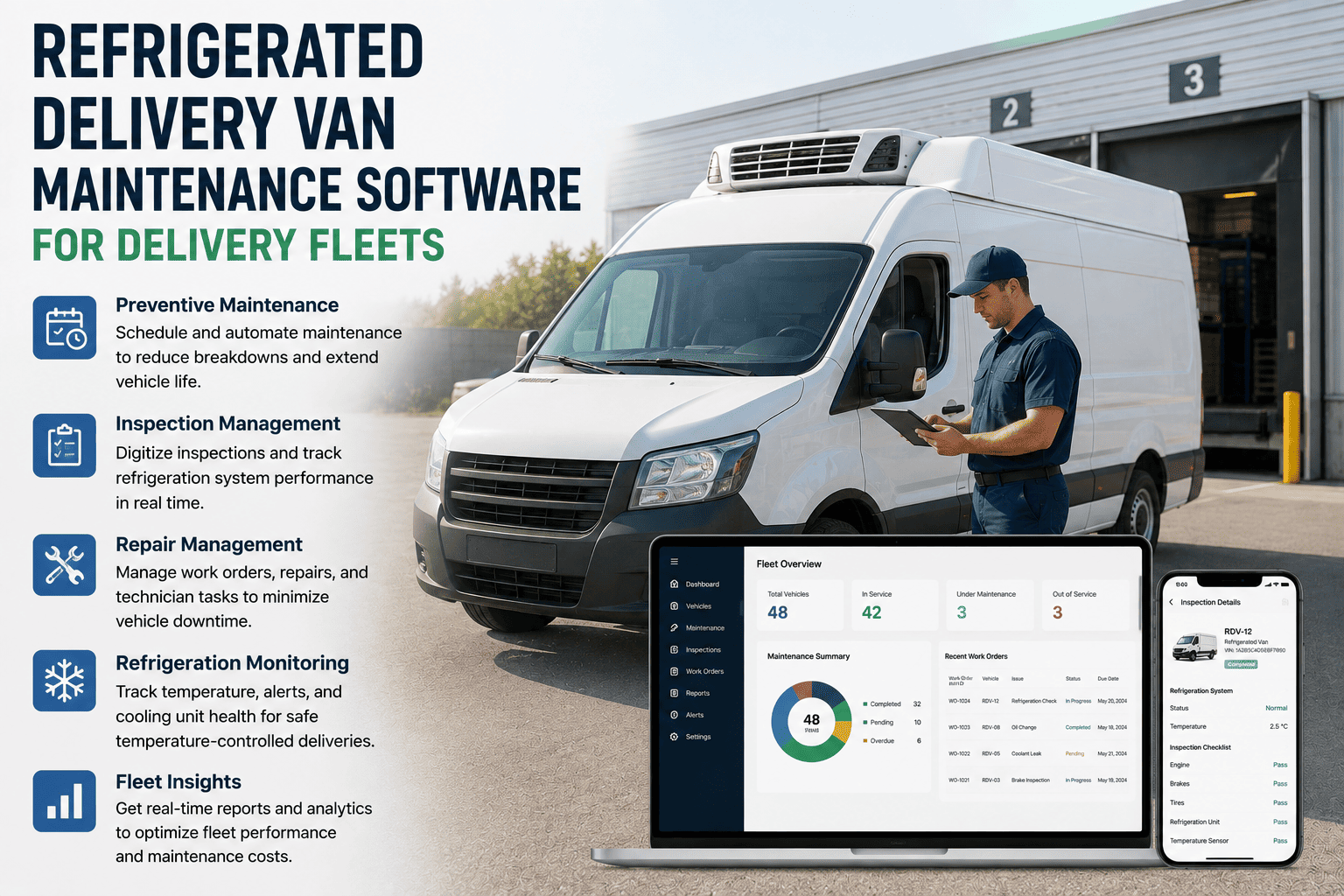
A reefer unit doesn't send a warning before it fails, it sends a spoiled load. Refrigerated delivery vans carry cargo with a shelf life measured in degrees and minutes, and a compressor fault that goes unnoticed for even an hour can turn a full route into a write-off. FleetRabbit's refrigerated delivery van maintenance software tracks the health of every reefer unit alongside the vehicle carrying it, so a failing compressor or a drifting temperature setpoint gets flagged before it becomes a rejected delivery. Fleets that sign up stop hearing about a failing unit from a customer complaint and start seeing it days in advance instead.
What one reefer failure actually costs
A single mid-route reefer failure rarely stays a single cost. It stacks: a roadside technician gets dispatched at premium labor rates, the van sits idle burning several hundred dollars a day in lost capacity, the cargo inside crosses its safe temperature band and is typically written off in full, and if the load was headed to a retailer or foodservice account, a rejected delivery often comes with a chargeback attached. For pharmaceutical or FDA-regulated freight, a documented temperature excursion can also trigger an audit finding that costs far more than the load itself. None of these costs are rare events, they're the default outcome of running reefer units without predictive monitoring, which is exactly why operators book a demo before their next peak season rather than after a failed one.
Two ways a reefer problem can play out
The same worn compressor part leads to two very different weeks, depending on whether anyone was watching it.
Without monitoring
With FleetRabbit
Catch the failure before it catches your cargo
Get reefer health, van maintenance, and delivery tracking on one screen for your whole fleet.
Audit-ready by default
Paper logs and end-of-shift temperature checks don't hold up when an auditor or a retailer asks for proof. FleetRabbit builds the record automatically, so the fleet is ready for review on any given day instead of scrambling before one. Operators who sign up get this running in the background from day one.
Continuous temperature logs
Every reefer zone is recorded on an ongoing basis, not spot-checked at pickup and delivery.
Maintenance history per unit
Service dates, parts replaced, and inspection results are tied to each reefer unit, not just the van.
Digital compliance records
Records are exportable on demand, ready for FDA, USDA, or retailer audit requests without a scramble.
Service interval tracking
Preventive maintenance windows are scheduled automatically based on usage, not a fixed calendar guess.
Built for fleets where a few degrees is the whole business
General fleet maintenance software treats a refrigerated van like any other vehicle, tracking oil changes and mileage while ignoring the one system that actually determines whether the delivery succeeds. FleetRabbit treats the reefer unit as a first-class asset alongside the engine, tracking its own maintenance history, its own service intervals, and its own failure patterns. Carriers hauling multi-temperature loads and e-commerce operators running their own cold delivery fleet both book a demo to see the same platform adapt to either setup, and most sign up once they realize how much of their current process is still running on paper.
of cold chain spoilage industry-wide is estimated to happen in the last mile, where monitoring is often weakest
Stop finding out about failures after the load is gone
See predictive reefer maintenance and audit-ready records working together on your own fleet.
Common questions about refrigerated van maintenance software
How does the software know a reefer unit is about to fail
It tracks sensor data and usage patterns from each unit over time, so gradual changes that usually precede a failure, like a slower cooldown or a rising compressor cycle count, get flagged well before the unit actually breaks down.
Does it replace our current maintenance schedule or work alongside it
It works alongside it and makes it more accurate. Fixed calendar-based service intervals get replaced with schedules based on actual usage and wear, so vans get serviced when they need it rather than on a generic timetable.
What records does it keep for audits
Continuous temperature logs, maintenance and service history per unit, and inspection records are all kept digitally and can be exported on demand for an FDA, USDA, or retailer audit request.
Can it monitor multiple temperature zones in one van
Yes. Multi-zone refrigerated vans are tracked with separate readings and logs per zone, so a mixed-temperature load doesn't lose visibility into any single compartment.
Will drivers need to change how they work
Very little. Monitoring runs in the background from the reefer unit and vehicle sensors, so drivers keep running their routes while the platform handles the logging and alerting on its own.
Is this only useful for large fleets or does it work for smaller carriers too
It scales either way. A small carrier running a handful of refrigerated vans and a large e-commerce cold delivery fleet use the same predictive maintenance and audit-ready record keeping, sized to how many units they run.
A refrigerated fleet that can see its own reefer units failing early is a fleet that stops losing loads to surprises. Book a demo and walk through what that looks like on your own vans.