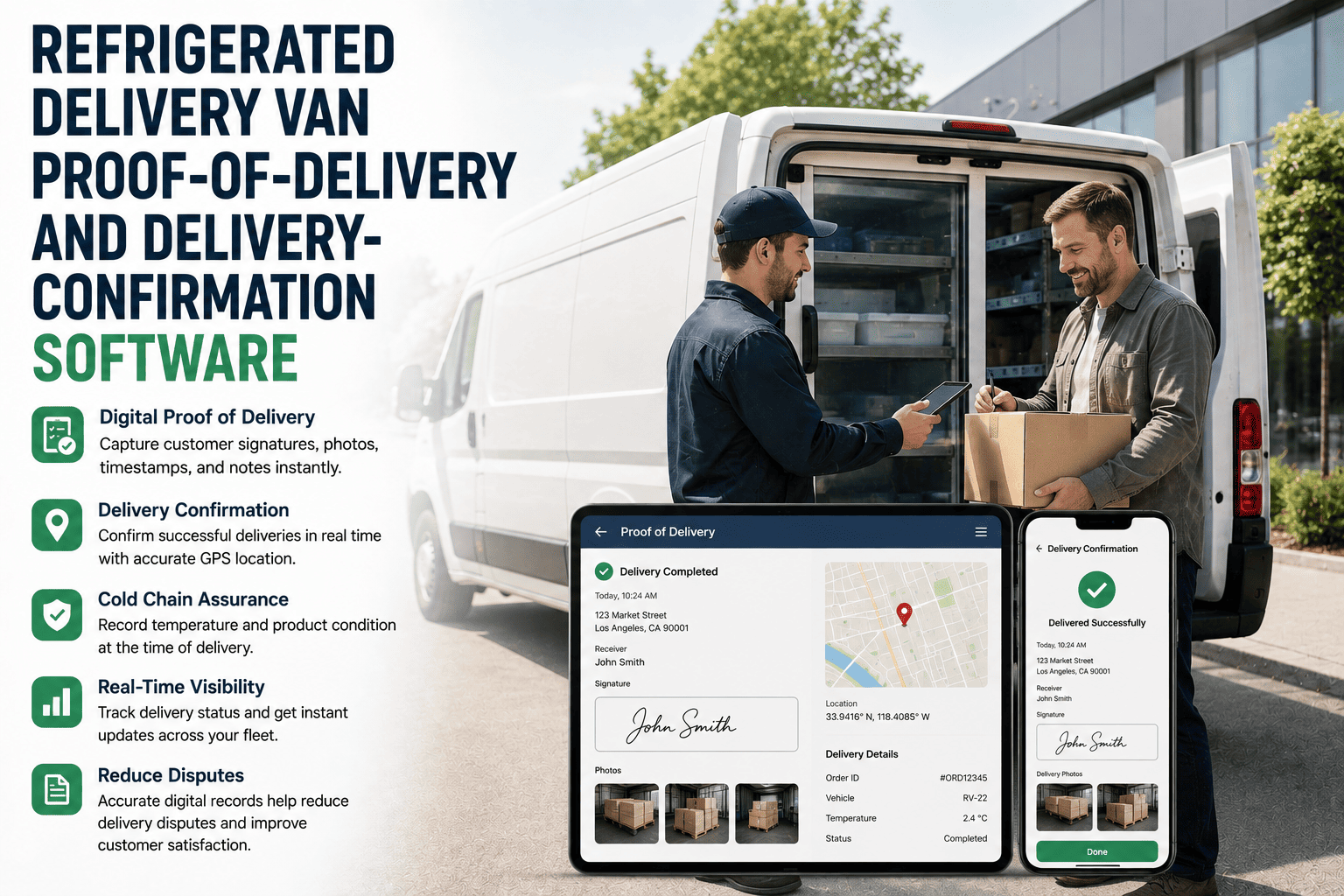
A grocery chain claims a pallet of chilled dairy arrived four degrees too warm and refuses to pay the invoice. The driver says the reefer was holding steady the whole route. Without a record that ties temperature, timestamp, and signature to that exact stop, the dispute drags on for weeks and the carrier usually eats the cost anyway. Refrigerated delivery van proof-of-delivery software exists to end that argument before it starts — turning every drop-off into a timestamped, temperature-backed record that both sides can trust.
Paper POD
Signature on a clipboard, no temperature tied to it
Disputes take days to trace back to a driver's memory
Delivery slips lost, faded, or never make it back to billing
Digital cold chain POD
Signature, photo, GPS location, and temperature on one record
Disputes resolved in minutes with a timestamped data trail
Every confirmation synced instantly to billing and the customer
Why refrigerated deliveries need more than a signature
Standard proof-of-delivery software was built for dry freight: get a signature, snap a photo, mark the stop complete. That works fine for a box of electronics. It falls apart for a pallet of seafood, because the real question at a cold delivery isn't just "did it arrive" — it's "did it arrive in spec." A driver can hand over the cargo perfectly on time and still get blamed for spoilage that happened an hour earlier from a door left open at a previous stop. Refrigerated delivery van proof-of-delivery software closes that gap by attaching the temperature and humidity history of the entire trip to the delivery record itself, not just the final handoff. Fleets that are still relying on a generic ePOD tool built for dry goods should sign up to see what a cold-chain-specific confirmation record actually looks like.
30%
of perishable shipments face some form of cold chain related loss in transit
4-7 days
to fully connect a mixed reefer fleet to a live tracking and POD platform
75 days
typical time to recover the full cost of onboarding a refrigerated fleet
What happens at the door, step by step
Arrival
GPS confirms the van reached the correct stop, logging arrival time automatically against the planned window.
Temperature check
The platform pulls the reefer's live reading and the full in-transit temperature log for that leg of the route.
Condition capture
Driver adds a photo of the cargo and any exceptions — short delivery, damaged pallet, partial rejection — right from the handheld app.
Sign-off
Digital signature or OTP confirmation from the receiver, tied to the exact GPS coordinates of the stop.
Instant sync
The complete record — location, temperature, photo, signature — pushes to dispatch and billing before the driver leaves the dock.
That last step is where most of the value shows up on the balance sheet. Delivery confirmation that used to take a driver's paperwork getting back to the office at the end of a shift now happens the moment a signature is captured, which means invoicing can start the same day instead of waiting on a stack of slips. Dispatchers who want to see how much time that saves their billing team can book a demo and walk through a real delivery record end to end.
What a cold chain POD record needs to hold up in a dispute
Continuous temperature history
Not a single reading at drop-off, but the full log from pickup to delivery, so a claim about "warm on arrival" can be checked against the whole trip.
GPS-stamped timestamps
Arrival and departure times tied to exact coordinates, closing the gap between what a driver logs and what actually happened on the ground.
Photo and condition notes
Visual evidence of the cargo's state at handoff, captured in seconds from the same app the driver already uses for the stop.
Digital signature or OTP
A verified receiver confirmation that can't be lost, faded, or disputed as forged the way a paper slip can.
Short-delivery and rejection flags
A structured way to record partial acceptance or on-the-spot rejection, instead of a scribbled note that gets misread back at the office.
Instant back-office sync
Every record lands in dispatch and billing in real time, so invoicing and customer notifications don't wait on a driver's return.
Stop losing arguments you were actually right about
Give every refrigerated delivery a record that proves what happened, from pickup to signature, on one connected platform.
The route-optimized side of delivery confirmation
Proof of delivery is only as useful as the route that gets a driver to the stop on time in the first place. When route optimization and delivery confirmation live on the same platform, a missed time window shows up immediately, not at the end of the week when a customer complaint arrives. Dynamic re-optimization keeps refrigerated vans moving through their planned stops as traffic and order changes happen through the day, which means fewer late arrivals for a dispatcher to explain and fewer disputes that start with "the delivery was hours late." Operations teams evaluating a switch can sign up to connect their existing routes and see confirmation data flow in from day one.
Predictive maintenance plays a quieter role in the same story. A reefer unit that's starting to fail shows up in the data well before it causes a temperature excursion, letting a fleet manager schedule a repair instead of discovering the problem through a rejected delivery. Paired with route-optimized scheduling and instant proof-of-delivery capture, that turns a fleet's delivery record from a defensive paper trail into a genuine operational advantage. Teams that want the full picture across a mixed fleet can book a demo and see predictive alerts alongside live delivery confirmations on the same screen.
38-52%
reduction in spoilage-related losses reported after connecting a fleet to live tracking and POD
44%
cut in refrigeration unit downtime through earlier fault detection
20-28%
lower fuel cost from route-optimized scheduling across the fleet
Frequently asked questions
What makes refrigerated delivery van proof-of-delivery software different from standard ePOD tools
It attaches the full in-transit temperature and humidity history to each delivery record, not just a signature and timestamp, so cold chain disputes can be resolved with data rather than a driver's word against a customer's.
Can a driver capture proof of delivery without an internet connection at the stop
Yes. Records are captured offline in the driver app and sync automatically once connectivity returns, so a dead zone at a rural drop-off doesn't mean a lost confirmation.
Does this replace our existing route optimization software
No replacement is required. Proof-of-delivery capture runs on the same platform as route-optimized scheduling, so arrival times, temperature data, and delivery confirmation all live on one dashboard instead of three separate tools.
How fast does a delivery record reach billing after signature
Delivery confirmation, including temperature history and signature, syncs to dispatch and billing in real time, which lets invoicing start the same day instead of waiting for paperwork to return to the office.
Is the temperature data admissible for resolving a spoilage claim with a customer
The continuous, timestamped temperature log tied to GPS location and the delivery signature gives fleets audit-ready evidence that holds up in most spoilage and short-delivery disputes, and the same record supports food safety compliance documentation.
How long does it take to get proof-of-delivery software running across a refrigerated fleet
A mixed fleet of refrigerated vans and trucks is typically fully connected within four to seven days, with drivers using the confirmation app on their normal routes from day one.