AI route optimization is reshaping last-mile delivery economics across California, Nevada, Arizona, Oregon, and Washington — where fuel costs and urban density make every dispatching decision worth thousands per month. A Los Angeles 3PL running 30 vans on manual dispatch burns 18–22% more fuel than optimized peers. A Phoenix courier missing dynamic reroutes pays $4,200 monthly in avoidable overtime. Fleet Rabbit's AI routing platform closes each gap — live traffic, delivery windows, vehicle capacity, and driver hours — across any fleet size, any OEM. Book a demo to see Fleet Rabbit's AI route optimization applied to your delivery fleet.
Quick Answer
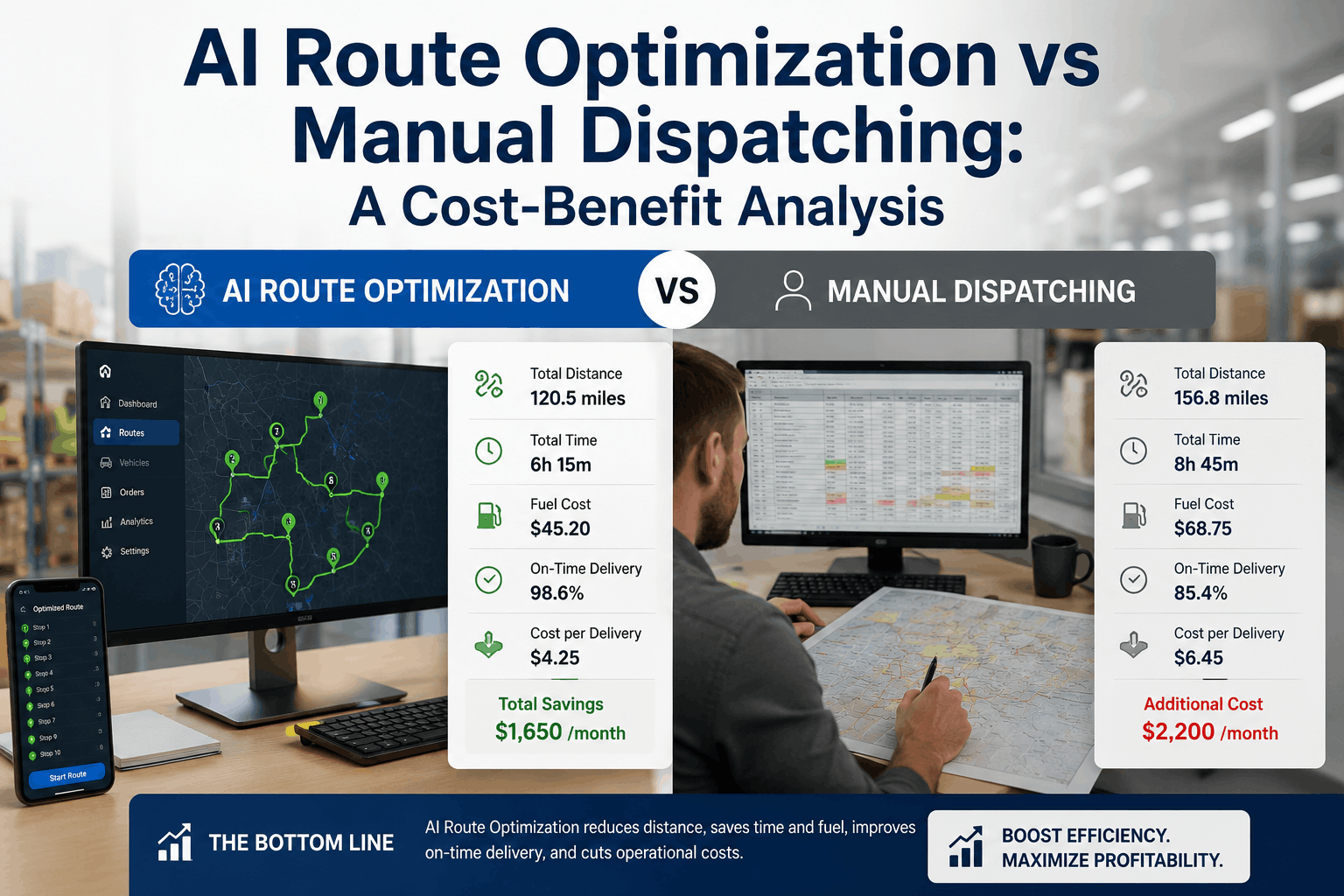
Manual dispatching costs Western US e-commerce fleets $3,500–$9,000 per month in excess fuel, overtime, and missed delivery windows. Fleet Rabbit's AI routing platform cuts miles driven by 18–26%, reduces overtime by 34%, and improves on-time delivery rates to 96%+ — with full ROI inside 30 days for fleets of 10 vehicles or more.
The Real Cost of Manual Dispatching in Western US Delivery Operations
A 25-vehicle fleet across Southern California or the Nevada corridor makes 600–900 routing decisions per week. Manual dispatchers miss traffic shifts, violate delivery windows, and underload vehicles by 15–22% — losses that accumulate invisibly until an AI audit exposes the pattern.
Overtime Labor
$4.1K
avg monthly loss / 25-vehicle fleet
Excess Fuel Burn
$2.8K
inefficient routes & backtracking
Failed Deliveries
$1.7K
redelivery costs & SLA penalties
Vehicle Underload
$1.1K
capacity wasted per dispatch cycle
AI Route Optimization vs Manual Dispatching — Head-to-Head
Manual Dispatching
Route planning time: 45–90 min/day
Fuel efficiency: 18–22% above optimal
On-time delivery rate: 74–82%
Vehicle load factor: 64–72%
Dynamic rerouting: Manual, 20–40 min lag
Monthly cost: $9,700–$18,400
Fleet Rabbit AI Routing
Route planning time: Under 3 min automated
Fuel efficiency: At or near optimal
On-time delivery rate: 94–97%
Vehicle load factor: 88–94%
Dynamic rerouting: Automatic, under 90 sec
Monthly cost: $5,200–$9,800
How Fleet Rabbit's AI Routing Engine Works
Live Traffic + Constraint Engine
Ingests real-time traffic, delivery windows, payload limits, driver HOS, and customer priority tiers — computing optimal multi-stop sequences in under 90 seconds for fleets up to 200 vehicles across all major Western US corridors.
Predictive Demand Modeling
Historical data and order forecasts train Fleet Rabbit's demand model — so dispatchers in Portland, Sacramento, and Las Vegas pre-position vehicles before morning surge. Reduces cold-start dispatch delays by 68%.
OEM-Agnostic Integration
Connects via OBD-II or CAN bus across Ford Transit, Sprinter, Isuzu NPR, Freightliner, and 50+ vehicle types. No hardware swap. A mixed California fleet of vans and box trucks runs in the same dashboard from day one.
Capability #1: Dynamic Rerouting — Respond in Seconds, Not Hours
Route Adjustment Response Time — AI vs Manual Dispatching
Fleet Rabbit platform data, Western US e-commerce delivery fleets 2024–2025. Manual dispatch misses 55–70% of mid-route optimization opportunities entirely.
1
Automatic Traffic Event Response
When a highway incident or closure alters travel times on an active route, Fleet Rabbit recalculates affected sequences within 90 seconds — pushing updated directions to drivers via mobile app. No dispatcher intervention required.
Los Angeles 3PL, 28 vans: Fleet Rabbit rerouted 14 vehicles around a SR-110 incident in under 2 minutes — recovering 22 delivery slots that would have missed windows.
2
New Order Insertion Without Full Replan
When an urgent order drops after routes are dispatched, Fleet Rabbit identifies the lowest-cost insertion point across all active drivers — accounting for current position, remaining capacity, and time windows — without forcing a full resequence.
Late order handlingCapacity matchingZero manual replan
3
End-of-Day Learning Loop
Fleet Rabbit logs every deviation between planned and actual routes, flags chronic delay zones, and feeds outcomes back into the predictive model — a Phoenix fleet running late on Camelback Road gets a smarter baseline by week three.
Seattle e-commerce courier, 5 active zones: On-time delivery rate rose from 79% to 96% in 38 days after Fleet Rabbit's model stabilized on local traffic patterns.
AI Route Optimization Platform
Cut Dispatch Costs 30–45% Across Your Western US Delivery Fleet — Free Trial, No Hardware Commitment
OEM-agnostic integration. Live on any vehicle in hours. Real-time routing, automated replanning, and full cost accountability from day one.
Capabilities #2–5: Load Optimization, HOS Compliance, Customer Visibility & Fleet Rightsizing
Capability #2: AI Load Sequencing — Maximize Every Cubic Foot
The problem: Manual dispatchers leave 22–28% of payload capacity unfilled — forcing extra vehicle deployments costing $180–$340 per unnecessary run.
Fleet Rabbit: Load order, stop sequence, and vehicle assignment are co-optimized together. A Phoenix courier running 60 stops no longer needs a second van because the AI packed the first to 91% capacity with LIFO stop ordering.
Western US impact: San Jose, San Diego, and Las Vegas routes see 24% average capacity improvement in the first 30 days.
Capability #3: Automated Hours-of-Service Routing
The problem: A California fleet on manual dispatch averages 1.8 HOS violations per month — each carrying $1,000–$16,000 in FMCSA fines. Manual dispatchers rarely model driver clock status into planning.
Fleet Rabbit: HOS remaining is a hard constraint in route generation. No sequence exceeds compliant hours. Break windows are embedded into stop timing automatically.
Oregon and Washington: State-level rest requirement overlays are baked in — multi-state Western US fleets stay compliant without dispatcher memorization.
Capability #4: Live ETA Sharing — Cut WISMO Calls 70%
The problem: "Where is my order?" calls cost Western US e-commerce operations $2.40–$4.80 per contact. A 25-van fleet generating 90 WISMO contacts daily spends $5,400–$10,800 monthly on inbound inquiry handling.
Fleet Rabbit: Customers receive live tracking links with AI-updated ETAs that recalculate as conditions change. Delivery confirmation with photo proof logs automatically to the order record.
Outcome: WISMO call volume drops 68–74% within the first billing cycle — savings alone often cover the platform cost.
Capability #5: Utilization Analytics — Know How Many Vehicles You Actually Need
The problem: 30–40% of Western US delivery fleets carry 2–4 vehicles deployed fewer than 3 days per week — each costing $1,800–$3,200 monthly in standing costs.
Fleet Rabbit: 90-day utilization reports by vehicle, zone, and order density give fleet managers data to right-size with confidence rather than gut feel.
Nevada and Arizona: Seasonal swings in Las Vegas hospitality logistics and Phoenix construction supply make utilization analytics especially high-value — dynamic rightsizing cuts standing costs 18–24% annually.
Results — 25-Vehicle Western US Delivery Fleet
Frequently Asked Questions
QHow does Fleet Rabbit handle same-day delivery windows in California urban zones?
Fleet Rabbit treats delivery time windows as hard constraints — no sequence violates a committed window. For same-day operations in Los Angeles, San Francisco, and San Diego, the platform supports rolling dispatch cycles every 30–60 minutes, inserting new orders into active routes without a full replan.
QCan Fleet Rabbit integrate with existing WMS or OMS platforms used by Western US 3PLs?
Yes. Fleet Rabbit connects via REST API to NetSuite, ShipBob, Extensiv, and custom systems common in California and Nevada 3PL operations. Order data, delivery windows, and proof of delivery flow bidirectionally — no manual re-entry.
QWhat happens when a driver calls out or a vehicle breaks down mid-route?
Fleet Rabbit's disruption engine redistributes affected stops across remaining active drivers based on current position and remaining capacity, pushing updated sequences in under 3 minutes — verified across California and Nevada operational data.
QHow long does onboarding take for a mixed fleet across multiple Western US locations?
A Fleet Rabbit specialist connects telematics and imports order data for a 25-vehicle fleet in 1–2 business days. Western US teams cover California, Nevada, Arizona, Oregon, Washington, and Colorado. Most fleets run their first AI-optimized dispatch cycle within 48 hours of kickoff.
Related Fleet Rabbit Resources
Real-time GPS, predictive health monitoring, dynamic route optimization, and delivery performance analytics — with ROI data for each capability.
AI-driven fault prediction and automated maintenance scheduling that prevents mid-route breakdowns across vans, box trucks, and delivery vehicles.
Utilization tracking, idle reduction analytics, and fleet right-sizing data that reduce total vehicle operating cost for Western US delivery operations.
How GPS hardware, IoT sensors, and cloud analytics combine to deliver real-time fleet visibility, predictive maintenance, and operational intelligence.
Switch from Manual Dispatching to AI Route Optimization — See Fleet Rabbit in Action
Fleet Rabbit's OEM-agnostic AI routing platform delivers dynamic rerouting, load optimization, HOS compliance, live customer ETAs, and fleet rightsizing analytics across your Western US delivery operation. On-premise or cloud. Any vehicle. Full ROI in 30 days.
OEM-Agnostic90s ReroutingHOS CompliantOn-Premise Option30-Day ROI
May 29, 2026
By Michael Finn
All Posts