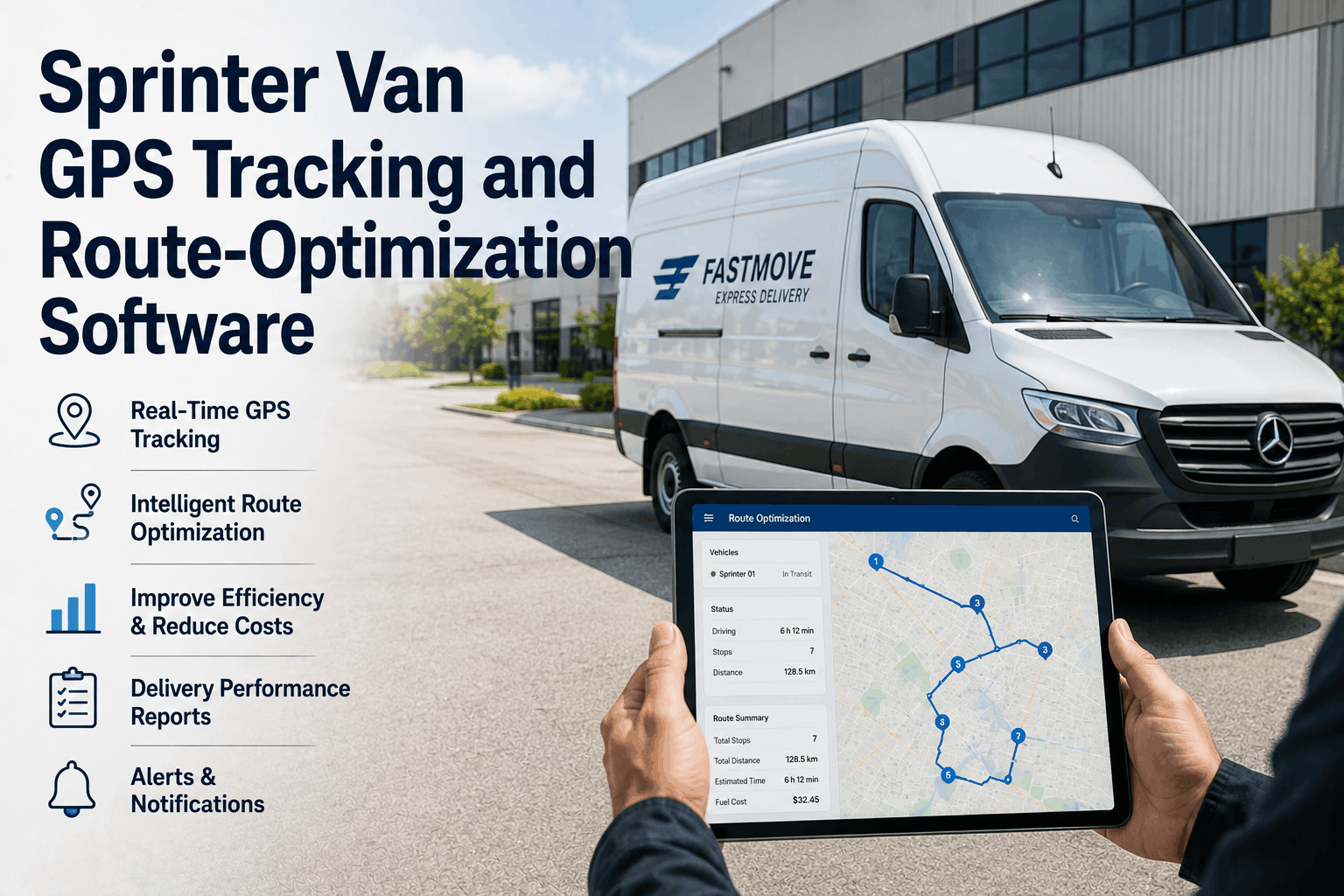
A Mercedes-Benz Sprinter is built to run for hundreds of thousands of miles, but that reputation only holds up when service intervals are actually tracked and acted on. Most carriers running Sprinter fleets don't lose uptime to a single catastrophic failure — they lose it to a mileage threshold that slipped past unnoticed, a fault code nobody saw until the van was already stranded, or a service window that got skipped because dispatch didn't know it was coming. Sprinter van GPS tracking software closes that gap by turning live location and engine data into a maintenance schedule that runs itself. If uptime has been slipping on your routes, you can sign up free and see your fleet's real service status today.
Why uptime is the real metric behind every sprinter van route
A Sprinter parked in a shop instead of on a route isn't just an idle asset, it's every stop behind it going late, reassigned, or missed entirely. For last-mile carriers running tight delivery windows, that ripple effect is often more expensive than the repair itself. Sprinter van GPS tracking software for last-mile carriers exists specifically to catch the warning signs early enough that a service visit gets scheduled around the workday instead of interrupting it.
None of that comes from the tracker alone. It comes from what the fleet does with the data underneath it, which is exactly why carriers evaluating a switch usually find it worth it to book a demo before locking in a plan.
How a fault code turns into a scheduled fix, not a roadside call
Sprinter vans report engine and system data continuously over OBD-II. On their own, those codes just blink a dashboard light the driver may not notice until it's serious. Paired with GPS tracking software, the same signal becomes something dispatch can act on before it becomes a breakdown.
Engine reports a fault
Sensor data flags an issue, from a dropping fluid level to unusual sensor readings.
Mileage meets the schedule
The platform compares live mileage against the van's Service A or B interval automatically.
A work order is raised
Dispatch sees the alert against the live route map, not buried in a separate report.
Service happens on a plan
The van gets routed to the shop between deliveries, not abandoned mid-route.
That's the difference between reactive tracking and sprinter van GPS tracking software built around uptime: the alert reaches someone who can act on it while the van is still moving, not after it has stopped moving for good. Set this up on your own fleet by choosing to create a free account and connecting your first Sprinter.
Turn every fault code into a scheduled fix, not a roadside call
Connect your Sprinter fleet and let live mileage and diagnostic data drive your maintenance calendar automatically.
Tracking software that respects service A and service B
Sprinter vans run on a defined two-tier service rhythm, alternating a lighter Service A visit with a more thorough Service B visit roughly every 10,000 to 20,000 miles depending on the model year and duty cycle. A fleet tracking system that ignores this rhythm just adds another dashboard to check manually. One built for Sprinter van GPS tracking software syncs directly to it, so a van approaching its next window shows up on the dispatcher's map before it's overdue.
Because the trigger is live odometer data instead of a paper log, a van that runs heavy stop-and-go city routes gets flagged sooner than one running lighter highway stretches, exactly as the duty cycle demands. It's worth seeing this mapped against your own vans, and the fastest way is to talk to our team about your current service records.
What carriers actually need from a tracking platform
For carriers moving freight or last-mile parcels in Sprinter vans, GPS tracking has to answer more than "where is the van." It has to protect cargo, hold up in an audit, and give dispatch something faster than a phone call. That's the bar sprinter van GPS tracking software for carriers has to clear.
Cargo and asset security
Geofenced alerts flag a van leaving an assigned zone or route, catching unauthorized detours or theft attempts early.
Audit-ready records by default
Mileage, stop times, and service history are logged automatically, so inspection or dispute requests don't turn into a records hunt.
Live ETA sharing
Dispatch and customers see arrival windows that update against real traffic instead of a static estimate set that morning.
Fleet-wide uptime view
A single dashboard rolls up every van's mileage, fault status, and next service window across the whole carrier network.
Carriers running mixed fleets of Sprinters alongside other van classes don't need to run separate systems for tracking and maintenance. One dashboard covering both is the whole point, and you can put it in front of your own fleet data the moment you sign up for a free workspace.
Keep every sprinter van on the road, not in the shop
Live GPS tracking, automatic service alerts, and audit-ready records, running from the same dashboard as your routes.
Sprinter van GPS tracking software, answered plainly
Does this replace the Sprinter's built-in maintenance computer
No, it works alongside it. The onboard computer tracks mileage and time for the vehicle itself, while the tracking platform pulls that same data into fleet-wide dispatch and reporting, so a manager sees every van's status in one place instead of checking each dashboard individually.
How early do fault code alerts actually reach dispatch
Alerts surface as soon as the van reports the code, layered directly onto the live route map, so a dispatcher can decide whether to route the van to a shop that day rather than finding out after a breakdown.
Can it handle a mixed fleet of sprinter vans and other vehicle types
Yes. The platform is built to track mileage, faults, and routes across different van and truck classes from a single dashboard, which matters for carriers who rarely run one vehicle type exclusively.
What counts as audit-ready for a carrier
Automatically logged mileage, stop times, geofence events, and service history that can be pulled up on demand, without a manager reconstructing records from paper logs or scattered spreadsheets.
Will this help reduce unplanned downtime specifically
That's the core design goal. By tying live mileage and fault data to the Sprinter's own Service A and B rhythm, the platform is built to catch a service window before it's missed, which is what prevents most unplanned roadside stops.
How do I see this against my current fleet records
Sign up and connect a van directly, or book a short walkthrough where our team maps your current service history against live tracking data.