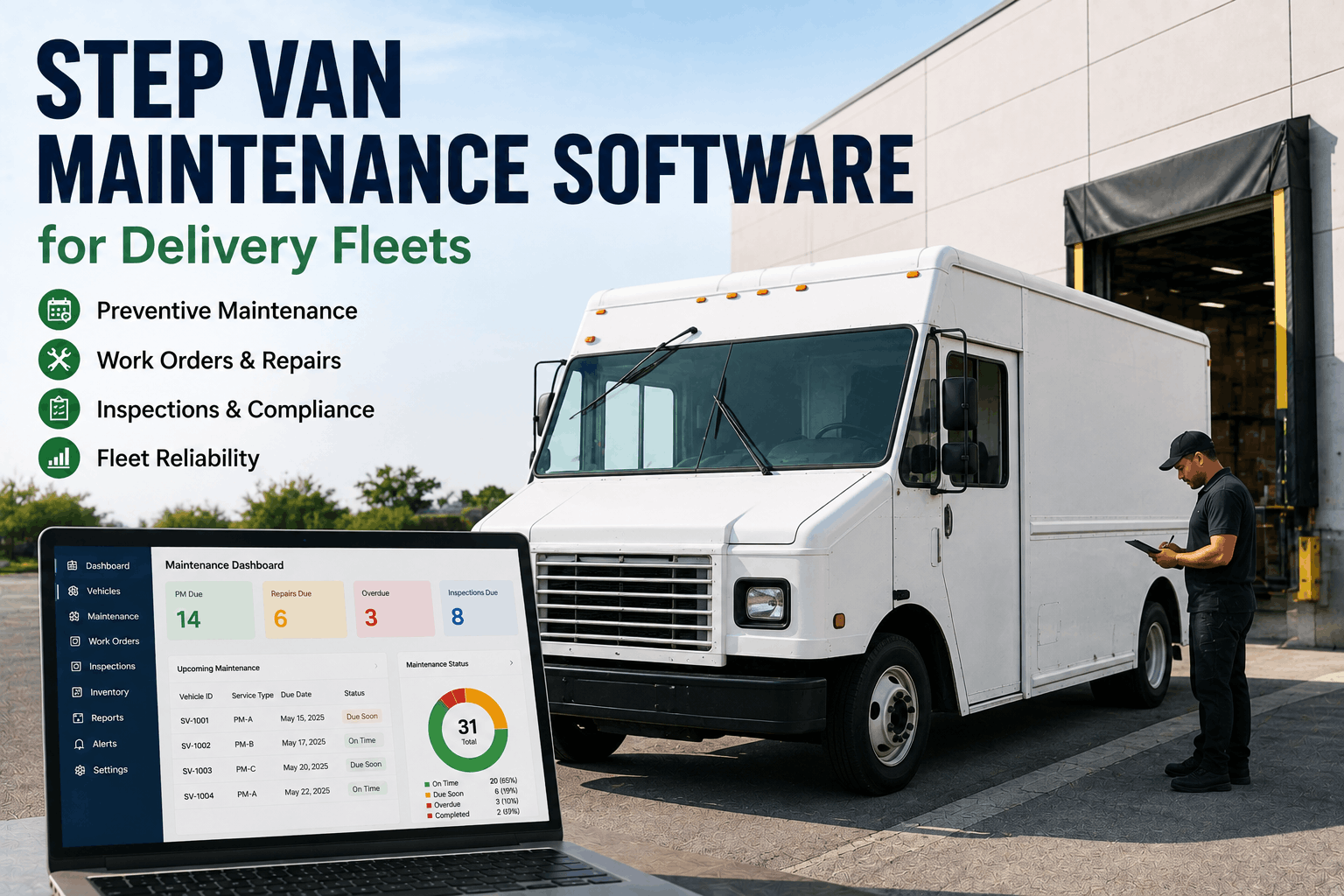
A step van rarely drives far in a single stretch. It creeps forward a block, stops, idles while a driver hops out and back in, then repeats that cycle sixty or more times before lunch. That stop-start rhythm is exactly what wears a step van down faster than almost any other vehicle in a delivery fleet, and it is exactly what most maintenance schedules were never designed to account for. Step van maintenance software exists to track that real duty cycle instead of a generic mileage chart, and it is quickly becoming the difference between a fleet that plans ahead and one that reacts to breakdowns.
stop-start cycles a single step van can complete in one delivery shift
more brake and transmission wear than a typical highway-driven van sees over the same mileage
average cut in unplanned roadside calls once predictive scheduling replaces fixed intervals
The duty cycle that makes step vans wear differently
Step vans are built for constant entry and exit, walk-in cargo areas, low step heights, and frequent idling at the curb. Every one of those design choices that makes a driver's day easier also adds mechanical stress that a standard highway maintenance schedule simply does not account for. Brakes wear faster from constant stopping, transmissions shift more often per mile than any long-haul vehicle, and door and step mechanisms see more daily cycles than most vehicle parts are rated for. Fleets that keep running fixed, calendar-based service on this kind of vehicle usually find out the hard way that a step van's real wear pattern looks nothing like a brochure schedule, which is why so many are choosing to sign up for software built around actual duty-cycle data.
Brakes and transmission
Constant stop-start driving pushes these components through wear cycles far faster than mileage alone would suggest.
Doors and step mechanism
Every stop means an entry and exit cycle, and those moving parts need their own tracked service life.
Idle time and battery load
Long curbside idling periods add engine hours that a distance-based schedule never captures.
Suspension and tires
Frequent loading, unloading, and curb approaches add stress that steady highway driving would not.
Track the wear your step vans actually see
Move from fixed service intervals to a schedule built around real stop-start duty cycles, route data, and proof-of-delivery.
What step van maintenance software needs to get right
A platform built for long-haul trucks or passenger fleets will miss the parts of a step van's day that matter most. The right software is built around the reality of multi-stop, curb-heavy delivery work.
Predictive maintenance
Brake wear, transmission cycles, and idle hours are tracked continuously, so a fault is flagged while there is still time to plan around it instead of after a van stalls on route.
Route-optimized scheduling
Service windows are placed inside natural breaks in a route, so a van never has to leave a delivery zone mid-shift to sit in a service bay.
Proof-of-delivery, connected
Delivery confirmations and vehicle condition data live in the same record, so a late stop and a mechanical flag never need separate investigations.
Fleet-wide uptime view
Every van's health, from brake wear to door cycle count, is visible from a single dashboard, whether a fleet runs ten step vans or a thousand.
Fleets that move to this kind of connected approach usually describe the same change: fewer emergency calls mid-route, and a maintenance team working from real wear data instead of a printed calendar. That shift is often reason enough to book a demo before the next round of route planning.
A day in the life of a monitored step van
Brake condition, tire pressure, and door mechanism status are checked before the van leaves the depot, so only cleared vehicles head out.
Every stop, idle period, and brake application is logged in the background and compared against expected wear patterns for that van.
Delivery data, proof-of-delivery confirmations, and any flagged components come together, ready to shape tomorrow's schedule.
Wear history builds a clear picture of which vans are aging faster than others, long before a breakdown forces the conversation.
Before and after a switch to condition-based service
Fixed-interval scheduling
Condition-based scheduling
None of this requires a full fleet overhaul on day one. Most delivery operations start by connecting a handful of step vans, watching how the platform performs across a few real weeks of routes, and expanding once the pattern holds. Fleets that want to see this against their own vans usually find it faster to just sign up and run a live comparison.
Questions worth asking before choosing a platform
- Does it track brake and transmission wear from actual stop-start data, not just mileage
- Can service windows be planned around real delivery routes instead of fixed depot slots
- Is door and step mechanism wear tracked as its own service category
- Is proof-of-delivery connected to vehicle condition, or logged separately
- Can a fleet manager see every van's status without switching between tools
Fleets that already answer yes to most of these are ahead of the curve. If your current process still runs on a fixed calendar and a paper log, the fastest way to see the difference is to book a demo and walk through your own step van data live.
Keep every step van on the road longer
FleetRabbit brings predictive maintenance, route-optimized scheduling, and proof-of-delivery together for step van fleets, live in days, not months.
Frequently asked questions
How is step van maintenance software different from regular fleet software
It tracks the wear patterns specific to constant stop-start delivery work, brake cycles, transmission shifts, door and step mechanism use, and idle time, rather than treating every mile the same way a highway-driven vehicle would.
Will it work with the step vans we already operate
Yes. The platform connects to existing telematics hardware across most major step van models, so fleets can onboard current vehicles without waiting on a new purchase cycle.
How long does setup take for a full fleet
Most fleets are live within days. Vans connect through existing telematics, historical service records import in bulk, and the dashboard is ready to use from the first day.
Can route-optimized scheduling really avoid pulling a van off its route
Yes. Service windows are placed inside natural breaks already built into a route, so a van gets serviced without abandoning stops it is already committed to that day.
Is proof-of-delivery data included, or a separate system
Proof-of-delivery lives inside the same platform as maintenance data, so a delivery exception and a vehicle condition flag can be reviewed together instead of chased separately.
Does this scale for both small and large step van fleets
Yes. A ten-van local operation and a fleet running hundreds of step vans across multiple depots both work from the same core dashboard, sized to fit the operation.