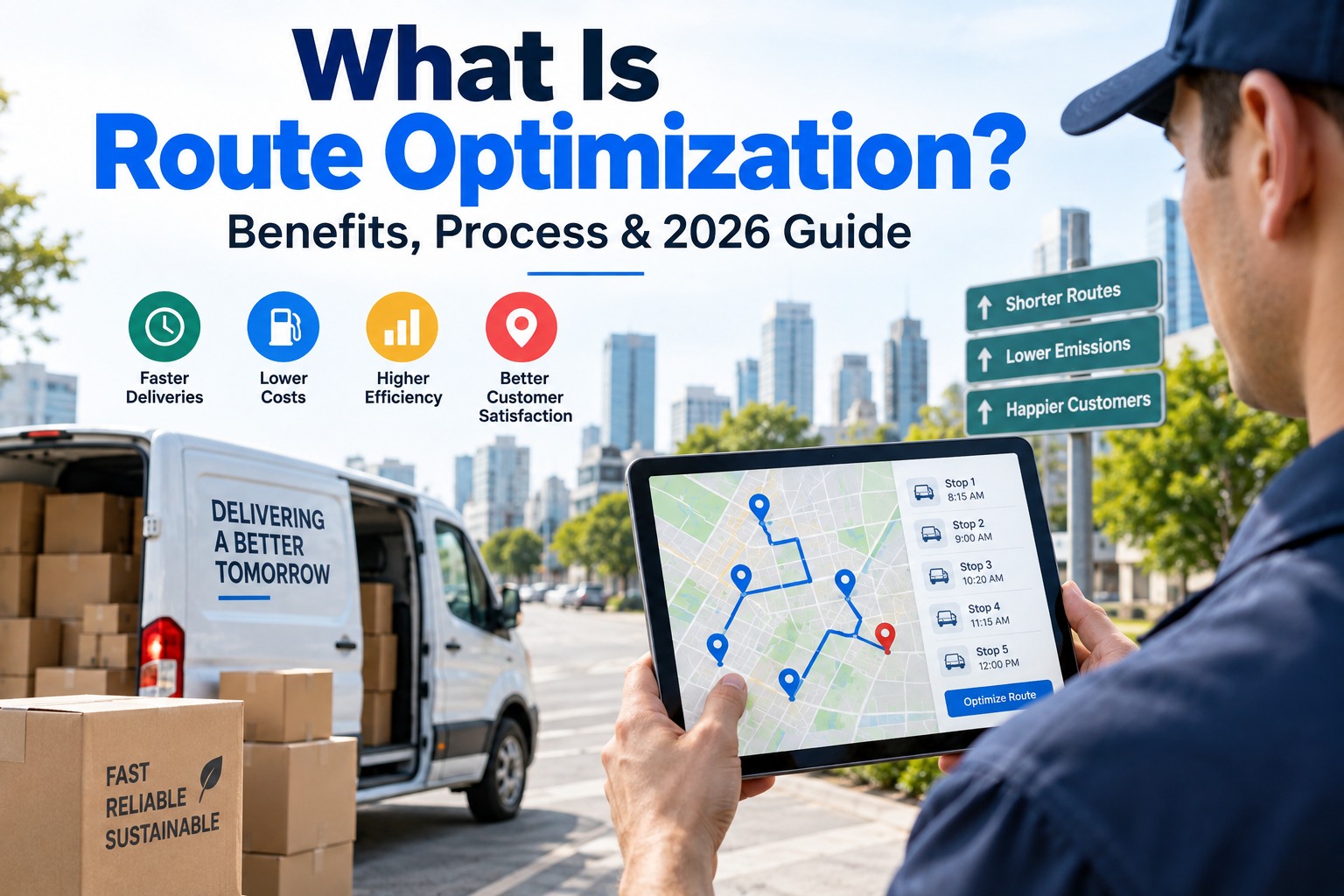
Modern parcel delivery networks, e-commerce fulfillment carriers, and retail distribution fleets navigate severe economic pressures: rising driver payroll, unpredictable urban traffic congestion, tight customer delivery appointment windows, and strict commercial safety standards under DOT 49 CFR Part 396. At its core, route optimization is the mathematical and operational process of determining the most cost-effective path for a fleet of vehicles to visit a specific sequence of stops while balancing real-world constraints such as delivery time windows, vehicle load capacities, driver hours of service (HOS), and curbside dwell times. True route optimization goes far beyond basic point-to-point GPS navigation or sequential address sorting; it solves complex vehicle routing problems (VRP) by analyzing multi-variable algorithms in real time. When dispatchers rely on manual territory planning, static paper manifests, and consumer navigation apps, delivery drivers end up crisscrossing city corridors, accumulating excessive deadhead mileage, burning unnecessary fuel, and missing promised delivery timeframes. FleetRabbit provides modern delivery route optimization software that integrates dynamic dispatching, turn-by-turn mobile directions, proof-of-delivery (e-POD), and automated vehicle pre-trip eDVIRs into a single command platform priced at $5 per asset per month. Protect your operating margins, eliminate unnecessary mileage, and maintain continuous navigation and delivery execution completely offline inside concrete parking decks, multi-story basement docks, and rural delivery dead zones with zero cellular connectivity. Learn how our software streamlines your delivery routes when you book a demo or start testing our cloud platform immediately when you sign up for our platform.
Discover how algorithmic route planning transforms delivery operations. Move beyond simple GPS turn-by-turn navigation to dynamic multi-stop sequencing, automated capacity balancing, real-time traffic adaptation, and predictive curbside dwell modeling that lowers cost-per-stop by up to 28%.
How Modern Route Optimization Algorithms Actually Work
Route optimization is not merely finding the shortest line between two GPS coordinates; it resolves the classic Vehicle Routing Problem (VRP) by running multiple algorithmic constraints simultaneously across your entire fleet.
Geocoding & Address Validation
Raw manifest stop addresses are standardized, verified, and converted into precise latitude/longitude coordinates, identifying specific loading docks and service alley entrances rather than generic curbside centerlines.
Multi-Constraint Solving
The mathematical solver calculates millions of routing permutations, cross-referencing vehicle payload weight, cubic volume limits, delivery appointment windows, and driver maximum shift durations.
Dynamic Clustering & Sequencing
Stops are grouped into geographical clusters that minimize transit stem-time from the distribution center, sequence stops in optimal delivery order, and eliminate overlapping territory assignments.
Live Telematics Re-Optimization
As drivers complete stops, real-time traffic updates, delivery delay exceptions, and urgent on-demand pickup insertions trigger automated mid-route recalculations to preserve delivery windows.
The 4 Tangible Benefits of Automated Delivery Route Planning
Transitioning from manual route planning to dynamic algorithmic dispatch delivers measurable, compounding savings across last-mile delivery operations. Review our operational ROI models when you book a demo with our logistics engineers.
20% to 30% Reduction in Mileage & Fuel Spend
By eliminating overlapping territory loops, reducing non-revenue deadhead transits, and avoiding high-congestion urban corridors, optimized fleets cut total vehicle miles traveled, directly lowering fleet diesel and gasoline expenses.
Higher Delivery Density & Stops Per Hour
Sequencing deliveries based on realistic curbside dwell times and clustering adjacent stops allows couriers to complete 15% to 25% more deliveries per shift without pushing drivers into unauthorized overtime payroll.
Accurate Customer ETAs & Lower SLA Penalties
Dynamic calculations factoring in historical unloading times produce narrow, accurate delivery windows. Automated notifications keep recipients informed, slashing failed first-attempt deliveries and protecting merchant service contracts.
Reduced Vehicle Wear & Lower Maintenance Costs
Eliminating unnecessary mileage and stop-and-go traffic idling reduces wear on braking friction linings, steer tires, and transmission clutches, extending vehicle operational lifespans and preventing midday mechanical breakdowns.
Built for High-Frequency Commercial Delivery Fleets
FleetRabbit connects algorithmic multi-stop route sequencing, mobile driver directions, barcode proof-of-delivery, and vehicle health monitoring into an integrated operations platform. See our platform in action when you sign up for a 14-day free trial.
Multi-Stop Algorithmic Sequencing
Automatically sequences up to hundreds of delivery stops per vehicle in seconds, balancing package volume, payload weight limits, and narrow customer appointment timeframes.
Predictive Curbside Dwell Modeling
Calculates realistic dwell allowances based on property category: distinguishing quick single-family home drops from complex multi-story commercial high-rise elevator deliveries.
eDVIR Defect Dispatch Lockout
Vehicles tagged with critical mechanical defects on morning pre-trip walkarounds—such as worn brake linings or damaged tires—are automatically locked from receiving route manifests.
Basement Dock Offline Mobile Sync
Drivers navigate stop manifests, scan package barcodes, take photo proof-of-delivery, and capture signatures inside underground concrete parking structures with zero cell reception.
Automated Geofenced Recipient Alerts
Transmits live tracking links and automated SMS alerts to recipients when the delivery vehicle enters a 1-mile geofence perimeter, ensuring loading docks and receiving doors are cleared.
Real-Time Cost-Per-Stop Analytics
Calculates fully-burdened cost-per-stop in real time, blending driver wages, fuel burn, and vehicle depreciation down to the specific route, driver, and geographic territory.
Direct Mapping to Federal Commercial Transportation Rules
Effective route optimization must maintain strict compliance with federal motor carrier safety standards, labor guidelines, and vehicle maintenance rules.
Enforces driver shift limits, statutory 30-minute rest breaks, and 14-hour on-duty windows, ensuring algorithmic route sequences do not force drivers into non-compliant operations.
Standardizes daily pre-trip/post-trip eDVIR walkarounds (§ 396.11), qualified mechanic corrective action signatures (§ 396.13), and statutory 90-day electronic maintenance record retention.
Correlates package payload tonnage with vehicle carrying capacity across steer and drive axles, ensuring delivery vans operate safely within statutory gross vehicle weight limits.
Maintains verified electronic shift records, actual driving timestamps, and automated route pacing logs to substantiate driver payroll records and defend against unverified wage claims.
Route Planning & Optimization Software Comparison
A feature-level comparison evaluating route optimization accuracy, dispatch gating, and offline mobile resilience as of 2026. Schedule a personalized walkthrough when you book a demo with our team.
| Optimization Capability | FleetRabbit | Legacy Enterprise Fleet CAD | Basic Telematics Portals | Consumer Navigation Apps |
|---|---|---|---|---|
| Pricing (per asset/month) | $5/month flat | $35–$70/month | $15–$30/month | Free / Consumer ads |
| Dynamic Multi-Stop VRP Solver | Automated capacity & time windows | Requires expensive add-ons | Basic point A-to-B only | Sequential manual input only |
| Defect Dispatch Safety Lockout | Instant block on eDVIR defect | Manual supervisor note | Not supported | None |
| Curbside Dwell Time Heatmapping | Property-level pacing radar | Manual driver tap only | Raw stop ping only | None |
| Basement Dock Offline Mobile Sync | Full store-and-forward | Network connection required | Data dropped offline | Offline maps only |
| Free Trial Access | 14 days, up to 3 assets | Sales demonstration only | Limited sandbox demo | Free trial |
| Contract Terms | Monthly or annual (No lock-in) | 36 to 60-month mandatory lock-in | 24 to 36-month contract | None |
5-Step Route Optimization Rollout Pathway
FleetRabbit embeds cleanly into your delivery operations, dispatch desks, and driver mobile devices in under two weeks without logistics disruptions. Begin testing immediately when you sign up for a free trial.
Fleet Roster & Vehicle Capacity Ingestion
Import delivery vans, step-vans, payload weight ratings, cubic volume limits, driver wage scales, and depot geofences via one-click CSV mapping or direct API integration.
Delivery Window & Dwell Buffer Setup
Configure appointment window tolerances, expected curbside dwell allowances by property type, customer notification rules, and early-warning delay alert thresholds.
Inspection Checklist & Lockout Setup
Configure digital eDVIR walkaround checklists tailored to delivery operations, establishing automated dispatch blocks for safety-critical brake, tire, or steering defects.
Drivers Mobile BYOD Rollout
Equip last-mile couriers with the offline-first mobile app on standard iOS or Android smartphones for turn-by-turn navigation, barcode scanning, and e-POD captures.
Algorithmic Dispatch Go-Live
Activate live route sequencing, dynamic mid-route re-optimization, curbside dwell heatmaps, cost-per-stop dashboards, and 1-click DOT compliance archives.
2-Week Deployment Plan & Milestones
A structured timeline designed to transition delivery operations to automated route optimization with zero disruption to daily package manifests. Review our full onboarding plan when you book a demo today.
Week 1: Data Integration & Algorithm Tuning
- Import vehicle rosters, driver profiles, and route manifest schemas via automated CSV tools
- Set up dynamic route constraints: vehicle volume limits, time windows, and dwell buffers
- Configure mobile pre-trip inspection walkarounds and proof-of-delivery barcode workflows
- Assign user access permissions for Fleet Directors, Shop Foremen, and Route Drivers
Week 2: Field Rollout & Live Verification
- Distribute mobile app to drivers and conduct 15-minute training on digital routing and e-POD
- Validate store-and-forward offline syncing inside concrete basement loading docks
- Simulate a traffic delay to verify dynamic mid-route recalculation and automated ETA alerts
- Launch live fleet analytics dashboard, cost-per-stop tracking, and client SLA compliance archives
Optimize Your Delivery Routes and Lower Cost-Per-Stop in Less Than 2 Weeks
Cut vehicle mileage by up to 25%, eliminate manual route planning, and maintain 100% on-time delivery execution at $5/asset/month with a 14-day free trial.
Real-World Route Optimization Results
Operational improvements documented by commercial delivery fleets who deployed algorithmic route optimization software. Review the complete delivery case study when you book a demo with our team.
24.6% Mileage Trimmed Across 65 Delivery Vans
A regional parcel carrier managing 65 delivery vans struggled with overlapping route territories and mounting driver overtime payroll. FleetRabbit deployed dynamic multi-stop sequencing and curbside dwell modeling, reducing total fleet mileage by 24.6% and cutting $86,000 in monthly fuel and overtime expenses in year one.
18% More Stops Completed Per Driver Shift
An urban delivery contractor operating 40 cargo vans faced heavy congestion and delayed afternoon drop-offs. FleetRabbit introduced dynamic clustering and mobile offline e-POD, increasing average completed deliveries from 110 to 130 stops per driver shift without adding overtime hours.
When you run a last-mile delivery business with sixty vans on the road every morning, route planning is the single biggest factor that determines whether you make a profit or lose money. For years, our dispatchers spent two hours every morning trying to manually balance territory manifests, and our drivers were still crisscrossing each other's paths and getting stuck in afternoon gridlock. Before FleetRabbit, our average cost per delivery was creeping past three dollars a stop. FleetRabbit revolutionized our entire dispatch operation. It takes our daily manifests, calculates the exact optimal delivery sequence in seconds, accounts for our vehicle weight capacities, and gives our drivers turn-by-turn directions that work even inside underground parking decks. It cut our fleet mileage by nearly twenty-five percent, trimmed our fuel bill, and lowered our cost per stop dramatically. It paid for itself within the first three weeks.
Frequently Asked Questions
Take Control of Your Fleet's Delivery Route Optimization in Less Than 2 Weeks
Eliminate manual route scheduling, cut vehicle mileage by up to 25%, and maintain 100% DOT compliance at $5/asset/month with a 14-day free trial.