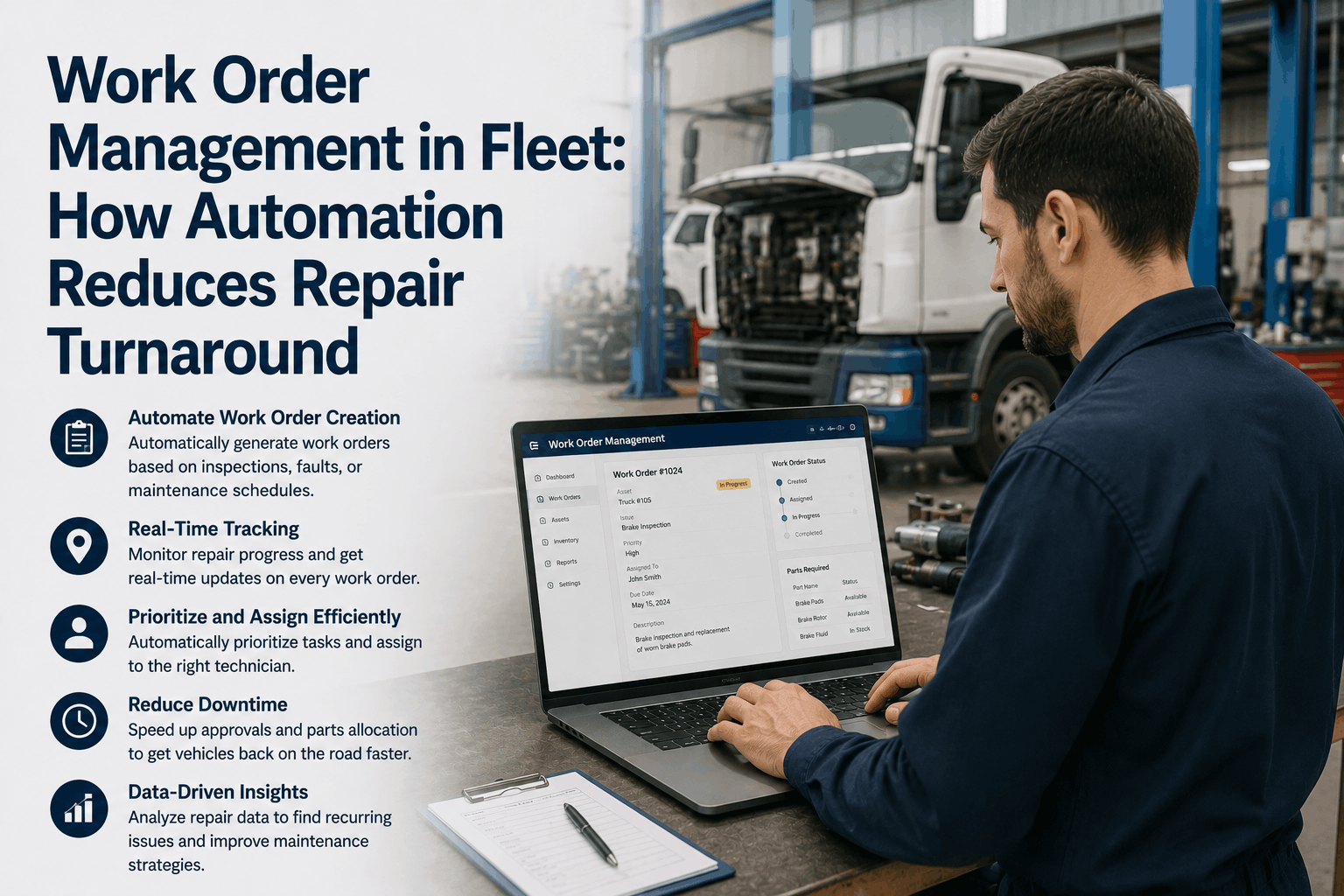
Work order management is the operational backbone of fleet maintenance — yet most western delivery fleets still run it on spreadsheets, whiteboards, and verbal handoffs that introduce delays, missed assignments, and vehicles sitting off-road 30–50% longer than necessary. In the U.S. and Europe, where driver shortages and rising fuel costs have compressed delivery margins to their limits, unplanned vehicle downtime isn't a maintenance issue — it's a revenue problem. Fleet Rabbit's fleet management and delivery analytics platform gives e-commerce logistics operations automated work order creation, intelligent technician assignment, and real-time repair tracking to cut vehicle off-road time and keep delivery capacity where it belongs: on the road. Book a demo to see Fleet Rabbit's work order automation applied to your fleet.
Quick Answer
Automated work order management in fleet operations covers the full repair cycle: fault detection and work order creation, technician assignment, parts procurement, repair execution, and vehicle return-to-service. U.S. and European delivery fleets using automated work order systems reduce vehicle off-road time 25–40%, cut administrative labor 60–70%, and eliminate missed-maintenance gaps that turn minor repairs into major breakdowns. Fleet Rabbit's platform automates the entire work order lifecycle — from fault code trigger to closed repair — so fleet managers spend less time coordinating and more time optimizing.
What Work Order Management Covers — and Where Manual Systems Break Down
A work order is more than a repair ticket. It connects fault detection, parts availability, technician capacity, and vehicle scheduling — and in manual systems, every handoff is a delay opportunity. U.S. and European delivery fleets running 20–200 vehicles generate hundreds of work order events monthly. Manual management doesn't scale.
The 5 Stages of a Work Order Lifecycle
Fault detection: Driver report or telematics alert triggers the event. Work order creation: Issue logged, categorized, prioritized. Assignment: Technician allocated by skill and availability. Parts and labor: Procurement confirmed, repair executed. Return to service: Vehicle cleared, capacity restored. Manual systems introduce 4–18 hours of avoidable administrative delay across steps 2–4.
The Real Cost of Manual Work Order Management
Every hour a delivery vehicle waits for an assigned technician, parts confirmation, or supervisor sign-off is lost delivery capacity. For a U.S. suburban fleet averaging $280/hour vehicle utilization value, a work order taking 22 hours instead of 14 costs $2,240 per event in lost capacity. Fleets averaging 8 unplanned work orders monthly lose $215,000+ annually to administrative delay alone.
Why Automation Changes the Economics
Automated work order systems eliminate administrative lag between fault detection and repair start. Telematics-triggered work orders reach the right technician in minutes, not hours. Parts checks run automatically. Supervisors receive exception alerts — not routine approvals — freeing 6–10 hours of manager time weekly that compresses to under 90 minutes. Result: repair turnaround drops 25–40%.
Work Order Turnaround Benchmarks: Western Fleet Standards by Operation Type
Benchmarking repair turnaround requires context. The table below reflects 2025 competitive benchmarks for delivery fleet operations across major western markets.
Fleet Type / Market
Minor Repair
Major Repair
Unplanned
Sched. PM
U.S. Large Metro (20+ vehicles)
4–8 hrs
1–2 days
Same day
Overnight
U.S. Regional / Suburban Fleet
8–16 hrs
2–4 days
24–36 hrs
1–2 days
UK / Ireland Delivery Fleet
4–10 hrs
1–3 days
Same day
Overnight
Germany / France / Benelux
6–12 hrs
2–3 days
24 hrs
1–2 days
Western Canada / Australia
8–18 hrs
2–5 days
24–48 hrs
1–3 days
The 5 Root Causes of Slow Work Order Turnaround
Repair turnaround failures in western delivery fleets concentrate around five systematic causes that automated work order management directly addresses.
1
Delayed Fault Detection and Work Order Creation
In fleets relying on driver-reported defects, fault-to-work-order lag averages 4–12 hours. Drivers complete their shift, report issues verbally, and a supervisor creates the work order the following morning — after the vehicle has already missed its next dispatch window. Telematics-triggered automatic work order creation eliminates this lag entirely.
Fleet Rabbit telematics integration on a 40-vehicle Dallas fleet: fault-to-work-order time reduced from 9.4 hours (driver report) to 12 minutes (auto telematics trigger). Vehicles available for next-day dispatch increased 23%.
2
Manual Technician Assignment and Scheduling Conflicts
Manual assignment relies on a supervisor knowing which technician has the right skill set, current workload, and schedule availability — information that exists in three different places and is never fully current. The result: misassigned work orders, idle technicians alongside overloaded colleagues, and repair start delays of 2–6 hours.
Assignment delay: 2–6 hrs avgManager time: 40–60 min/eventImpact: 15–25% of total off-road time
3
Parts Availability Gaps and Procurement Delays
A technician who arrives ready to repair and discovers the required part isn't in stock converts a 4-hour repair into a 24–48 hour delay. Parts unavailability extends 18–30% of all unplanned work orders by at least one full business day in U.S. fleets. Automated inventory checks at work order creation flag shortages before dispatch.
Automated parts checks at work order creation reduce procurement-related repair extensions by 60–70% — recovering 1–2 days of off-road time per affected vehicle.
4
Approval Bottlenecks and Escalation Gaps
Repair authorizations requiring supervisor sign-off with no automated escalation path sit in queues for hours when managers are in dispatch or off-site. A $400 brake repair waiting 6 hours for sign-off costs more in lost vehicle capacity than the repair itself. Automated approval routing with time-based escalation ensures work orders don't stall.
5
No Return-to-Service Tracking or Dispatch Coordination
In manual systems, a completed repair doesn't automatically notify dispatch. Vehicles sit cleared in the shop while dispatchers assume they're still down — missing load assignments that would recover lost delivery capacity.
Automated return-to-service notification recovers 1.5–3 hours of dispatch delay per completed work order — adding meaningful delivery capacity that manual coordination routinely loses.
Work Order Automation + Fleet Analytics
Cut Vehicle Off-Road Time 25–40% — Measurable from Week One
Fleet Rabbit automates work order creation, technician assignment, parts checks, and return-to-service notification — so repair turnaround compresses and delivery capacity stays on the road.
25–40%
Off-Road Time Reduction
6 Automation Mechanisms That Reduce Repair Turnaround
Reducing vehicle off-road time without adding technicians requires automation that attacks repair turnaround at every delay point simultaneously.
Auto Fault-to-Work-Order Creation
Engine fault codes, brake alerts, and tire pressure events automatically generate categorized, prioritized work orders — without dispatcher involvement. Fault-to-work-order time drops from hours to minutes, and vehicles flagged mid-shift are queued for overnight repair rather than grounding the next morning's dispatch.
Skill-Based Technician Assignment
Automated assignment matches work order requirements to technician skill profiles, workload, and shift availability — routing brake jobs to brake-certified technicians without manual coordination. Workload balancing prevents overload while eliminating idle-time gaps that manual scheduling routinely creates.
Inventory Check and Procurement Trigger
At work order creation, automated inventory checks confirm parts availability before technician dispatch. For parts below threshold, procurement requests generate automatically — enabling same-day sourcing for standard items. Fleets with automated checks reduce procurement-related extensions by 60–70%, recovering 1–2 days of off-road time on affected work orders.
Approval Routing with Timed Escalation
Work orders requiring authorization route to the appropriate level automatically, with time-based escalation if no action is taken within the configured window. Unapproved after 90 minutes, they escalate automatically — eliminating queue-sitting that turns a morning approval request into an afternoon repair start.
Real-Time Work Order Status and Dispatch Sync
Work order status updates — repair started, parts confirmed, vehicle cleared — push to fleet dashboards and dispatch systems in real time. Dispatchers see vehicle availability the moment a repair is completed, enabling immediate route reassignment rather than the 1.5–3 hour notification gap manual coordination produces.
Predictive Maintenance Scheduling
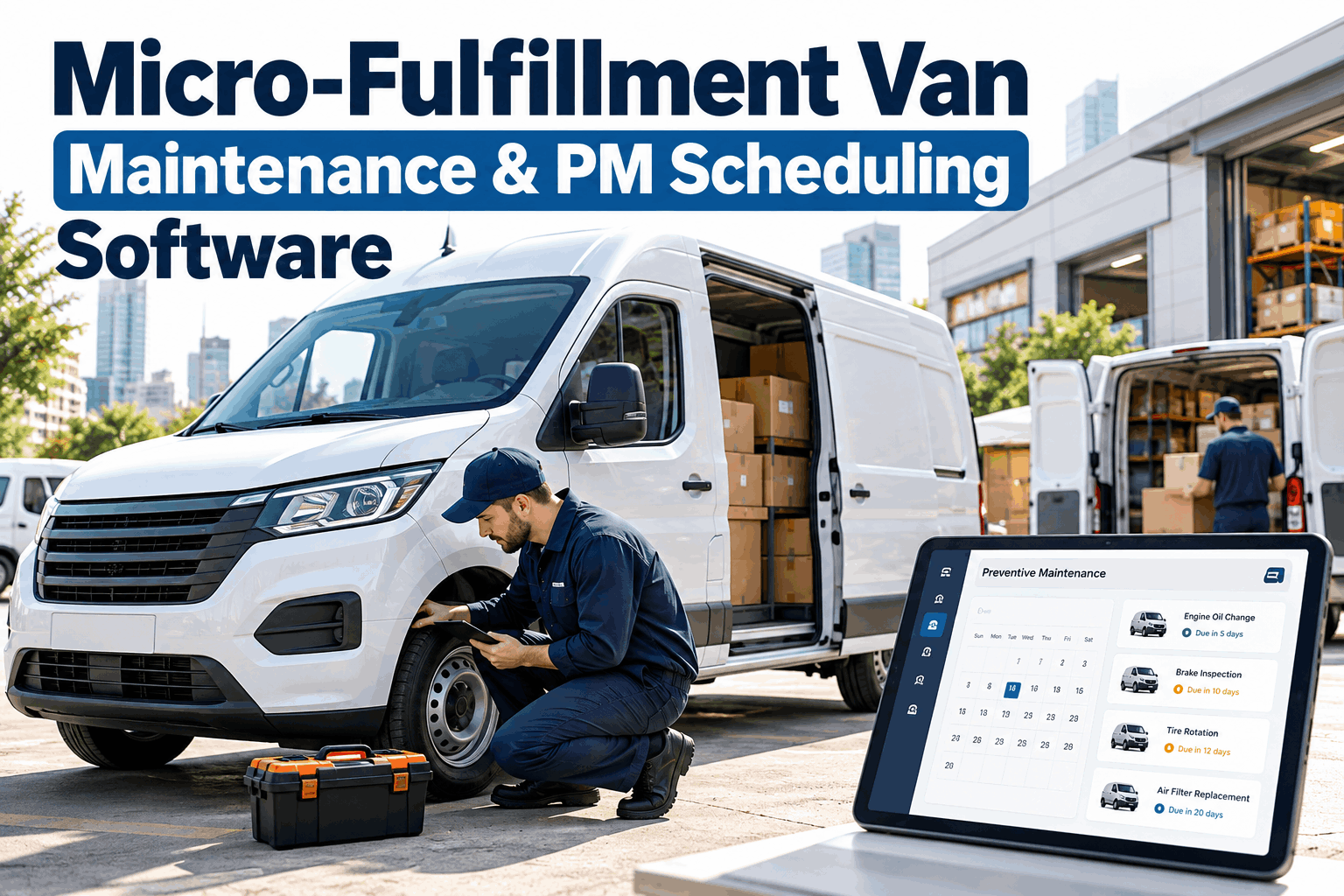
Continuous monitoring of engine hours, mileage, and fault code patterns generates scheduled PM work orders before failures occur — placing appointments during overnight off-hours. Each prevented unplanned breakdown eliminates 8–14 delivery failures and recovers 24+ hours of vehicle availability that reactive maintenance would have consumed.
How to Build a Work Order Automation Framework
Work order automation delivers results only when built on accurate baseline data. Fleets that automate before understanding their current cycle times end up automating inefficient processes rather than eliminating them.
Audit Current Work Order Cycle Times by Stage
Before automating, measure time from fault detection to work order creation, to technician assignment, to repair start, and to vehicle clearance. Most U.S. fleets discover that 60–70% of total off-road time is administrative delay — not actual repair time. Fleet Rabbit's analytics generate this breakdown automatically from the first week of deployment.
Prioritize Automation by Delay Stage Impact
Not all automation delivers equal value. For fleets where fault detection lag is the primary delay, telematics integration comes first. Where assignment coordination is the bottleneck, skill-based routing delivers more immediate impact. Sequencing automation by actual delay impact — not feature preference — compresses payback periods significantly.
Set Turnaround Targets Against Market Standards
Internal improvement metrics are misleading if the baseline was already 40% slower than competitive benchmark. U.S. metro fleets should target same-day clearance for minor repairs and overnight return-to-service for scheduled PM. European fleets — particularly UK and German operations — face customer and regulatory expectations that make turnaround a compliance issue as well as an operational one.
Work Order Automation Results: What Western Fleets Achieve
25–40%
Off-Road Time Reduction
60–70%
Fewer Parts Delay Extensions
18–24%
Fleet Availability Increase
30–45%
Unplanned Breakdown Reduction
30–60 days
Typical Full ROI Timeline
Frequently Asked Questions: Work Order Management in Fleet Operations
QWhat is work order management in fleet operations?
Fleet work order management covers the end-to-end process of detecting vehicle faults, creating repair assignments, allocating technician resources, procuring parts, executing repairs, and returning vehicles to active service. In delivery fleet operations, work order management directly determines how long vehicles sit off-road — making it a primary driver of fleet availability, delivery capacity, and operating cost. Automated systems replace manual coordination at each stage with rule-based workflows that eliminate administrative delays.
QHow much can automation reduce vehicle off-road time?
Western delivery fleets implementing automated work order management consistently achieve 25–40% reductions in total vehicle off-road time. The largest gains come from eliminating administrative delay — the 4–18 hours that typically elapse between fault detection and repair start in manual systems. For a 30-vehicle U.S. fleet averaging 6 unplanned work orders monthly, a 35% reduction in off-road time recovers the equivalent of 180–240 vehicle-hours of delivery capacity annually.
QHow does work order automation integrate with delivery dispatch systems?
Effective work order automation requires bidirectional integration with dispatch. Fleet Rabbit's platform connects work order status directly to dispatch dashboards — vehicle clearance notifications reach dispatchers within minutes of repair completion, enabling immediate route reassignment. Scheduled maintenance is automatically sequenced around delivery peaks, placing PM appointments in overnight or low-demand windows rather than competing with morning dispatch.
Cut Vehicle Off-Road Time 25–40% — See Fleet Rabbit's Work Order Automation in Action
Fleet Rabbit's platform automates the full work order lifecycle — from telematics-triggered fault detection to dispatch-synced return-to-service — reducing repair turnaround and keeping delivery capacity on the road. Most U.S. and European operations achieve full ROI within 30–60 days.
25–40% Less Off-Road Time
Auto Work Order Creation
Smart Technician Assignment
Parts Procurement Automation
Real-Time Dispatch Sync
May 26, 2026
By Harley Marley
All Posts