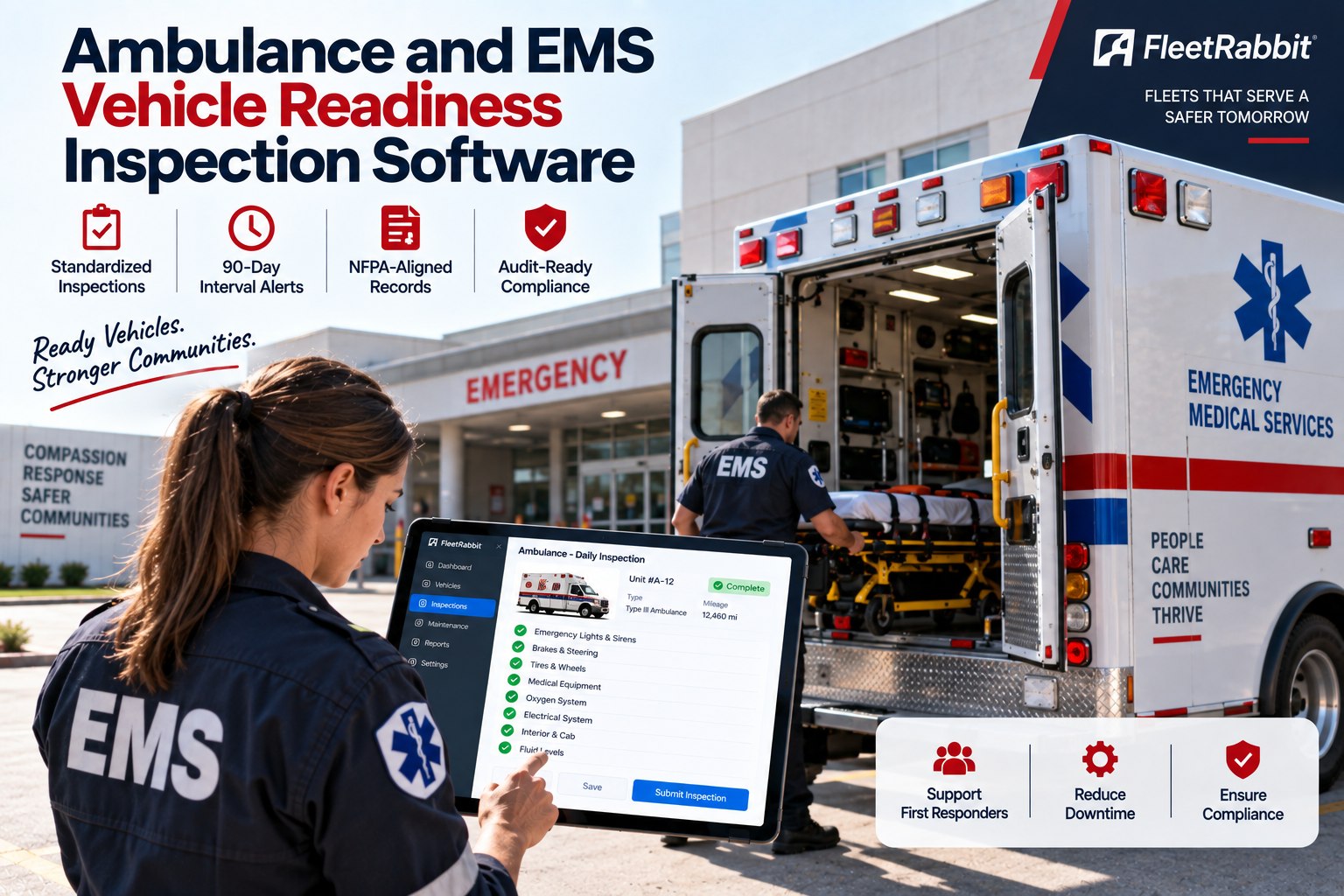
Municipal emergency medical services, county EMS agencies, fire-based transport divisions, and private ambulance operators manage frontline mobile intensive care fleets under zero-tolerance operational and clinical standards: executing rigorous KKK-A-1822 and NFPA 1917 daily shift pass-offs, ensuring sub-second biomedical equipment availability, tracking dual-battery and high-amp alternator charging curves, monitoring onboard medical oxygen bottle pressures, and adhering to strict DOT 49 CFR Part 396 vehicle roadworthiness rules. When narcotic vault electronic seals, stretcher power-load hydraulic logs, suction unit certifications, and emergency vehicle pre-trip records are logged on disconnected paper run-sheets or station clipboards, EMS operations face patient transport stalls, high-consequence roadside mechanical failures, and state health department compliance sanctions. FleetRabbit delivers dedicated ambulance and EMS vehicle readiness inspection software engineered specifically for pre-hospital emergency fleets. Combining mobile digital shift walkarounds, real-time biomedical inventory reconciliation, automated Out-of-Service (OOS) dispatch lockouts, and 90-day mechanical PM tracking, FleetRabbit guarantees that every Type I, II, and III ambulance is clinically prepared, mechanically sound, and audit-ready by default. Book a Demo to see FleetRabbit ambulance and EMS readiness software in action.
Ambulance and EMS Vehicle Readiness Inspection Software
Eliminate manual station clipboards. Automate daily shift pass-offs, verify critical biomedical equipment readiness, track 90-day preventive maintenance intervals, and enforce instantaneous out-of-service safety lockouts across your entire EMS and emergency transport fleet.
Why Paper Shift Sheets Threaten EMS Transport Operations
In life-or-death patient response, missing diagnostic equipment, low onboard oxygen, or unrecorded alternator degradation can turn routine dispatches into critical medical emergencies.
Unnoticed Oxygen Cylinder & Suction Depletion
Paper sign-offs often gloss over active main O2 tank PSI levels and portable aspirator battery runtimes. Crews responding to critical respiratory arrests discover half-empty cylinders mid-transit, triggering life-threatening clinical crises and state investigation reviews.
Power-Cot Hydraulic & Patient Fastener Failures
Skipping physical cycling tests on powered patient stretcher systems and floor lock anchors leads to catastrophic load failures at the emergency room ramp, resulting in patient drop injuries and crippling agency liability lawsuits.
Severe Electrical & Dual-Alternator Thermal Burnouts
Ambulance patient compartments generate intense electrical draws from dual inverters, suction pumps, and climate control units during high-idle hospital staging. Mileage-based schedules miss electrical system degradation, causing total in-transit power loss.
Hospital Basement & Rural District Radio Dead Zones
Ambulances frequently stage in reinforced underground hospital emergency bays or rural district outposts with zero cellular reception. Cloud-only applications lock up, preventing paramedics from completing mandatory shift pass-offs or equipment check-ins.
Engineered for High-Frequency Emergency Medical Service
FleetRabbit connects mobile paramedic pass-offs, biomedical inventory tracking, automated dispatch safety gates, and shop EVT workflows into a single cloud dashboard. Request an interactive platform tour.
Step-by-Step Clinical & Cab eDVIRs
Paramedics and EMTs conduct structured digital walkarounds on station tablets, verifying warning lights, siren modes, tire wear, suction units, and medical oxygen supply with photo verification.
Automated Out-of-Service (OOS) Lockouts
Tagging critical medical or mechanical defects—such as low brake vacuum, failed power-load retention, or depleted O2 reserves—locks the rig in dispatch, preventing it from being routed on calls.
Narcotics Vault & Seal Serialization
Scan tamper-evident numbered seals on drug safes, trauma jump bags, and pediatric packs during shift transitions, auto-generating an unalterable electronic audit trail for DEA and state pharmacy boards.
Engine-Hour & High-Idle PM Triggers
Track cumulative diesel engine hours and auxiliary patient-box generator runtimes via telematics, triggering oil services, alternator diagnostics, and cooling flushes on true duty wear.
Full Offline ER Bay Synchronization
Crews perform inspections and log fuel additions inside subterranean hospital emergency ramps without Wi-Fi or cellular service; all records auto-sync the moment connectivity is re-established.
1-Click State Health Board Compliance Vault
Export certified digital vehicle readiness dossiers with one click—complete with shift timestamps, biomedical equipment test curves, technician repair sign-offs, and historical DVIRs.
Built to Exceed Federal & State Emergency Vehicle Mandates
FleetRabbit’s EMS inspection workflows systematically satisfy national ambulance manufacturing standards, public safety directives, and federal roadworthiness rules.
Aligns daily shift inspections with federal guidelines covering electrical load management, high-output auxiliary heating/AC performance, emergency warning light intensity, and patient compartment sound levels.
Governs daily and weekly apparatus checks, auxiliary battery condition monitoring, carbon monoxide detector functionality, tire age and pressure limits, and 90-day comprehensive chassis maintenance cycles.
Enforces pre-shift functional checks of powered ambulance cot retention systems, wall-mounted medical equipment crash-locks, and modular equipment mounting brackets under dynamic crash-rated parameters.
Standardizes driver/operator pre-trip and post-trip eDVIR workflows, hydraulic/air brake pushrod stroke checks, suspension inspections, and certified mechanic corrective action sign-offs.
EMS Vehicle Readiness Software Comparison
A feature-level comparison focused on pre-hospital readiness, clinical asset tracking, and offline hospital performance as of 2026. Request a technical comparison.
| Capability | FleetRabbit | Generic Fleet CAD | Basic Telematics | Paper Shift Sheets |
|---|---|---|---|---|
| Pricing (per asset/month) | $5/month | $25–$60/month | $20–$45/month | High liability exposure |
| Automated OOS Clinical Lockouts | Instant dispatch gating | Manual workarounds | Not supported | Unenforced paper notes |
| High-Idle Engine-Hour PM Alerts | True runtime scheduling | Odometer biased | Basic GPS tracking | Guessed intervals |
| Narcotics Vault & Seal Tracking | Barcode scan & serialize | Separate add-on | Not available | Handwritten logbook |
| Hospital Basement Offline Sync | Full offline data engine | Limited data caching | Network dependent | Paper only |
| Free Trial Access | 14 days, up to 3 assets | Demo only | Demo only | None |
| Contract Commitment | Monthly or annual | Multi-year lock-in | Multi-year lock-in | None |
5-Step EMS Readiness Implementation Roadmap
FleetRabbit deploys across EMS stations, firehouses, and central maintenance facilities in under two weeks without interrupting active emergency transport shifts.
EMS Fleet & Module Ingestion
Import Type I, II, and III ambulances, fly-cars, and paramedic rescues via CSV or API, cataloging chassis types, engine hours, cot systems, inverters, and station assignments.
Readiness Checklists & OOS Threshold Setup
Configure daily shift pass-offs, weekly deep-clean schedules, and minimum medical supply thresholds (e.g., O2 PSI > 1,000; suction > 300 mmHg), setting automatic lockout gates.
High-Idle & 90-Day PM Interval Setup
Establish automated maintenance alerts for dual-alternator inspections, auxiliary battery load testing, suspension air bag checks, and transmission fluid flushes.
Paramedic & Shop Mechanic Mobile Rollout
Equip field paramedics, EMTs, and emergency vehicle mechanics with the intuitive offline-first mobile inspection app on rugged station tablets or mobile phones.
EMS Fleet Command Board Go-Live
Activate live fleet readiness boards, automated defect work order triage queues, and 1-click state health board compliance export tools across all EMS stations.
2-Week Deployment Plan & Milestones
Modernize your ambulance fleet readiness tracking with zero disruption to scheduled emergency response operations. Request an onboarding plan.
Week 1: Setup & Asset Configuration
- Import vehicle rosters, module serials, engine hours, and battery specifications
- Configure KKK-A-1822F, NFPA 1917, and state EMS daily shift inspection checklists
- Set up 90/60/30-day alerts for stretcher crash-lock tests and DOT chassis inspections
- Assign user access roles for Paramedics, Shift Lieutenants, and Fleet EVT Technicians
Week 2: Shift Rollout & Live Operations
- Distribute mobile tablets to stations and train crews on 6-minute shift pass-offs
- Validate store-and-forward offline syncing across underground hospital parking bays
- Test closed-loop mechanic defect routing on simulated brake and power-load faults
- Activate central operations readiness dashboard across regional EMS dispatch desks
Guarantee EMS Readiness and Eliminate Roadside Response Failures
Track critical medical oxygen, enforce automated safety lockouts, and schedule runtime engine PMs. Start today at $5/asset/month with a 14-day free trial.
Real-World Emergency Medical Transport Results
Documented outcomes reported by county emergency medical services districts and municipal fire-based EMS divisions. Request the EMS fleet case study.
52% Reduction in In-Service Breakdowns — 48-Ambulance Fleet
A high-volume county EMS provider running 48 ambulances faced recurring roadside stalls caused by dead auxiliary batteries and neglected brake wear on high-idle units. FleetRabbit implemented runtime engine-hour PMs and mobile eDVIR shift pass-offs, cutting roadcall failures by 52% and saving over $44,000 in emergency repair costs in year one.
Zero Defect Findings on State Health Inspection — 32-Unit Fleet
A municipal fire-based EMS division struggled with missing paper shift records and unlogged narcotic safe seal audits during annual state health board reviews. FleetRabbit consolidated all pre-trip walkarounds, tamper-evident seals, and stretcher maintenance into automated digital archives, achieving a 100% spotless audit pass rate.
When our paramedics turn the key on a Priority 1 cardiac response, there is zero margin for error. You cannot have a low-pressure oxygen tank, a dead cot battery, or a vehicle that stalls at an intersection. Before FleetRabbit, shift pass-offs were scribbled on paper sheets that ended up in recycling bins. FleetRabbit brought complete accountability to our stations. Our crews complete their morning walkarounds in five minutes, drug safe seals are scanned and tracked, and if a critical brake or electrical defect is flagged, that ambulance is locked in dispatch immediately. It has given our medical directors total confidence in our frontline readiness.
Frequently Asked Questions
Upgrade Your Ambulance Readiness and Compliance in Less Than 2 Weeks
Automate digital shift walkarounds, enforce clinical equipment lockouts, and maintain audit-proof records at $5/asset/month with a 14-day free trial.