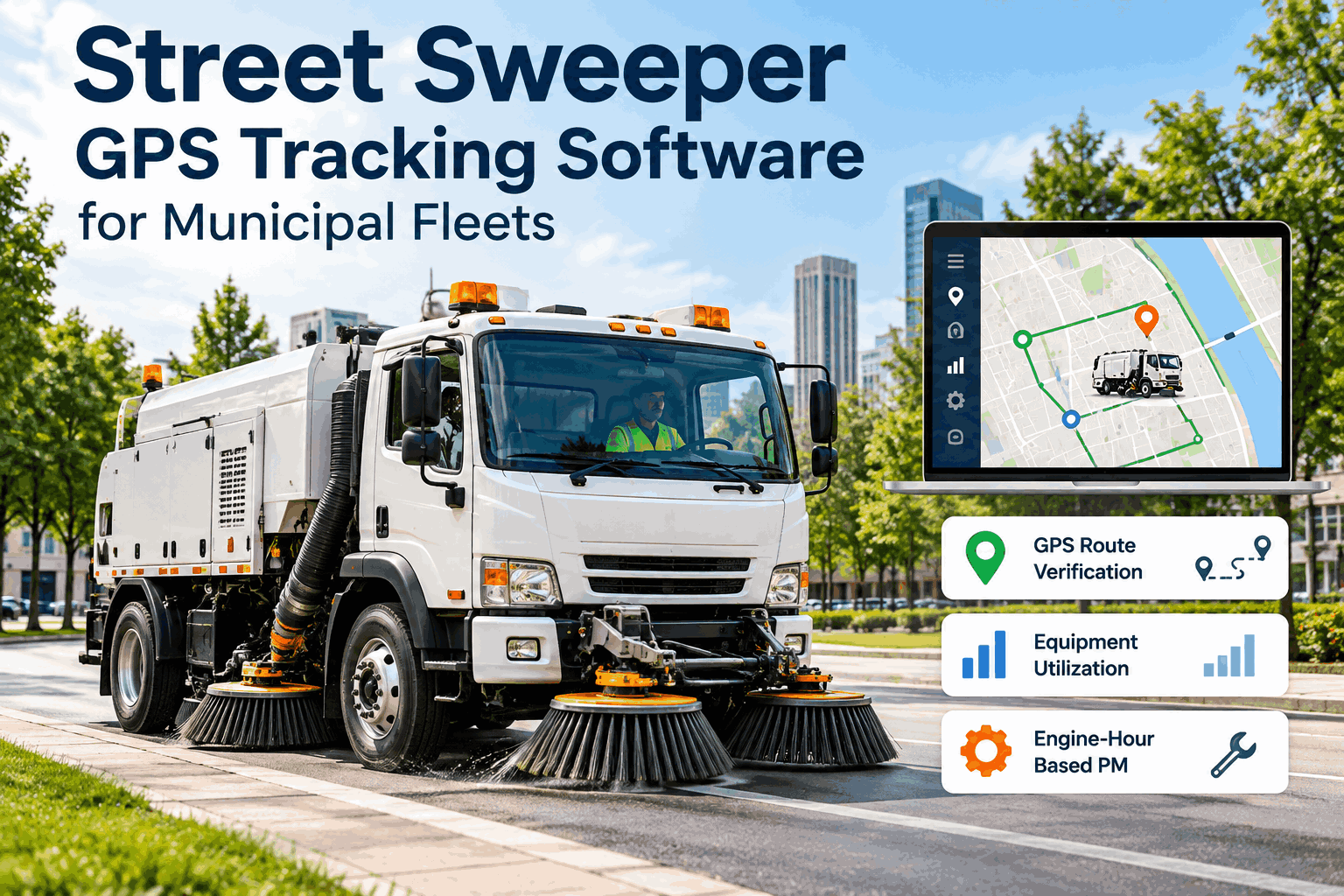
"When was my street last swept?" is one of the simplest questions a public works office gets, and one of the hardest to answer from a paper map. Sweeper routes run for weeks, stormwater permits ask for proof of coverage and the machines themselves rack up engine hours that a simple odometer never shows. Municipal teams that pair GPS route history with utilization data and hour-based PM can answer all three with confidence. See how FleetRabbit tracks sweeper routes, hours and maintenance in one place and turn every shift into a record you can stand behind.
Street Sweeper GPS Tracking Software for Municipal Fleets
See which streets were swept, how hard each machine works and when it is due for service. Build route proof, utilization data and maintenance history from one system.
A GPS Dot Is Not a Swept Street
A truck can drive a route without cleaning it. That is why route verification looks at more than location, and why every route needs a plan to compare against.
Sample completion board. Pair GPS path, speed and stops with operator records for broom-down time and loads dumped.
Curb Miles, Explained in One Picture
Sweeping work is usually counted in curb miles, not road miles. A two-way street with curbs on both sides has two curb miles for every centerline mile, so your totals can be twice what a map suggests.
What Stormwater Permits Ask You to Prove
Many municipalities sweep as part of a stormwater (MS4) permit. Requirements differ by state, but permits commonly ask for records like these, and some require that sweepers run at proper design speed and stay well maintained.
Check your own permit for the exact wording. This is general information, not legal advice.
Answer "When Was This Street Swept?" in Seconds
GPS route history, run time, engine-hour PM and repair records for every sweeper in one system. Free for your first three vehicles.
Where an 8-Hour Sweeper Shift Really Goes
Utilization is not just hours on the clock. It is how many of them the brooms are actually down on the street. GPS run time and stop data show the rest.
Illustrative shift. Your split will differ by route density, dump distance and season.
Sweepers Run on Hours, Not Just Miles
A sweeper can spend a shift crawling at low speed with brooms, fans and hydraulics working hard. Many machines also carry a second engine for the sweeping system, so mileage understates the wear.
Chassis engine
Sweeper engine
Wear parts
Example hour meter readings. Set intervals from your manufacturer's manual.
One Board for the Whole Sweeper Fleet
Route status, breakdowns and PM due dates belong on the same screen. Start free and see your fleet the way a dispatcher needs to.
Frequently Asked Questions
It records where each sweeper goes, how long it runs and where it stops, then turns that into route history and utilization reports for public works teams.
Compare the GPS path to the planned route, check speed and stops, and pair it with operator records for broom-down time and loads dumped. Location alone shows travel, not cleaning.
Curb miles measure the length of curb a sweeper cleans. A two-way street with curbs on both sides counts as two curb miles for each centerline mile.
It varies by permit. Common items include date and area swept, curb miles, frequency, sweeper type, route maps and waste volume. Some also require that equipment is maintained. Check your permit language.
Sweepers work hard at low speeds, and many have a second engine for the sweeping system. Engine hours reflect that wear far better than mileage, so PM should run on hours.
Yes. You can start free with three vehicles and add more as your fleet grows.
Prove the Work, Protect the Machines
GPS tracking, utilization, engine-hour PM, inspections and repair history for your whole municipal fleet in one system. Free for your first three vehicles.