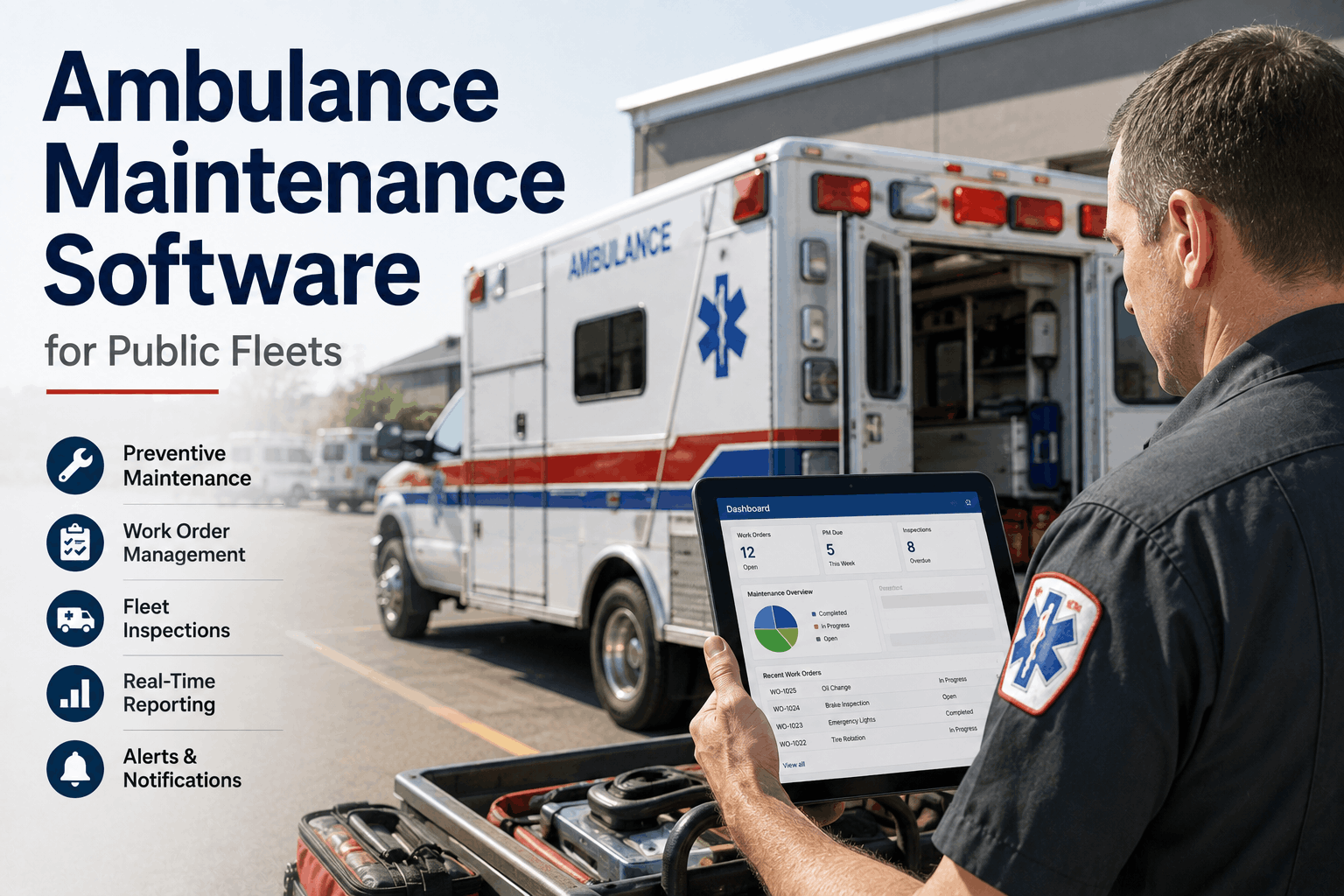
An ambulance that will not start is not a maintenance delay, it is a 911 callwith no unit to answer it. Public safety fleets run ambulances on a duty cycle unlike almost any other government vehicle: hours of idling with full electrical load, patient compartment climate control running non-stop, and mileage that barely reflects how hard the engine has actually worked. A maintenance program built around odometer readings alone misses the wear that actually takes an ambulance out of service.
Ambulance maintenance software closes that gap by tracking engine hours alongside mileage, keeping NFPA 1911 and DOT inspection records audit-ready by default, and flagging the exact unit that needs attention before it gets dispatched on a call it cannot finish. Departments that sign up for a platform built around emergency vehicle duty cycles typically move from reacting to breakdowns mid-shift to catching wear during a scheduled bay inspection.
Mileage-Based Triggers
Standard PM intervals set by manufacturer recommendation for oil, filters, and drivetrain wear tied to distance traveled.
- Oil and filter change
- Brake pad and rotor inspection
- Transmission fluid service
- Tire rotation and tread check
Engine-Hour Triggers
Idle time behind the wheel still ages an engine, alternator, and battery system even when the odometer barely moves.
- Alternator and charging system load test
- Battery capacity and inverter check
- Coolant system service under sustained idle
- HVAC compressor and blower inspection
Most ambulances log more engine hours per mile driven than almost any vehicle class in a municipal fleet, because the unit idles on scene, at the hospital bay, and during standby. A PM schedule built purely on mileage will consistently under-service the exact components, charging system, HVAC, electrical load, that fail from hours of running rather than miles of driving. Fleets that book a demo usually ask first how dual-trigger scheduling works, because it is the single change that catches failures a mileage-only program would miss entirely.
NFPA 1911
Inspection, Maintenance, Testing & Retirement
Governs daily and weekly visual and operational checks, scheduled preventive maintenance intervals, and documentation standards for in-service emergency vehicles, including ambulance patient compartments.
DOT / FMCSA
Federal Roadworthiness Standards
Requires documented annual inspections, driver vehicle inspection reports, and retained maintenance records demonstrating the vehicle was fit for service at time of dispatch.
Patient compartment inspection deserves particular attention, since NFPA 1917 and the corresponding chapters in NFPA 1911 cover far more than the chassis: oxygen delivery systems, cot mounting hardware, interior lighting, and climate control all fall under the same audit scope as the engine and brakes.
Chassis & Drivetrain
Engine, transmission, brakes, steering, and suspension under both mileage and hour-based triggers.
Electrical & Inverter
Battery, alternator, and power inverter systems supporting medical equipment during extended idle.
Oxygen & Medical Gas
Onboard oxygen system integrity, pressure regulation, and fitting inspection per NFPA 1917.
Patient Compartment Climate
HVAC performance validated separately from cab climate, since compartment temperature affects patient care.
Lighting & Siren
Emergency lighting, siren, and warning system function tested on the same cycle as chassis checks.
Cot & Restraint Hardware
Mounting integrity and restraint function inspected on a schedule, not only after visible wear.
1 Unit Down
is one less ambulance covering your response area, which means longer response times and heavier load on the units still in service. Every hour an ambulance sits waiting on a paper-based inspection or a missed PM interval is an hour of reduced coverage across the whole district.
Give every ambulance a documented, dual-trigger PM schedule
See engine-hour and mileage tracking running against your own unit numbers.
Paper logs are the default for many EMS fleets simply because they were the default twenty years ago, not because they hold up under a modern audit. The difference becomes obvious the first time a compliance review or an insurance claim asks for a specific unit's full inspection history.
Fleet readiness is easiest to manage when it is visible at a glance rather than buried in individual vehicle files. A readiness view that shows every ambulance's current PM status lets a fleet manager see coverage risk before it becomes a dispatch problem, not after.
Unit 4 — Fully Ready
Unit 7 — PM Due in 20 Hours
Unit 2 — Inverter Flagged, In Bay
Fleet managers who sign up and connect their existing roster typically build this kind of readiness view in under a day, since engine hours, mileage, and inspection history import together rather than requiring separate systems for each.
Beyond scheduling and compliance, the day-to-day features that matter most for an EMS fleet are the ones that reduce the gap between a defect being noticed and a defect being fixed.
Dual-Trigger PM Engine
Mileage and engine-hour thresholds tracked together so no wear pattern gets missed.
Crew Defect Reporting
EMTs and paramedics log issues from shift-end checks directly into the maintenance queue.
NFPA & DOT Record Vault
Every inspection, test, and repair timestamped and tied to the standard it satisfies.
Fleet Readiness View
A single screen showing which units are dispatch-ready, due soon, or in the bay.
Departments evaluating a change usually run through the same short list of concerns before they commit: will crews actually use it during a shift, will it hold up during an audit, and will it fit alongside the CAD and records systems already in place. Agencies that book a demo can walk through all three with their own fleet data rather than a generic sales demo.
Move from reactive repairs to documented readiness
Most EMS fleets are fully onboarded within a week.
Frequently asked questions from public fleet managers evaluating ambulance maintenance software.
Why track engine hours instead of just mileage for ambulances.
Ambulances idle for extended periods on scene, at the hospital, and during standby, which ages the engine, charging system, and HVAC components without adding much mileage. Engine-hour tracking catches that wear before it causes a failure.
Does this cover NFPA 1917 patient compartment requirements.
Yes. Patient compartment items including oxygen systems, cot hardware, interior lighting, and climate control are tracked on their own inspection schedule alongside chassis and engine maintenance.
How does crew defect reporting work.
EMTs and paramedics log issues found during shift-start or shift-end checks directly into the system, and those reports route straight into the maintenance queue instead of a separate paper form.
Can this produce records for a DOT or NFPA audit.
Every inspection, PM service, and repair is timestamped and linked to the regulation or standard it satisfies, so records for a specific unit or date range can be pulled in minutes rather than searched for in filing.
Is this only for large EMS agencies.
Smaller departments running a handful of units often see the fastest benefit, since they rarely have dedicated compliance staff and depend most on automated tracking to avoid missed intervals.
How long does onboarding take.
Most departments load their unit roster, mileage, and engine-hour history and are fully operational within a week.