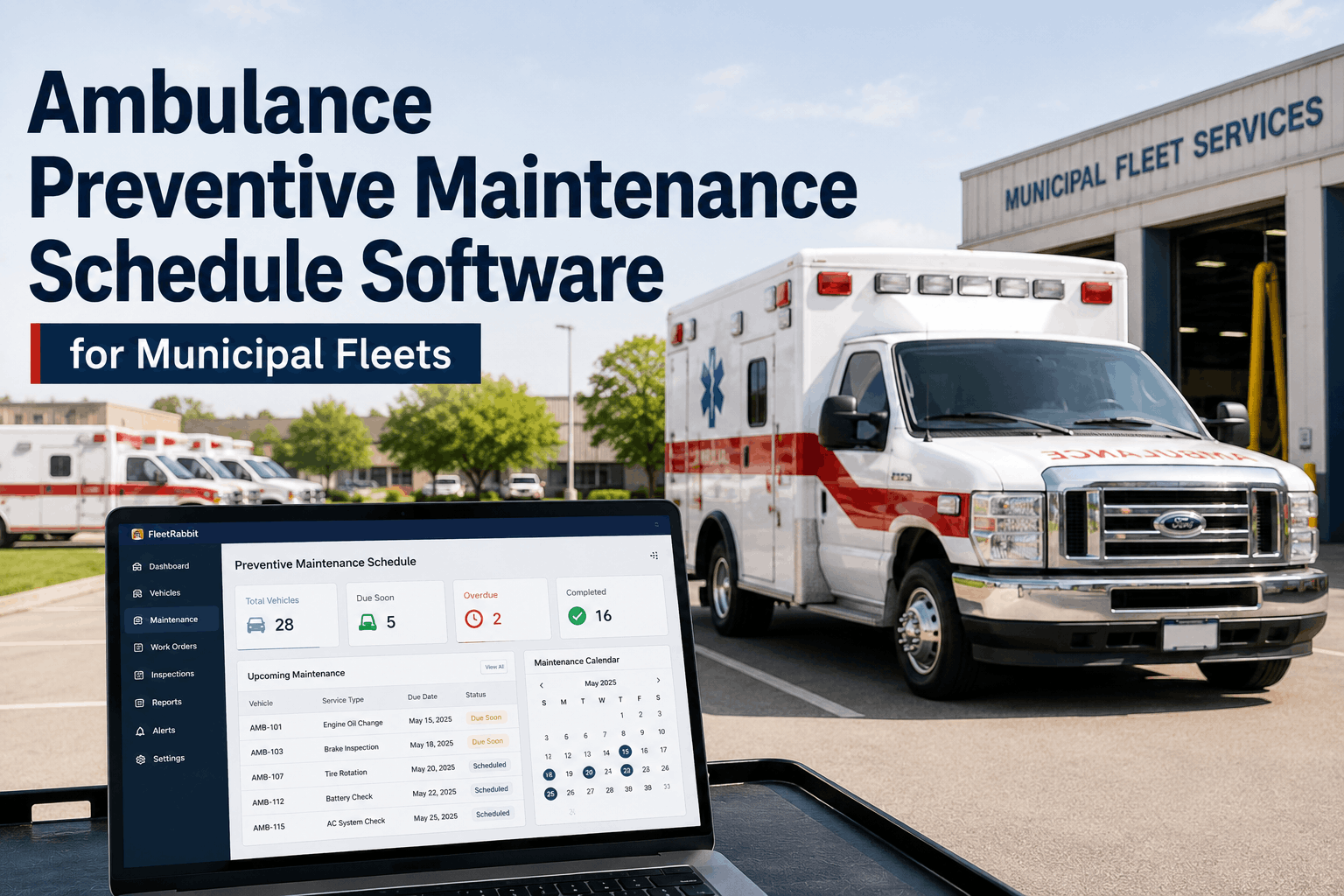
An ambulance runs a duty cycle unlike almost anything else in a municipal fleet. It idles on scene for twenty minutes running patient monitors, lighting, and climate control, then drives four blocks to the next call, then idles again. Mileage barely moves while the engine and electrical systems absorb real wear the whole shift. A preventive maintenance schedule built for a standard sedan or pickup misses that pattern entirely, which is exactly why ambulance preventive maintenance schedule software has to track engine hours, dual power systems, and patient module equipment as their own tracks, not as an afterthought bolted onto a generic fleet plan. Municipal fleets ready to see their own PM gaps mapped out can sign up free and connect their first unit today.
Why an ambulance needs two maintenance tracks running at once
Underneath the chassis, an ambulance is still a truck that needs oil changes, brake inspections, and transmission service on a normal interval. Bolted onto that chassis is a patient module with its own electrical load, climate system, and medical equipment mounts, all of which need their own inspection cadence. Ambulance preventive maintenance schedule software for agencies keeps both tracks moving in parallel instead of forcing a maintenance officer to manage them as two separate spreadsheets.
- Engine oil and filter service on hour and mileage intervals
- Brake, tire, and suspension inspection
- Transmission and cooling system checks
- DOT-required annual roadworthiness inspection
- Dual electrical system and battery load testing
- Climate control performance for the patient compartment
- Oxygen and suction system inspection
- Mounted equipment and lighting function checks
Neither track can be allowed to slip just because the other one looks fine on paper, since a unit with a spotless engine record can still fail an equipment check the moment it's needed on scene. See both tracks running against your current fleet by choosing to book a demo.
Engine-hour scheduling versus mileage on a real EMS shift
A twelve-hour EMS shift can easily produce more engine hours than road miles, especially in dense urban districts with short transport distances and long scene times. A preventive maintenance schedule built only around mileage will keep pushing that unit's next service date out even as the engine keeps running, which is how a mileage-based plan quietly falls behind on a vehicle that never seems to rack up the miles to justify it.
Illustrative comparison for a busy urban EMS unit, where scene idle time and short transports push engine hours well ahead of mileage on the same shift.
Tracking hours alongside mileage means an ambulance that runs hard but drives short distances still gets flagged for service on time, not months after the wear actually happened. Connecting your fleet's engine-hour data is the fastest way to see this in practice, and you can create a free account to start.
Schedule maintenance around actual wear, not just the odometer
Engine-hour and mileage-based PM, chassis and patient module tracking, and DOT-ready records, all from one dashboard.
Mapping PM intervals so nothing gets buried under something else
Municipal EMS budgets are built a year in advance, which means a maintenance schedule that shifts unpredictably is a planning problem as much as a mechanical one. Ambulance preventive maintenance schedule software lays out every interval clearly, across both maintenance tracks, so a fleet manager can see the full year at a glance instead of reacting interval by interval.
Once that matrix lives in one system, a fleet manager can forecast parts, labor, and downtime for the year rather than discovering the cost of a missed interval after it turns into an out-of-service unit. Departments building next year's plan can talk to our team about mapping their current intervals in.
Documentation that satisfies DOT and NFPA-aligned reviewers
An ambulance that's mechanically sound but poorly documented still creates risk for a municipal fleet, since an inspector, auditor, or accreditation review expects to see records, not just a working vehicle. Ambulance preventive maintenance schedule software keeps that proof current automatically instead of leaving it to a scramble before a review.
DOT roadworthiness records
Annual inspection results stored and searchable by unit, ready to produce on request.
Complete service history
Every chassis and patient module service tied to the unit's record, with technician notes attached.
Equipment calibration tracking
Defibrillators, gas detection, and other calibrated equipment flagged before certification lapses.
Fleet-wide readiness view
Every unit's status rolled up for shift commanders and fleet managers in one dashboard.
For a municipal fleet running mixed apparatus alongside its ambulances, having one system handle documentation across every vehicle type removes a real source of audit risk. Start building that record by choosing to sign up for a free workspace.
Keep every ambulance on schedule, documented, and ready
Dual-track preventive maintenance, engine-hour scheduling, and DOT-ready records built for municipal EMS fleets.
Ambulance preventive maintenance schedule software, answered plainly
Does this track the patient module separately from the chassis
Yes. Chassis and powertrain items follow their own schedule, and patient module systems like electrical load, climate control, and medical equipment mounts follow theirs, so neither track gets buried under the other.
Why does engine-hour tracking matter for ambulances specifically
Ambulances often accumulate significant engine hours from scene idle time and short transports without covering much mileage. Tracking hours alongside mileage catches wear that a mileage-only schedule would miss for months.
Can it help us plan a municipal maintenance budget in advance
Laying out every PM interval across the fleet in one calendar view lets a fleet manager forecast parts, labor, and expected downtime for the year, rather than reacting to each service as it comes due.
Does it cover DOT roadworthiness inspection requirements
Annual roadworthiness inspection results are logged and stored by unit, searchable on demand, so a department can produce complete documentation for a review without reconstructing records manually.
Can equipment calibration, like defibrillators, be tracked here too
Yes. Calibrated equipment can be tracked individually with its own certification and service dates, so an expiring calibration surfaces as an alert before it lapses.
How do we see this against our current ambulance fleet
Sign up and import your existing PM schedule and service records directly, or book a walkthrough where our team maps your current intervals into both maintenance tracks.