Public procurement officers, city purchasing directors, and municipal fleet managers frequently spend between six and twelve months drafting lengthy Request for Proposals (RFPs), advertising bids, evaluating vendor scoring matrices, and negotiating enterprise software master service agreements. Cooperative purchasing fundamentally transforms this administrative burden by allowing state, county, and local government entities to "piggyback" onto competitively solicited master contracts established by lead public agencies. When civic fleet leaders utilize established cooperative purchasing agreements, they legally satisfy competitive bidding statutes, lock in volume-discounted software pricing, and bypass administrative delays to deploy vital fleet operations technology in days rather than quarters. Fleet Rabbit provides a modern, cooperative-friendly government fleet management platform engineered for municipal and public agency procurement: offering transparent pricing, automated power take-off (PTO) engine-hour tracking, mobile driver pre-trip safety checklists, and seamless inter-departmental fund chargebacks without cumbersome enterprise lock-in. Accelerate your public procurement cycle, protect taxpayer budgets, and equip municipal maintenance shops with modern digital tools. Book a Demo to explore cooperative purchasing options for your agency.
Public Agency Cooperative Procurement & Pricing Blueprint
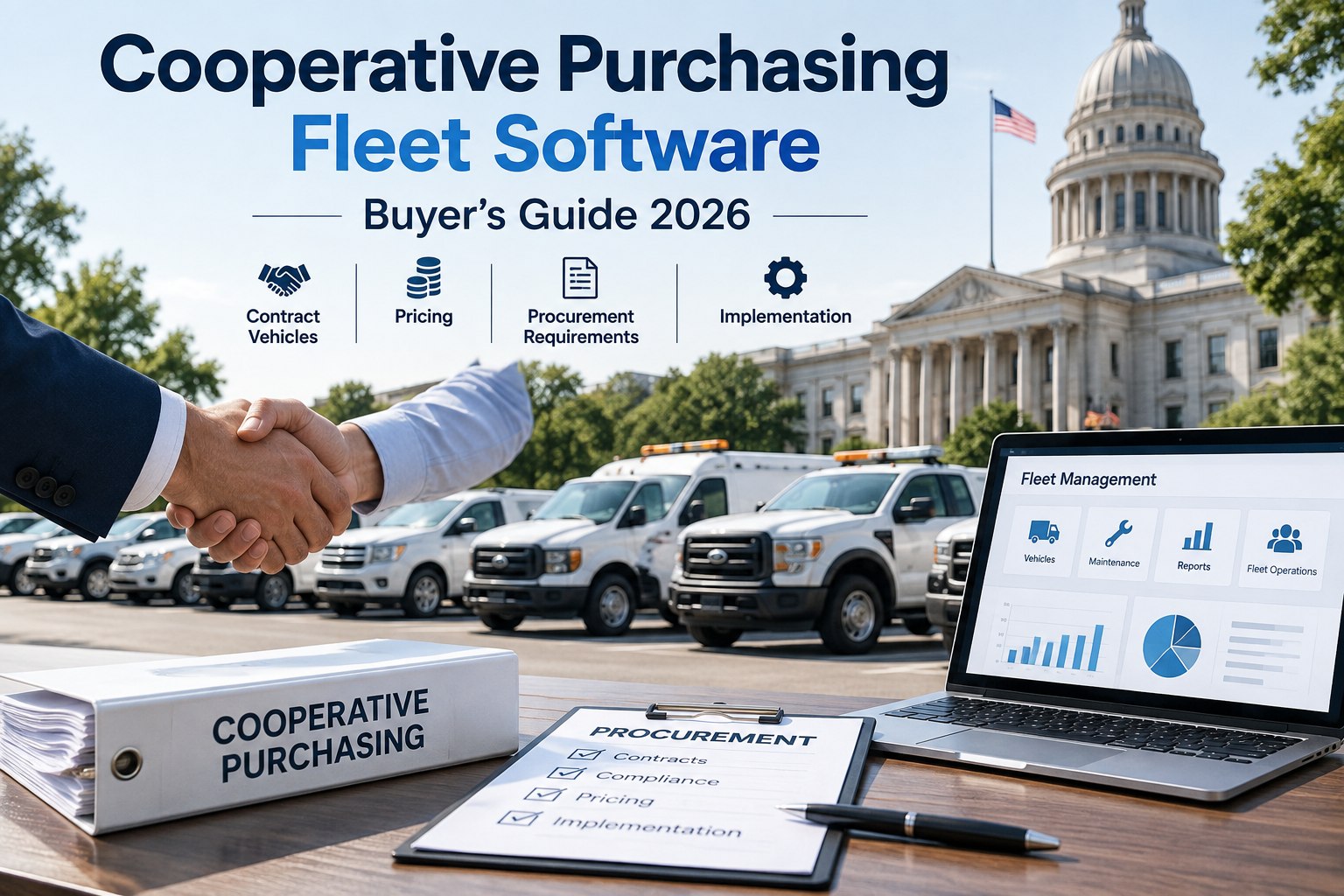
Cooperative Purchasing Fleet Software: Buyer's Guide 2026
An authoritative legal and operational guide for government fleet buyers: explore how master contract vehicles satisfy statutory competitive bidding, review transparent municipal software pricing tiers, eliminate administrative procurement overhead, and deploy live within two weeks.
100%
Statutory Compliance
Meets state and municipal competitive bidding legal requirements.
75%
Procurement Time Saved
Deploy in under 14 days without running lengthy independent RFPs.
$5
Per Asset / Month
Predictable civic software pricing with zero onboarding consultancies.
Modernize Municipal Fleet Operations Without the 9-Month RFP Cycle
Leverage piggyback procurement and pre-negotiated volume terms to deploy automated PTO maintenance, mobile driver DVIRs, and multi-fund chargebacks immediately.
The Reality of Traditional Public Fleet RFP Procurement
Municipalities, school districts, and regional utility boards frequently default to independent competitive bidding for software modernization. In practice, running an independent software RFP is an expensive, resource-draining process that delays critical technological upgrades. Sign up to experience our streamlined procurement model.
Friction 01
Months of Administrative Legal Drafting
Drafting RFP specifications, legal terms, evaluation rubrics, and public public-notice notices consumes hundreds of hours across procurement staff, city attorneys, and fleet directors, taking between six and twelve months before evaluation begins.
Friction 02
Inflated Enterprise Bid Pricing
Legacy enterprise software vendors build the high administrative cost of responding to lengthy municipal RFPs directly into their bid prices, quoting $50 to $90+ per asset monthly plus mandatory five-figure onboarding consultancies.
Book a demo to compare true public sector pricing models.
Friction 03
Vendor Scoring Disputes & Formal Protests
Disgruntled legacy vendors frequently file bid protests when passed over for modern platforms, tying city attorneys in administrative hearings and delaying software deployment by additional quarters.
Friction 04
Continued Dependence on Inefficient Spreadsheets
While procurement drags on, garage mechanics and vehicle operators continue managing mixed public works dump trucks, emergency apparatus, and police cruisers on paper logs, leading to missed maintenance and unallocated costs.
Sign up to digitize municipal maintenance logs today.
How Cooperative Purchasing Works for Public Fleets
Cooperative purchasing harnesses the aggregated buying volume of thousands of public agencies. Understanding the legal mechanics allows municipal directors to move forward with complete legal confidence. Book a demo to inspect cooperative contract structures.
1
Lead Agency Issues National or Regional RFP
A designated public lead agency (such as a county government or state purchasing agency) issues a formal, competitive, publicly advertised solicitation on behalf of itself and other public participating entities.
2
Competitive Evaluation & Master Contract Award
The lead agency scores responses, negotiates terms, and awards a master purchasing contract. Pricing is pre-negotiated and locked, establishing volume ceiling pricing for all eligible participating agencies.
3
Local Agency Executes "Piggyback" Authorization
4
Rapid Purchase Order & 14-Day Deployment
Your procurement office issues a purchase order directly against the master contract vehicle. Asset ingestion and garage onboarding begin immediately without months of legal delays.
Common Cooperative Purchasing Contract Vehicles
Public sector fleet directors can utilize several recognized national and regional cooperative programs to procure fleet software smoothly. Book a demo to discuss compatible contract vehicles for your agency.
National Co-op
Sourcewell (formerly NJPA)
A premier national cooperative purchasing agency serving over 50,000 public entities. Master contracts for fleet software and municipal equipment are competitively solicited, providing pre-negotiated pricing for local government buyers.
National Co-op
OMNIA Partners (Public Sector)
One of the largest cooperative purchasing organizations in the United States, combining agreements from US Communities and National IPA to provide public agencies with compliant software purchasing vehicles.
State Co-op
NASPO ValuePoint & State Master Contracts
Led by state procurement directors, NASPO agreements allow municipalities, counties, and higher education institutions to piggyback directly onto established state-level master software contracts without separate bidding.
Sign up to explore state master contract compatibility.
Regional Co-op
GSA Multiple Award Schedule (MAS)
Under the Cooperative Purchasing Program (Local Preparedness Acquisition Act), state and local governments can purchase fleet management software directly through GSA Schedule 70 IT contracts.
Procurement Comparison: Cooperative Contracts vs. Independent RFP
Examine the operational timeline, legal expenditure, and total cost of ownership between cooperative purchasing vehicles and traditional independent municipal bidding. Book a demo to evaluate your agency's procurement cost savings.
| Procurement Criteria |
Cooperative Purchasing (Fleet Rabbit) |
Independent Municipal RFP |
Emergency Discretionary Sole-Source |
| Procurement Duration |
1 to 2 weeks |
6 to 12 months |
2 to 4 weeks (audit scrutiny) |
| Competitive Bidding Compliance |
100% compliant via lead agency RFP |
100% compliant locally |
High risk of vendor audit protest |
| Legal & Administrative Cost |
Near zero (pre-established terms) |
$15,000 – $35,000+ staff time |
Moderate legal justification prep |
| Platform Pricing Rate |
$5 / asset / month |
$50 – $90+ / asset / month |
Unfavorable non-volume pricing |
| Implementation Velocity |
Live in under 14 days |
9 to 18-month consultant setup |
Variable implementation |
| Contract Flexibility |
Annual billing, cancel anytime |
3 to 5-year locked RFP commitments |
Annual renewal scrutiny |
Alternative Fast-Track: The Micro-Purchase Threshold
In addition to cooperative agreements, many public agencies can bypass lengthy procurement through discretionary micro-purchase rules. Understanding your agency's spending caps provides an immediate path to deployment. Sign up to onboard under municipal micro-purchase thresholds.
Most city charters, county ordinances, and state procurement codes allow department heads to make direct discretionary purchases without formal bids or cooperative piggybacking if the annual contract value remains below a specific threshold (commonly between $5,000 and $10,000 per year).
The Municipal Micro-Purchase Formula:
100 Municipal Vehicles × $5 / month = $500 / month = $6,000 / year total investment
Because Fleet Rabbit costs only $5 per asset per month with zero implementation fees, an agency managing 50 to 100 vehicles can onboard immediately using departmental purchase orders or purchasing cards (p-cards), remaining fully compliant with municipal micro-purchase statutes. Book a demo to see if your fleet qualifies for direct purchase onboarding.
4-Step Cooperative Procurement Execution Blueprint
Follow this step-by-step checklist to guide your agency from initial cooperative contract identification to active garage deployment in under two weeks. Sign up to access our cooperative onboarding documentation.
Step 01
Identify Applicable Cooperative Program
Verify which cooperative purchasing programs (e.g., Sourcewell, OMNIA, or state master contracts) your agency is already registered with or authorized to use under state statute.
Step 02
Review Master Contract Documentation
Obtain the lead agency's master solicitation, RFP award notice, and pricing schedule to place in your local procurement compliance file for audit defense.
Step 04
Rapid Ingestion & Bay Deployment
Upload vehicle inventories, configure PTO engine-hour intervals, and equip shop technicians with mobile tablet apps within 14 days of purchase order approval.
Public Agency Case Study: County Highway & Emergency Services
Learn how a regional county government bypassed an 8-month RFP cycle to modernize fleet operations across 92 civic vehicles. Sign up to achieve similar procurement efficiency for your agency.
Procurement Case Study
9 Days
Purchase to Full Go-Live
$72,000
Annual Software Savings
100%
Audit Compliance Rating
County Bypasses 8-Month RFP Cycle to Deploy Fleet Software Across 92 Assets
Managing 92 assets across Highway Maintenance, Sheriff Patrol, and County Parks, the county fleet superintendent faced an urgent dilemma: their existing legacy CMMS was being sunset, but drafting a traditional RFP would take at least eight months. Meanwhile, maintenance was slipping onto unorganized spreadsheets, risking winter storm road clearance capabilities.
Utilizing cooperative purchasing piggyback provisions, the county purchasing director reviewed pre-negotiated terms and issued a purchase order for Fleet Rabbit in under two weeks. Software expenditures dropped from $77,500 annually to $5,520, mechanics adopted mobile job cards immediately, and automated PTO tracking ensured 100% emergency equipment readiness throughout the winter season.
Frequently Asked Questions
Is cooperative purchasing legal for all municipal and county governments?
In almost all 50 states, statutes explicitly permit state and local government agencies, public school districts, and special utility authorities to purchase goods and services through cooperative purchasing agreements or intergovernmental piggyback contracts, provided the original master contract was competitively solicited by a recognized public lead agency.
How does cooperative purchasing ensure the public agency gets competitive pricing?
Cooperative purchasing leverages the combined purchasing power of thousands of public agencies nationwide. Lead agencies negotiate aggressive volume ceiling discounts that individual small or mid-sized municipalities could never negotiate on their own, guaranteeing transparent, competitive pricing for every participating entity.
What documentation does a city purchasing department need for audit compliance?
For audit defense, your procurement file should contain: (1) a copy of the lead agency's original competitive solicitation and public notice, (2) the formal contract award notice and master agreement, (3) your local agency's piggyback or intergovernmental agreement, and (4) the purchase order referencing the master contract number.
Can our agency start with a live trial before issuing a cooperative purchase order?
Yes. Fleet Rabbit provides a 14-day free live operational trial on up to 3 assets. Your fleet mechanics and operators can test real pre-trip DVIRs, auxiliary engine-hour tracking, and work order creation in your active maintenance bays before your purchasing department issues an official purchase order.
What are the pricing details and contract terms for government fleets?
Fleet Rabbit costs a flat $5 per asset per month billed annually, offering complete access to PTO engine-hour PM scheduling, mobile driver walkarounds, parts inventory management, inter-departmental chargeback reporting, and FEMA audit compliance exports. There are zero setup fees, zero user-seat charges, and no long-term locked commitments.
Ready to Streamline Your Government Fleet Software Procurement?
Bypass lengthy RFP cycles, leverage pre-negotiated cooperative terms, and modernize municipal fleet maintenance for just $5/asset/month.
September 21, 2026
By Mark
All Posts