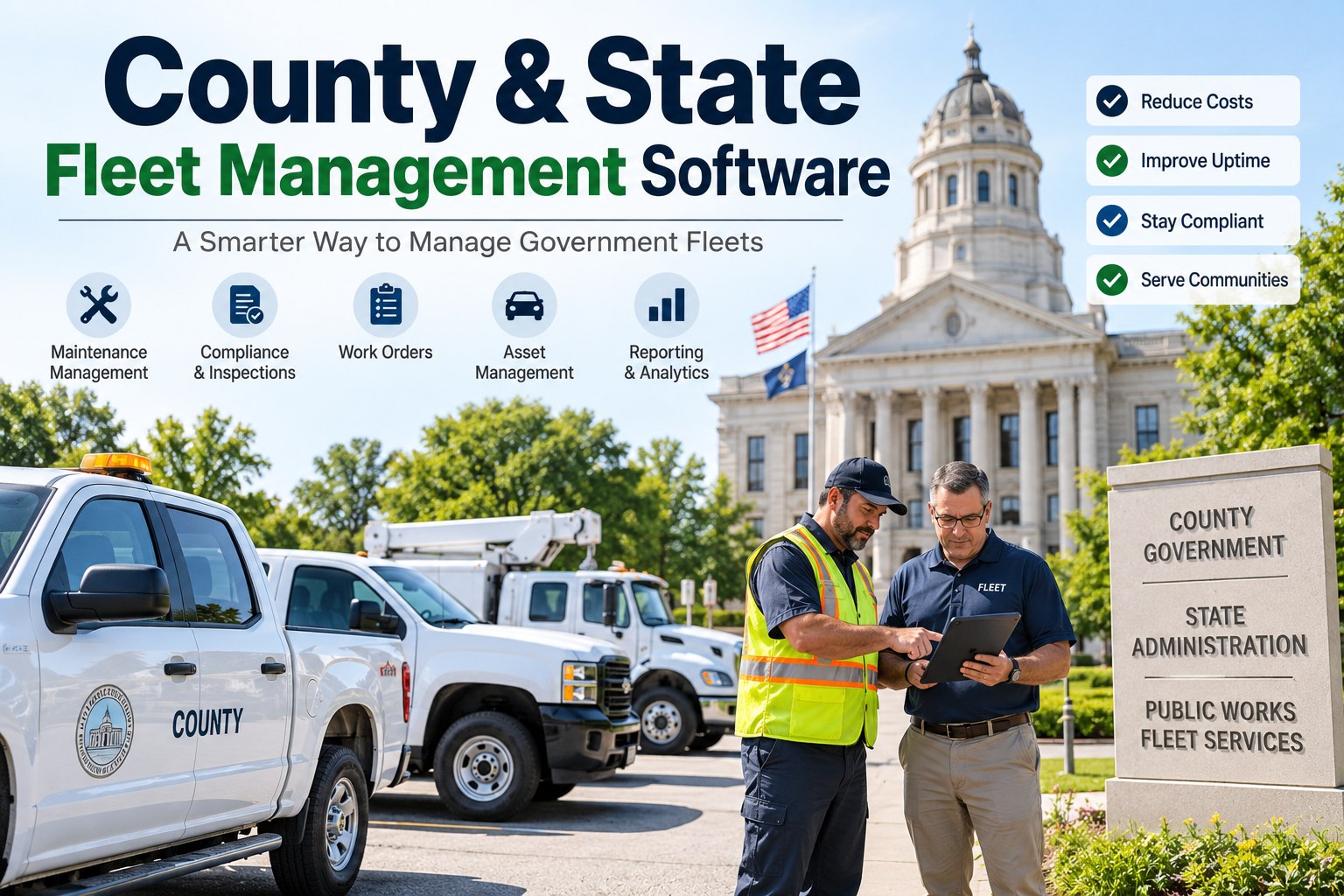
State departments of transportation, county commissioner boards, regional sheriff offices, and county public works divisions manage geographically dispersed, multi-agency fleets spanning thousands of square miles. Overseeing highway maintenance dump trucks, emergency rescue vehicles, law enforcement patrol units, regional transit shuttles, and shared administrative motor pools requires cross-jurisdictional fleet governance rather than fragmented district spreadsheets. When regional fleet directors lack a unified software platform, tax dollars leak through redundant vehicle procurement, missed OEM warranty recoveries, uncoordinated inter-agency maintenance billing, and severe vulnerability during Government Accounting Standards Board (GASB 34/87) compliance audits. FleetRabbit's county and state fleet management software unifies multi-district telematics, digital pre-trip inspection records, automated maintenance work orders, parts room inventory tracking, and capital asset planning into a secure cloud environment. To explore how our platform establishes total cross-county asset transparency, book an executive demonstration with our government fleet advisory team or initialize your multi-agency workspace directly via our free platform sign up.
County & State Fleet Management Software
A multi-agency administrative command portal built for county fleet superintendents and state logistics executives. Centralize district maintenance garages, automate inter-departmental chargebacks, track asset depreciation, and maintain audit-ready records across all municipal divisions.
Tandem Dump Spreaders, Motor Graders, Backhoes • Highway Maintenance Division
Pursuit Utilities, Tactical Command Rigs, Prisoner Transits • Public Safety Division
Sedans, Light Utility Pickups, Passenger Vans • Inter-Agency Shared Resource
Establish Airtight Fiscal Accountability Across Your Regional Fleet
Eliminate departmental data silos, automate inter-agency maintenance chargebacks, and protect taxpayer capital with multi-tiered role-based security starting from $3/vehicle/month with no hardware lock-in.
Operational Challenges Across Multi-Agency Public Sector Fleets
Managing county and state fleet operations presents complex organizational challenges that single-facility commercial fleets never experience. Public sector assets operate under separate departmental budgets: public works, emergency services, regional transit, conservation law enforcement, and county commissioners each draw from dedicated appropriations. When maintenance services are run out of centralized county garages without unified digital software, cross-departmental billing disputes emerge. Garage foremen waste weeks manually re-keying mechanic labor hours and parts inventory receipts into county accounting systems, leading to delayed chargebacks and unrecovered maintenance costs. Concurrently, regional directors struggle with asset hoarding, where individual bureaus retain older, maintenance-heavy spare trucks that sit parked for months while sister agencies bond out new capital purchases. State and county administrators can examine our shared pool optimization workflows by booking an interactive government fleet consultation demo or explore custom agency role configurations via our quick platform sign up.
Automated Inter-Agency Chargebacks and Accounting Sync
When county mechanics service sheriff patrol cruisers or health department vans, FleetRabbit automatically logs parts, fluids, and technician labor against the owning agency's budget code. The platform syncs verified chargebacks directly with municipal ERPs, eliminating billing reconciliations.
True Utilization Index and Fleet Right-Sizing
Departments routinely fight to keep spare vehicles that are rarely operated. FleetRabbit tracks real operating days, engine hours, and mileage accumulation across all divisions. The system identifies chronic underutilized units, providing county commissioners with objective justification to reallocate or auction surplus assets.
Role-Based Access Control and Public Safety Partitions
Public safety operations demand high data privacy. FleetRabbit features configurable, CJIS-aligned role-based access control (RBAC). Law enforcement patrol movements, unmarked investigative assets, and emergency tactical equipment remain hidden from general staff, while finance directors receive aggregated cost reporting.
Central Parts Room Barcode and Core Deposit Recovery
Multi-district garages carry millions of dollars in spare tires, filters, alternators, and hydraulic fittings. The platform monitors inventory minimums, automatically creates re-order requisitions off state supply contracts, and tracks supplier core returns so credits are never abandoned.
Direct Structural Comparison: Disconnected Spreadsheets vs. FleetRabbit
Many regional governments attempt to manage multi-million-dollar vehicle portfolios across isolated desktop spreadsheets, physical greaseboards, and legacy work-order tools that cannot communicate across district lines. Review how fragmented municipal recordkeeping compares directly against FleetRabbit's connected county and state fleet platform across critical public sector benchmarks. County administrators and public works directors can evaluate custom council reporting templates by scheduling an online executive demo or explore driver mobile inspection checklists directly through our self-service sign up.
| Fleet Governance Dimension | Siloed Department Spreadsheets & Paper | FleetRabbit County & State Platform | Taxpayer & Commission Advantage |
|---|---|---|---|
| Inter-Agency Repair Billing | Weeks of end-of-month spreadsheet reconciliation | Automated billing directly to agency budget codes | Zero cross-department billing disputes |
| Capital Asset Replacement Planning | Subjective; agencies guess vehicle retirement dates | Empirical maintenance cost curves & depreciation | Defends Capital Improvement Plans before commissioners |
| Statutory GASB 34/87 Auditing | Months of manual invoice and lease gathering | 1-click export of verified cryptographic ledgers | 100% audit defensibility for comptrollers |
| Parts Inventory & Core Tracking | Unmonitored shelves; frequent stockouts and lost cores | Barcode inventory checkout tied to work orders | Prevents parts shrinkage and recovers vendor credits |
| Multi-District Garage Visibility | Isolated shops with zero insight into neighbor bays | Centralized multi-district maintenance dashboard | Balances shop mechanic workloads across county yards |
4-Stage Regional Government Operational Lifecycle
FleetRabbit standardizes public sector fleet workflows from initial driver daily inspections to long-term capital retirement planning, ensuring complete transparency across every taxpayer-funded asset.
Mobile eDVIR & Shift Launch
Drivers launch the smartphone app to complete pre-trip inspections, photographing tires, safety lighting, hydraulic lines, and fluid levels before pulling out of regional district yards.
Auxiliary Telematics & Exception Triage
While on duty, telematics track vehicle road miles, idle time, and auxiliary power take-off (PTO) hours. Emerging engine trouble codes trigger instant alerts to dispatchers and shop foremen.
Automated Garage Work Orders & Billing
Mechanics issue parts via barcode scans and log repair hours on digital work orders. The system automatically assigns all repair costs directly to the owning agency's budget line item.
Capital Ledger Sync & Commission Reporting
All completed repairs, fuel card transactions, and warranty reimbursements sync to capital depreciation ledgers, producing audit-ready reports for county commissioner hearings.
Public Sector Capital Stewardship: Stopping Operational Budget Drains
Operating a diverse municipal, county, or state fleet without integrated fleet software creates compounding financial leaks across unmonitored jobsite idling, untracked warranty claims, and premature equipment purchases. Uncovering these hidden expenses helps fleet directors and county managers defend budget requests before elected commissioners. Measure your agency's exact savings potential by booking an executive consultation demo or initiate platform onboarding directly via our rapid platform sign up.
Top Causes of County & State Fleet Budget Overruns
Government Platform Architecture Advantages
Links regional maintenance bays, mobile service trucks, and shared parts rooms onto a unified work-order board.
Exports verified asset costs and internal billing directly to platforms like Tyler Technologies (Munis), Workday, and SAP.
Integrates via existing OBD-II units, J1939 CAN-bus ports, factory OEM telematics gateways, or standard driver smartphones.
Capital Improvement Planning and GASB 34/87 Architecture
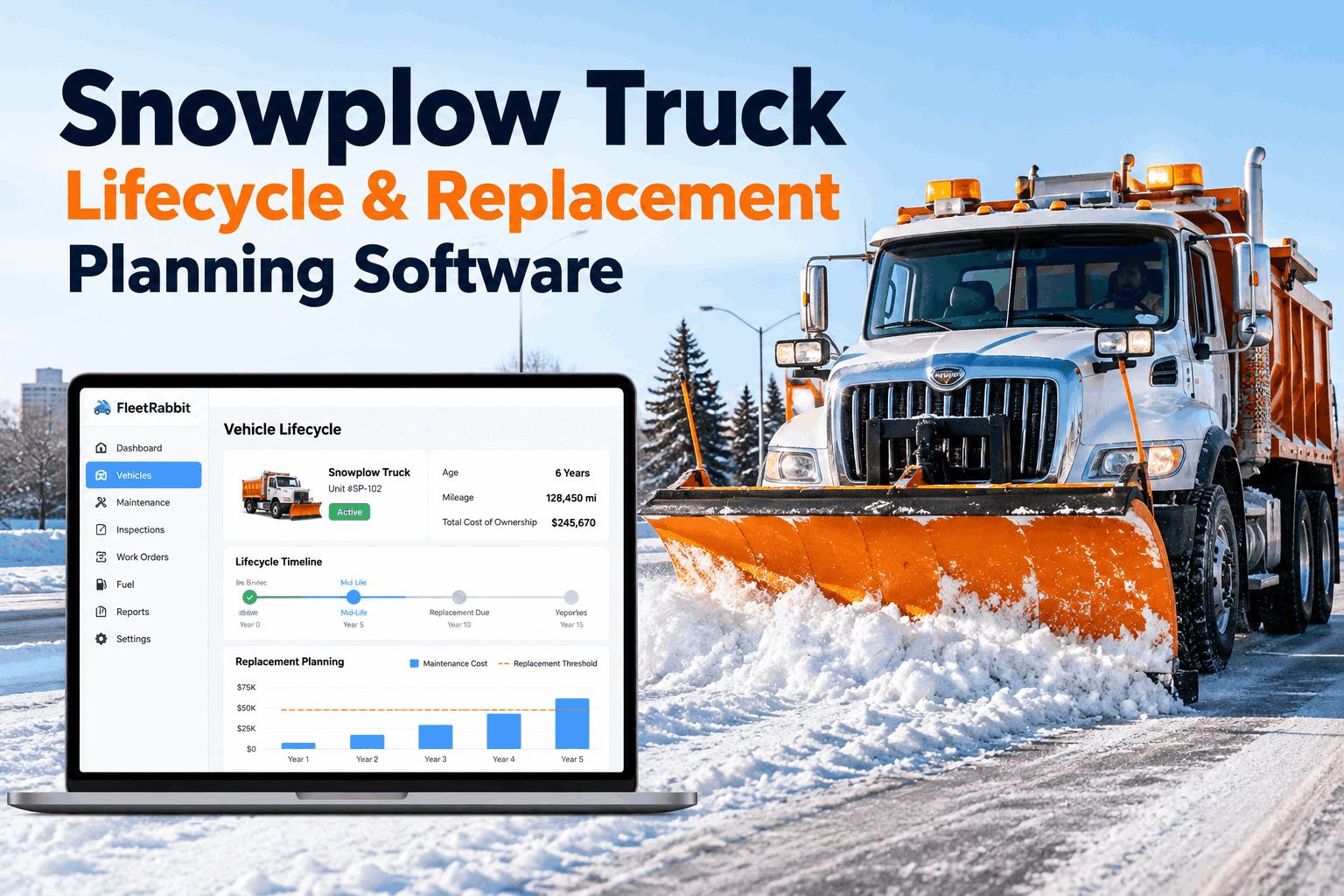
State and county agencies must satisfy strict statutory oversight regarding capital purchases, asset depreciation (GASB 34), and lease accounting (GASB 87). FleetRabbit replaces static vehicle binders with an auditable capital planning framework that models exact equipment replacement schedules based on empirical operating data.
Empirical Retirement Modeling
The system calculates the exact inflection point where cumulative maintenance expenses exceed an asset's residual market value, providing public fleet directors with data-backed justification for equipment replacement schedules.
Audit-Ready Capital Ledgers
Maintain continuous, cryptographically verified histories of capitalized vehicle overhauls, depreciation write-downs, and lease liabilities in full compliance with Government Accounting Standards Board mandates.
State & Federal Grant Compliance
Clean fuel, electrification, and highway safety grants require rigorous ongoing reporting on vehicle utilization, operational run hours, and emissions reductions. FleetRabbit compiles certified utilization reports in minutes.
Frequently Asked Questions for County and State Fleet Executives
How does FleetRabbit handle internal maintenance chargebacks between different county agencies?
When mechanics complete service orders at a central county garage, parts pulled from inventory and technician labor hours are automatically tagged to the vehicle. FleetRabbit assigns these costs directly to the owning agency's budget code and exports verified general ledger transfer files into municipal accounting systems like Tyler Munis or SAP, eliminating cross-department billing disputes.
Can public safety departments restrict operational data while allowing fiscal reporting?
Yes. FleetRabbit includes configurable, CJIS-aligned role-based access control. Sheriff and public safety divisions operate within secure data partitions. Administrative finance and audit personnel view aggregated cost and utilization figures without seeing patrol routes, unmarked vehicle locations, or sensitive incident logs.
How does the software assist with GASB 34 and GASB 87 financial audits?
FleetRabbit maintains an immutable digital ledger of every capitalized overhaul, component replacement, and lease agreement tied to individual asset IDs. At audit time, compliance directors can export pre-formatted depreciation tables, lease liability schedules, and complete service histories in under five minutes.
Does FleetRabbit require installing proprietary hardware across diverse public fleets?
No. FleetRabbit operates on an open, hardware-agnostic architecture. It connects seamlessly with existing OBD-II dongles, heavy-duty J1939 diagnostic ports, factory OEM telematics gateways (such as Ford Pro or GM Envolve), third-party GPS modems, or can be operated using standard mobile devices without adding hardware.
Modernize Your County and State Fleet Governance Today
Eliminate departmental data silos, automate inter-agency chargebacks, and protect taxpayer capital with real-time analytics. Deploy FleetRabbit today with zero proprietary hardware lock-in.