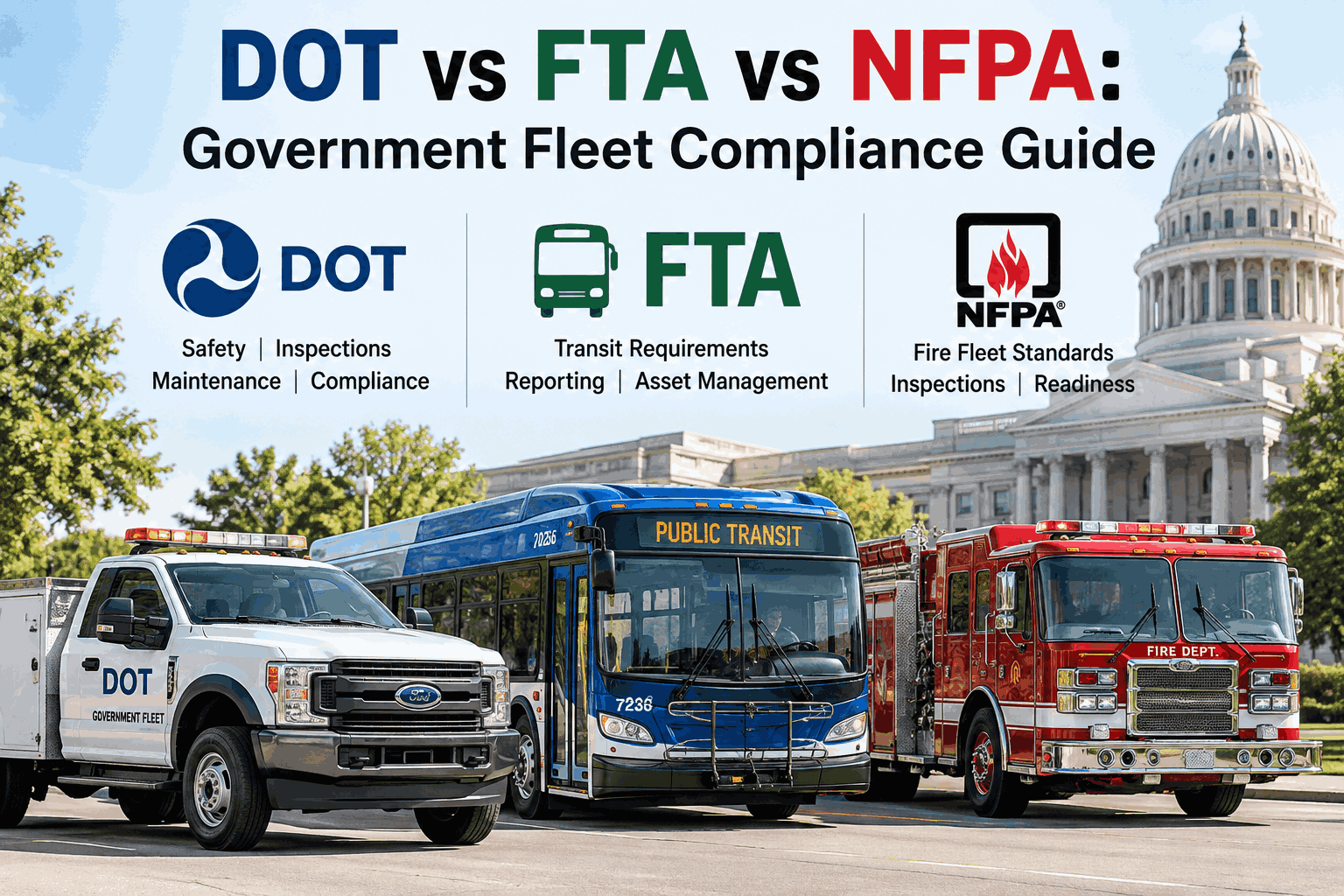
Municipal public works directors, emergency service fire chiefs, and regional transit authority coordinators navigate a complex web of overlapping regulatory frameworks: federal highway safety standards, passenger transit grant covenants, and emergency apparatus service readiness mandates. Operating a diverse public agency fleet requires understanding the clear legal jurisdictional boundaries between Department of Transportation (DOT) commercial motor vehicle safety rules, Federal Transit Administration (FTA) grant oversight mandates, and National Fire Protection Association (NFPA) emergency apparatus readiness codes. When local government entities manage municipal dump trucks, transit cutaways, police interceptors, and aerial fire apparatus on fragmented paper inspection sheets or disconnected spreadsheets, civic agencies face crippling regulatory audit fines, lost federal formula funding, and catastrophic emergency equipment failures during service calls. Fleet Rabbit delivers a purpose-built public sector compliance and fleet management platform engineered for cross-agency governance. Track daily pre-trip walkarounds, automate auxiliary power take-off (PTO) engine-hour maintenance, record mandatory pump pressure testing, and generate audit-defensible compliance records for every civic department in one unified cloud system. Book a Demo to see our cross-agency government compliance software live.
DOT vs FTA vs NFPA: Government Fleet Compliance Guide
An authoritative operational evaluation handbook for civic fleet leaders, municipal attorneys, and emergency directors: compare legal jurisdictions, align maintenance inspection schedules across public works, transit, and fire apparatus, and protect federal grant apportionments.
The Legal & Operational Friction of Competing Regulatory Standards
Municipalities frequently operate shared maintenance facilities where mechanics service heavy snowplows, fixed-route buses, and emergency pumpers in neighboring service bays. Without clear regulatory separation in maintenance workflows, agencies face severe legal liabilities. Sign up to structure compliant workflows for each municipal asset class.
Jurisdictional Comparison: DOT vs. FTA vs. NFPA Standards
Evaluate the statutory foundations, primary inspection scopes, mandatory intervals, and non-compliance penalties across the three dominant public sector fleet frameworks. Book a demo to review our cross-agency regulatory matrix.
| Regulatory Framework | Primary Regulatory Scope | Mandatory Inspection & PM Benchmarks | Driver / Operator Qualifications | Audit & Enforcement Mechanism |
|---|---|---|---|---|
| U.S. DOT / FMCSA (Federal Motor Carrier Safety) |
Commercial motor vehicles (>26,001 lbs GVWR), passenger vans (>15 passengers), and hazmat transport. | Daily pre/post-trip DVIR (49 CFR 396.11), periodic annual mechanical inspections (396.17). | Commercial Driver's License (CDL), medical examiner certificate, DOT drug/alcohol testing. | State commercial vehicle enforcement roadside inspections, FMCSA compliance audits. |
| Federal Transit Admin (FTA) (Public Transit & Mobility) |
Fixed-route buses, cutaways, demand-response paratransit, and transit support assets funded by federal grants. | Strict 10% PM window compliance, daily ADA wheelchair lift cycles, SGR condition scoring (Part 625). | CDL with passenger endorsement, Part 655 transit drug and alcohol testing, safety training (Part 673). | Statutory Triennial Reviews, State Safety Oversight (SSO) audits, grant compliance reviews. |
| NFPA Standards (Fire & Emergency Apparatus) |
Pumper apparatus, aerial ladder trucks, rescue squads, wildland units, and mobile emergency equipment. | Annual pump performance test, aerial non-destructive test, weekly operational service checks (NFPA 1911). | Emergency Vehicle Operator Course (EVOC/NFPA 1002), specialized apparatus driver training. | ISO public protection grading reviews, state fire marshal inspections, OSHA safety reviews. |
Cross-Agency Asset Compliance Profiles
Review the specific compliance requirements, maintenance intervals, and critical documentation points across primary municipal asset categories. Sign up to automate maintenance intervals by asset classification.
- Primary Standard: State Commercial Motor Vehicle / DOT Adoption
- Weight Class: 26,001 to 66,000+ lbs GVWR
- Critical Inspection: Air brake pushrod travel, steering linkage slack, pintle hitch wear, amber beacon visibility.
- Maintenance Trigger: Auxiliary PTO hydraulic hours and heavy engine load cycles. Book a demo to inspect our PTO engine runtime telemetry.
- Primary Standard: FTA 49 CFR Part 625 (TAM) & Part 673 (PTASP)
- Capacity Class: 12 to 40+ seated passengers
- Critical Inspection: Daily wheelchair ramp and lift deployment, passenger door interlock, emergency exits.
- Maintenance Trigger: Strict 10% PM mileage window and National Transit Database (NTD) mileage logs.
- Primary Standard: NFPA 1901 (Design) & NFPA 1911 (Maintenance)
- Apparatus Class: Structural fire apparatus, ladder trucks, wildland units
- Critical Inspection: Annual hydrostatic pump testing, aerial torque box non-destructive examination, breathing air quality.
- Maintenance Trigger: Engine pumping run-hours and NFPA out-of-service defect criteria. Sign up to deploy NFPA out-of-service digital checklists.
The 4 Pillars of Unified Municipal Compliance Architecture
Fleet Rabbit consolidates disparate federal and industry mandates into an intuitive, paperless operational platform designed for shared municipal maintenance facilities. Book a demo to see our unified compliance platform in action.
System Comparison: Disconnected Tracking vs. Fleet Rabbit
Compare the operational, financial, and compliance differences between fragmented paper binders and Fleet Rabbit’s unified civic compliance platform. Book a demo to review our platform capability comparison.
| Compliance Management Capability | Fleet Rabbit Unified Platform | Paper Clipboards & Filing Cabinets | Generic Fleet GPS Trackers |
|---|---|---|---|
| Subscription Rate | $5 / asset / month | High administrative payroll & audit risk | $25 – $45 / vehicle / month |
| Cross-Agency Standard Support | Native DOT, FTA, and NFPA modules | Fragmented across scattered binders | Commercial highway fleet only |
| Auxiliary PTO Engine Tracking | Automated CAN-Bus telematics capture | Unrecorded driver memory | Odometer miles only |
| Mobile Driver & Mechanic Walkaround | Included offline-first mobile app | Stained or lost paper inspection sheets | Driver app only (no shop tools) |
| FTA 10% PM Window Monitoring | Real-time alerts & compliance tracking | Frequent missed windows on paper logs | Not supported |
| NFPA Out-of-Service Red-Tagging | Instant dispatch lock & priority work order | Delayed verbal notes to mechanics | Not available |
| Deployment & Onboarding | 14-day free trial, live in 14 days | Continuous administrative overhead | 1 to 3-year auto-renewing contract |
Municipal Case Study: City of Central Falls Multi-Agency Fleet
Learn how a municipal government consolidated fleet compliance across Public Works, Municipal Transit, and Fire Rescue across 76 civic vehicles. Sign up to achieve similar cross-agency compliance results.
Managing 76 assets across Public Works, Municipal Transit, and Fire Rescue divisions, the City of Central Falls operated under conflicting maintenance standards. The transit division had received an audit finding during a previous FTA Triennial Review for missed 10% preventative maintenance windows, the fire department tracked pump tests on paper binders stored in firehouses, and public works drivers struggled with manual DOT logbooks.
By implementing Fleet Rabbit at $5/asset/month, the city deployed tailored mobile inspection checklists for each department, connected auxiliary PTO telematics for heavy machinery, and centralized maintenance records. At their subsequent federal Triennial Review, transit auditors cleared all previous findings with zero repeat deficiencies. The public works department achieved a 100% clean roadside DOT inspection record, the fire department automated NFPA pump test documentation for ISO grading reviews, and the city saved $52,000 in software overhead and administrative payroll.