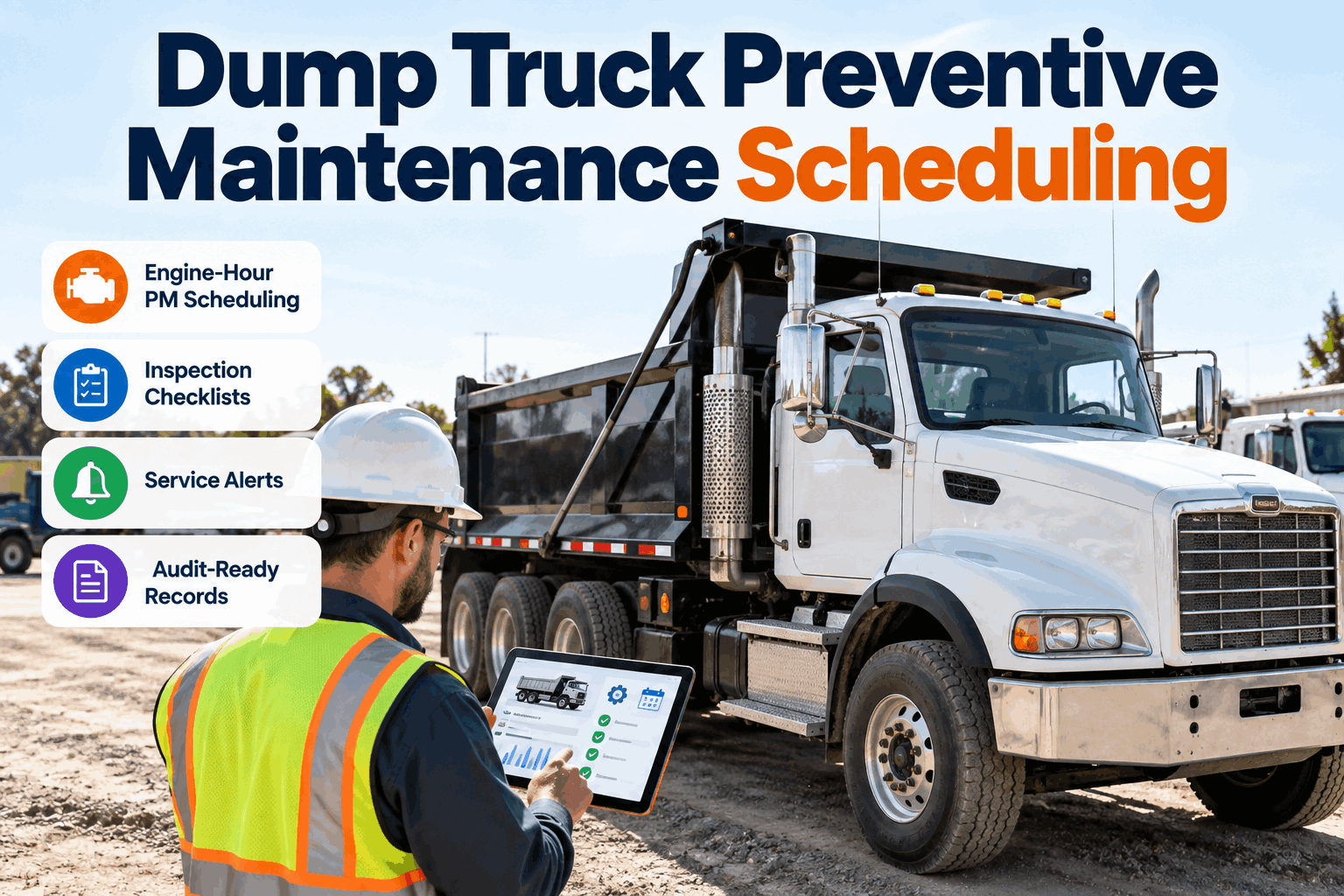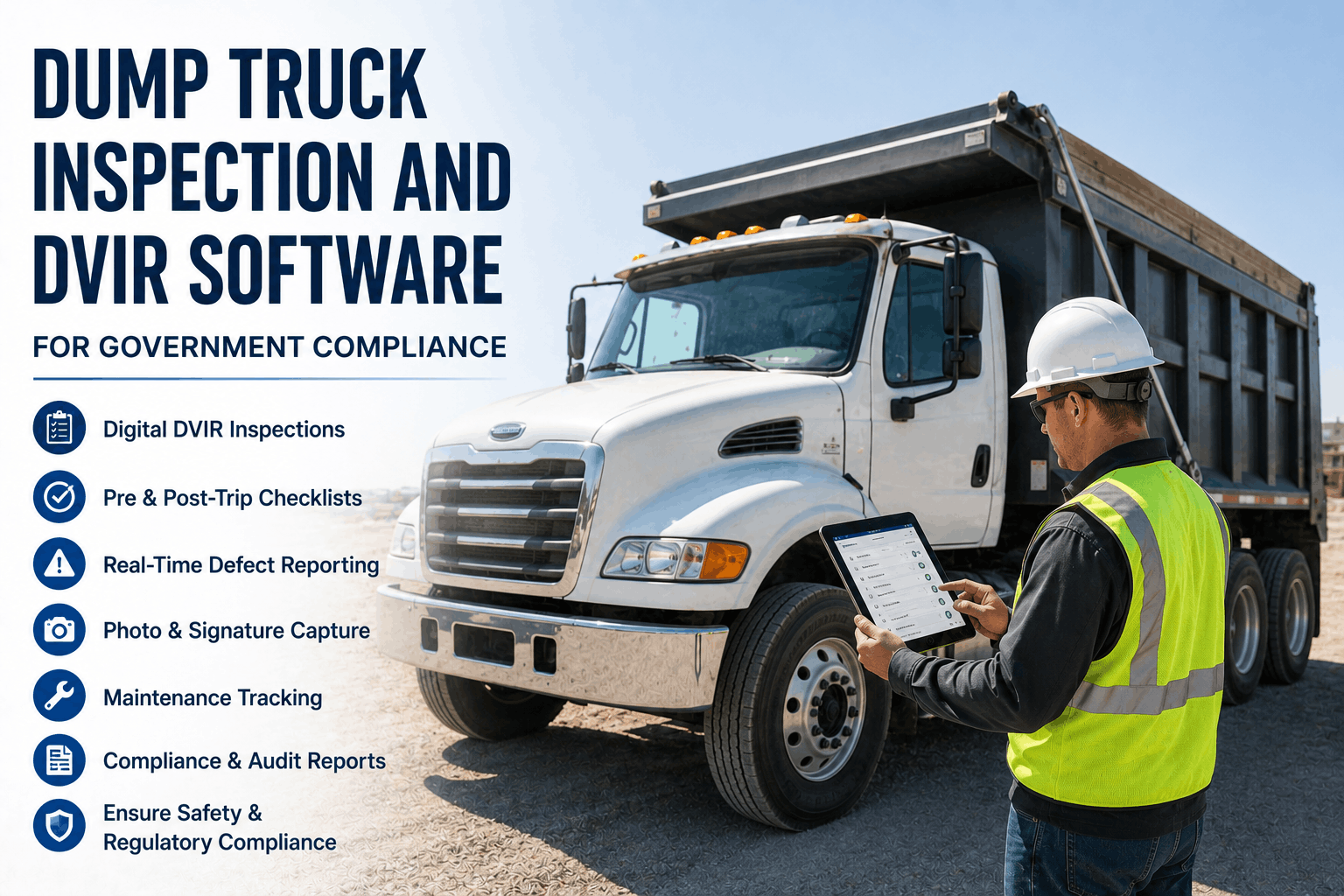
A dump truck fails an inspection for reasons a sedan never will: a hydraulic hoist that will not hold pressure under a full bed, a tailgate latch worn loose from thousands of dump cycles, an air brake system carrying loads well past what the chassis was ever meant to idle at. Government fleets running dump trucks are held to the same DOT and CVSA standards as any commercial vehicle, but the components doing the failing are specific to the job the truck does every day. This guide breaks down what a defensible DVIR and inspection program actually needs to cover for a dump truck, how the CVSA roadside inspection levels work, and how FleetRabbit keeps every pre-trip, post-trip, and defect record audit-ready without anyone digging through a glovebox for a paper form.
What a defensible DVIR cycle looks like
Federal rules require a driver vehicle inspection report before and after every trip, and the record only holds up if a flagged defect can be traced through to a signed repair. Departments that book a demo with FleetRabbit usually do it right after an audit exposed a gap somewhere in this chain.
Pre-trip inspection
Driver checks brakes, hoist controls, tailgate latch, tires, and lighting before the unit leaves the yard.
Defect logged
Any issue is recorded against the specific unit with time, location, and severity noted on the spot.
Repair assigned
Safety-critical defects route straight to a technician and the unit is held out of service until cleared.
Certified repair
The repair is signed off against the original defect record, closing the loop with a timestamp.
Post-trip sign-off
Driver completes the closing DVIR, and the full cycle sits ready for review at any point.
Close the loop on every defect automatically
FleetRabbit ties every DVIR entry to its repair record, so a flagged hoist or brake defect cannot quietly disappear between shifts.
The components inspectors actually check
A dump truck's inspection checklist is shaped by what the truck physically does: raise a loaded bed, hold it there, drop the load, and repeat all day. A checklist that treats it like a straight cargo truck will miss the parts that fail first, so it pays to sign up for a checklist built around the actual duty cycle.
Hydraulic hoist and PTO
Checked for hold-pressure, leaks, and cylinder pin wear before every load is raised, since a hoist failure under a full bed is a safety event, not a maintenance inconvenience.
Tailgate and latch mechanism
Latch wear from repeated dump cycles is checked daily, since a failed latch can release a load unexpectedly on the road or at the site.
Brakes and air system
Air brake components are inspected daily and again at every DOT periodic inspection, since loaded stopping distance is one of the most common CVSA out-of-service findings.
Tarp or cover system
Cover mechanism function is checked before every load to prevent debris spillage violations on public roads.
Frame and suspension
Frame stress points and suspension components are checked weekly for cracking or fatigue caused by repeated heavy-load cycling.
Body and bed liner
Bed wear and structural integrity are checked weekly, particularly for units hauling abrasive material such as gravel or demolition debris.
Understanding the CVSA inspection levels
A dump truck pulled at a weigh station or roadside checkpoint can face any of six standard inspection levels, and knowing what each one covers helps a department prepare its drivers and records accordingly.
| Level | What it covers |
|---|---|
| Level I | The most thorough inspection, covering driver credentials plus a full mechanical check including under the vehicle |
| Level II | Same driver and vehicle scope as Level I, but limited to what can be checked without going underneath |
| Level III | Driver credentials, hours of service, and documentation only, with no vehicle mechanical check |
| Level IV | A focused one-time check of a single item, usually conducted to support a broader safety study |
| Level V | A full vehicle-only inspection performed without the driver present |
| Level VI | An enhanced inspection reserved for vehicles hauling specific radioactive shipment categories |
Paper DVIRs vs FleetRabbit
| Task | Paper and spreadsheets | FleetRabbit |
|---|---|---|
| Pre and post-trip DVIRs | Paper forms filed in a cab folder | Digital forms tied directly to the unit |
| Defect-to-repair tracking | Manually cross-referenced, if at all | Automatically linked and closed out |
| Hoist and brake check history | Scattered across paper logs | Searchable by unit and date |
| Audit preparation | Days of manual document pulling | One export, always current |
| Field connectivity | Not usable on remote job sites | Works offline, syncs automatically |
Make every dump truck audit-ready by default
From pre-trip DVIRs to hoist inspections and CVSA prep, FleetRabbit keeps your dump truck fleet's records complete without extra paperwork for your drivers or shop.
Common questions
How many DVIRs does a dump truck need each day.
Federal rules require a pre-trip and a post-trip driver vehicle inspection report for each day the unit is operated, and both records need to be tied to the specific unit for audit purposes.
What makes dump truck inspections different from a standard cargo truck.
The hydraulic hoist, tailgate latch, and tarp or cover system are checked on a duty-cycle basis rather than only daily, since these components take direct load stress every time the bed is raised and lowered.
Which CVSA inspection level is most common for dump trucks at a weigh station.
Level I and Level III are the most commonly performed, with Level I covering a full driver and vehicle check and Level III covering driver credentials and documentation only.
How quickly does a flagged safety defect need to be repaired.
A vehicle with a safety-critical defect should be held out of service until the repair is completed and certified, with the repair record linked directly back to the original DVIR entry.
Can drivers complete inspections without cell signal at a remote job site.
Yes. FleetRabbit inspections can be completed offline and will sync automatically once the device reconnects, so remote sites never create a gap in the record.