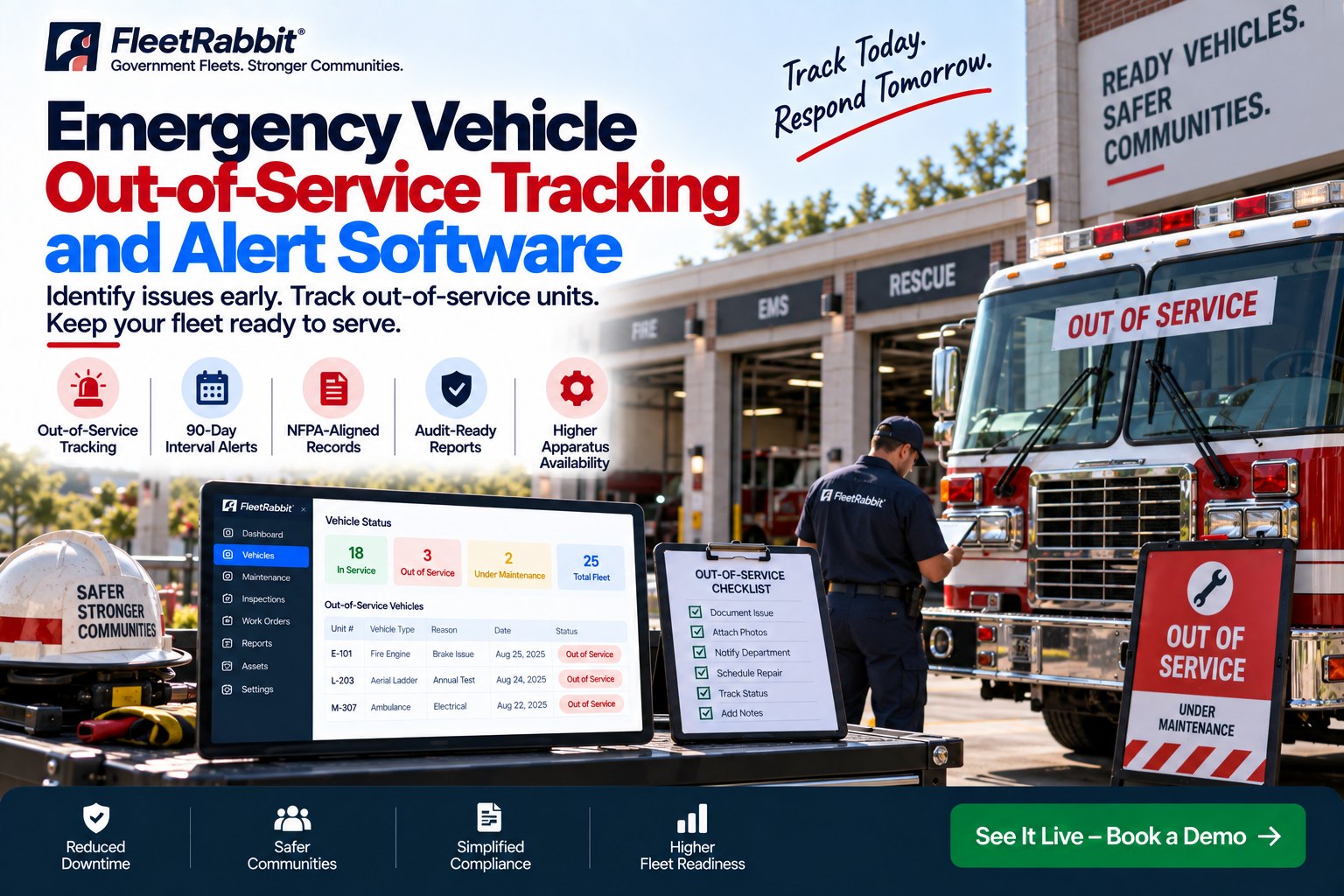
NFPA 1911 gives technicians three possible calls on an apparatus: service-ready, in service with restrictions, or out of service entirely — and it makes the authority having jurisdiction responsible for enforcing whichever one applies. The catch is that most agencies still track that status on a whiteboard, a radio call, or a mechanic's memory, which means a unit that should be restricted or grounded can end up dispatched anyway. FleetRabbit's emergency vehicle out-of-service tracking software turns that three-way call into a live status that follows the vehicle, blocks dispatch automatically, and keeps a documented record for as long as that apparatus is in service — even if it changes hands. Book a demo to see the status board on your own fleet.
A Grounded Unit Shouldn't Be One Radio Call Away From Getting Dispatched Anyway
Track every apparatus against a real status — service-ready, restricted, or out of service — and stop a flagged vehicle from ever reaching the dispatch board by accident.
NFPA 1911 Doesn't Give You a Pass/Fail — It Gives You a Judgment Call
Chapter 6 of NFPA 1911 defines conditions that require immediate removal from service, and others a technician has to evaluate case by case. That evaluation lands on one of three outcomes — and each one changes what a unit is allowed to do next.
Service-Ready
No defect found that affects safe operation. The unit is cleared for full, unrestricted response.
Restricted Use
A defect exists that doesn't require full removal, but limits what the unit can safely be assigned to — noted so every crew that uses it knows the limitation.
Out of Service
A condition serious enough that the apparatus is removed from service immediately, until the defect is corrected and verified.
The Record Has to Follow the Vehicle — Even If the Vehicle Changes Hands
Every inspection, maintenance action, and out-of-service determination has to be logged against that specific unit, and that record is expected to travel with the vehicle for its entire service life — including if it's ever transferred or sold to another department.
Put Your Out-of-Service Criteria on a Board Every Dispatcher Can See
Bring your current out-of-service policy to the call — we'll show you how it maps to FleetRabbit's status workflow before you commit to anything.
What Actually Changes When a Unit Gets Flagged
Dispatch lock, automatically
A unit marked restricted or out of service is removed from the assignable list the instant a technician logs it — no separate call to dispatch required.
90-day and custom interval alerts
Recurring inspection and testing intervals fire automatically, so a unit doesn't drift into a defect nobody was watching for.
One record per vehicle, for life
Every inspection, repair, and status change is tied to the specific unit — and moves with it if the apparatus is reassigned or sold.
Audit export, on demand
Pull the full inspection, testing, and out-of-service history for any unit into one export for an AHJ review or insurance audit.
FleetRabbit vs. Whiteboards vs. Generic Fleet Software
| Capability | FleetRabbit | Generic Fleet Software | Whiteboard / Radio Call |
|---|---|---|---|
| Three-state out-of-service tracking | Built in | Rarely supported | Verbal / easy to miss |
| Automatic dispatch lock on flag | Yes | Manual step | None |
| Lifetime, transferable vehicle record | Yes | Tied to one agency's system | Lost with the unit |
| 90-day / custom interval alerts | Configurable | Basic reminders only | None |
| One-click AHJ audit export | Yes | Limited | Manual compiling |
We used to find out a unit was supposed to be restricted when the crew radioed in confused about why it wasn't handling the way it should. Now that status is set the moment our tech logs the finding, and it's gone from the dispatch board before the truck even leaves the bay.
Fleet Maintenance Supervisor, Regional Fire & Rescue Department
Frequently Asked Questions
Does NFPA 1911 apply to ambulances or only fire apparatus?
Since the standard was retitled to cover "in-service emergency vehicles," it applies to ambulances as well as fire apparatus, not just engines and ladder trucks.
Who decides whether a unit is out of service?
A technician evaluates the specific condition and recommends an outcome, but it's the authority having jurisdiction that is responsible for enforcing the out-of-service criteria for that apparatus.
What happens to a unit's history if we sell or transfer it?
The expectation is that inspection, maintenance, and testing records travel with the vehicle for its service life, including after a transfer or sale. FleetRabbit's export lets you hand that full record to the receiving agency instead of starting their file from zero.
Can we customize inspection intervals beyond 90 days?
Yes. 90 days is a common configuration, but every interval — daily, 90-day, annual, or a custom schedule tied to your own program — can be set per vehicle or per component.
Is there a free trial before we roll this out fleet-wide?
Yes — start a free trial on a small group of units, or book a walkthrough with your current out-of-service policy first.
Stop Relying on Memory to Keep a Grounded Unit Grounded
Three-state out-of-service tracking, automatic dispatch locks, and a lifetime vehicle record — built for how fire and EMS fleets actually enforce readiness.