Public works directors, municipal garage superintendents, police fleet managers, and county maintenance engineers operate mixed-asset public service fleets under harsh mechanical conditions: heavy public works dump trucks idling during winter blizzards, police interceptors running auxiliary electronics on roadside patrol for eight straight hours, and diesel backhoes operating at peak hydraulic throttle with zero odometer movement. In municipal government operations, relying strictly on odometer mileage or calendar-month maintenance intervals creates massive blind spots. According to widely accepted automotive engineering standards, one hour of engine idling inflicts thermal fatigue and lubricant degradation roughly equivalent to driving 30 miles. A police pursuit utility vehicle with 40,000 miles on the odometer that has accumulated 3,000 idle hours has actually endured engine wear equivalent to over 130,000 highway miles. When public agencies service equipment solely by odometer mileage, auxiliary diesel engines, power take-off (PTO) hydraulic pumps, and pursuit powertrains miss essential oil, filter, and cooling services. The result is catastrophic engine seizures, sudden snowplow breakdowns mid-storm, emergency repair bills that exceed scheduled preventive maintenance costs by 150% to 200%, and unbudgeted municipal capital expenses that draw scrutiny from town councils and taxpayer boards. FleetRabbit delivers dedicated public sector fleet management software built specifically around engine-hour tracking and dual-interval preventive maintenance. By fusing J1939 and OBD-II CAN-bus engine-hour telemetry, automated PM triggers, mobile operator pre-trip eDVIRs under DOT 49 CFR Part 396, and closed-loop municipal garage work orders into a platform priced at $5 per asset per month, FleetRabbit protects public equipment uptime. Track run-hour thresholds, eliminate unexpected breakdowns, and log municipal equipment walkarounds completely offline inside reinforced concrete maintenance barns, underground utility garages, and rural DPW yards with zero cellular reception. Discover how our engine-hour maintenance platform protects municipal budgets when you book a demo or start tracking your public equipment immediately when you sign up for our platform.
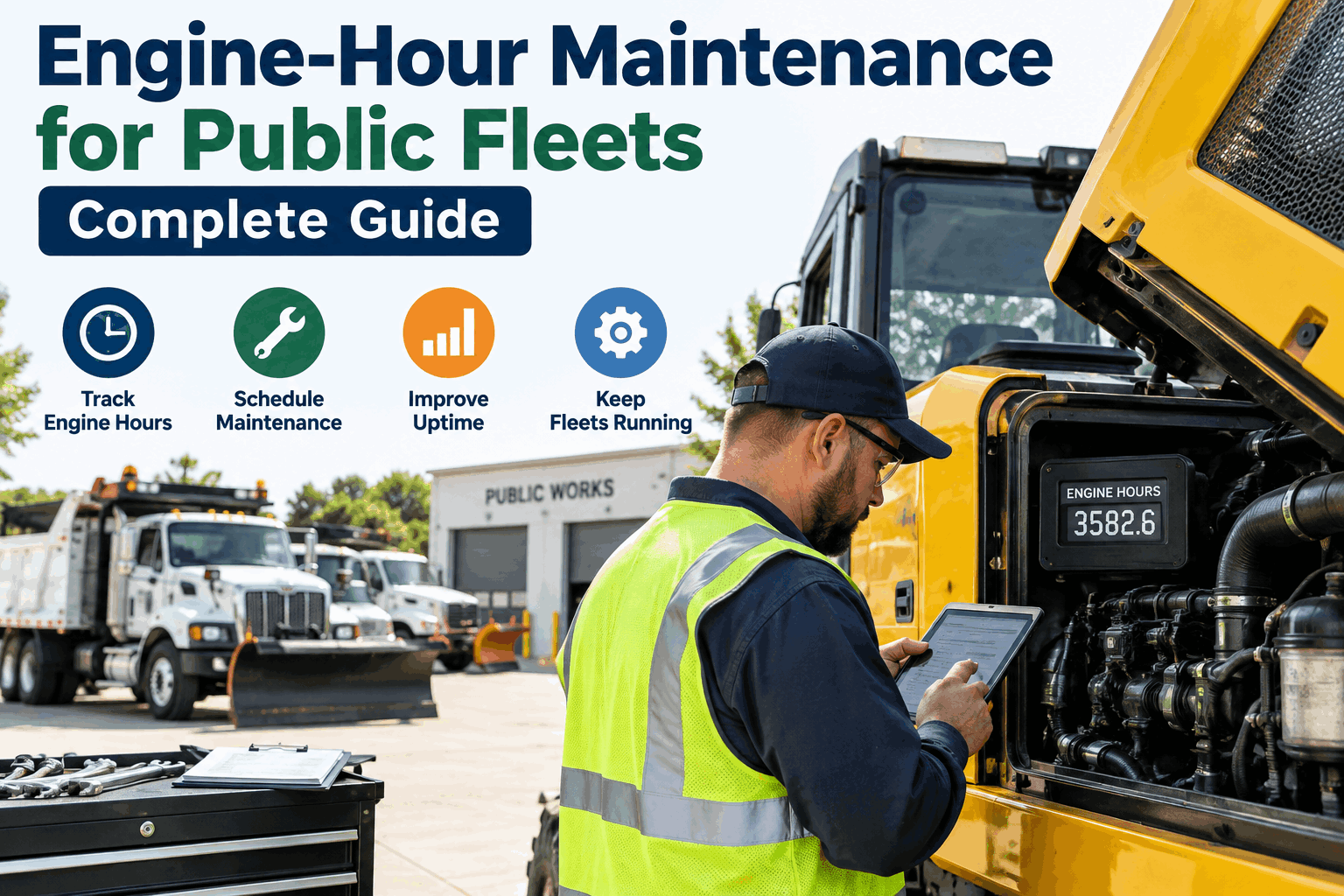
Eliminate odometer blind spots in municipal fleet management. Learn the 1-hour-to-30-miles conversion formula, establish empirical run-hour preventive maintenance tiers (250, 500, 1,000 hrs), and deploy automated CAN-bus hour tracking that cuts unexpected public works equipment downtime by up to 40%.
The 1-Hour-to-30-Miles Rule: Why Public Fleet Odometers Lie
Odometer mileage measures wheel rotation, not thermal component fatigue; understanding the conversion between operating hours and equivalent road miles is essential for public sector fleet survival.
When an engine idles, fuel burns, oil shears, heat builds up, and carbon deposits form on valves and diesel particulate filters (DPFs)—all with zero recorded wheel movement. A public safety patrol SUV that logs 10,000 miles and 1,000 idle hours in a year has accumulated equivalent engine component wear of $10,000 + (1,000 \times 30) = 40,000\text{ miles}$. Servicing this vehicle on a standard 5,000-mile odometer schedule means it goes through multiple cycles of severely degraded, thermal-stressed engine oil.
Municipal Equipment Idling Ratios & Wear Patterns
Recommended Engine-Hour Preventive Maintenance Tiers
Public fleet preventive maintenance schedules operate across four standard run-hour tiers; structuring service intervals around these thresholds prevents component breakdown and premature engine retirement.
Short-Cycle Lubrication & Visual Safety
- Inspect and grease all steering linkage and suspension fittings
- Drain water separator bowls and fuel filter sediment
- Check hydraulic fluid levels and inspect PTO pressure hoses
- Inspect snowplow cutting edges, salt spreader chains, and wear plates
Minor PM-A Engine & Filter Service
- Change engine crankcase oil and replace full-flow oil filters
- Extract oil fluid sample for spectrographic lab analysis
- Inspect engine serpentine drive belts and alternator tensioners
- Clean and load-test starter battery terminals and cranking health
Intermediate PM-B Fuel & Cooling Service
- Replace primary and secondary fuel filters and strainers
- Replace return-line hydraulic filters and air intake elements
- Test engine coolant SCA/nitrite levels and freeze-point protection
- Inspect air brake treadle valves, brake chambers, and slack adjusters
Major PM-C Powertrain & DPF Overhaul
- Service transmission fluids, differential gear oils, and transfer cases
- Clean diesel particulate filter (DPF) and test exhaust backpressure
- Conduct valve lash clearance adjustments on applicable diesels
- Perform complete structural boom and bucket non-destructive weld tests
The Real Costs of Odometer-Only Scheduling in Public Fleets
Managing government equipment on odometer miles or calendar months creates serious financial and legal liabilities for municipalities. Review our municipal risk mitigation models when you book a demo or start testing our cloud tools directly when you sign up for immediate platform access.
Catastrophic Snowplow Stalls During Winter Storms
Public works dump trucks idle for hours during severe blizzards while clearing secondary roads. When hydraulic fluid and engine oil are serviced strictly by odometer mileage, high engine runtime degrades oil additives. Hydraulic pumps seize and engines overheat mid-storm, leaving primary emergency routes unplowed.
Unbudgeted Emergency Repairs Overrunning Town Tax Funds
Emergency roadside towing and outside diesel repair shop invoices carry a 150% to 200% cost premium over planned in-house garage preventive maintenance. A single blown diesel engine on a 7-year-old municipal utility truck can cost $18,000 to replace, wiping out a small town's annual fleet repair contingency fund.
Premature DPF Clogging and Emissions Limp Modes
Extended engine idling without load creates low combustion temperatures, resulting in rapid soot accumulation in the diesel particulate filter. Without engine-hour tracking to prompt forced regenerations or 1,000-hour DPF cleanings, engines trigger derate limp-home modes during emergency calls.
Steel DPW Barns and Rural Municipal Dead Zones
Public works garages, salt sheds, and utility treatment plants are built with steel reinforcement, creating complete cellular dead zones. Cloud-only tools crash, causing operators to abandon digital pre-trip inspection logs and leaving municipal equipment undocumented.
Built Specifically for Public Sector Engine-Hour Maintenance
FleetRabbit connects CAN-bus telematics gateways, mobile driver walkaround forms, shop work orders, and town council budget reporting into an integrated command platform. Discover how our software streamlines your municipal operations when you book a demo with our team.
Automated Whichever-Comes-First PM
Triggers service work orders on whichever metric occurs first—operating hours, odometer miles, or calendar days—ensuring high-idle public safety vehicles and equipment are never neglected.
Microprocessor Run-Hour Ingestion
Directly reads cumulative engine run hours, idle hours, PTO operating time, and diagnostic trouble codes from heavy-duty J1939 and OBD-II vehicle diagnostic ports without manual data entry.
Defect-Driven Dispatch Lockouts
Vehicles tagged with critical mechanical defects—such as low brake pressure, hydraulic leaks, or overdue safety PMs—are automatically blocked on the central municipal dispatch board.
DPW Garage Offline Mobile Sync
Municipal mechanics sign off work orders and operators complete pre-trips inside reinforced steel DPW sheds with zero cellular reception; all diagnostic records auto-sync upon departure.
Town Garage Parts Inventory Control
Links parts consumption directly to engine-hour work orders: reserve filters, hydraulic fluid, and brake pads automatically when vehicles approach their 250-hour service window.
1-Click Town Council Budget Dossiers
Generate clear, professional fleet lifecycle reports, maintenance histories, and capital justification sheets formatted for town managers, select boards, and municipal auditors.
Direct Mapping to Federal & Municipal Safety Regulations
Operating a public sector fleet with dual engine-hour and mileage tracking maintains strict compliance with commercial motor carrier safety standards, employee protection laws, and public accounting directives.
Standardizes daily pre-trip and post-trip driver walkarounds (§ 396.11), qualified mechanic corrective action signatures (§ 396.13), and statutory 90-day electronic maintenance record retention across heavy municipal assets.
Enforces statutory employee protection requirements: mandatory documentation of emergency brake systems, backup alarms, tire condition, and hydraulic liftgate safety latches across public works equipment.
Tracks historical acquisition costs, annual depreciation schedules, and cumulative overhaul expenditures for municipal rolling stock, ensuring compliance with capital asset reporting standards.
Provides standardized preventive maintenance frameworks matching national fire and emergency apparatus service standards, including pump transmission checks, chassis inspections, and electrical load monitoring.
Public Fleet Maintenance Software Benchmark Comparison
A feature-level comparison evaluating engine-hour scheduling precision, dispatch safety gating, and offline resilience as of 2026. Schedule a personalized walkthrough when you book a demo with our team.
| Maintenance Capability | FleetRabbit | Legacy Enterprise Municipal CAD | Basic Telematics Portals | Paper Clipboards & Spreadsheets |
|---|---|---|---|---|
| Pricing (per asset/month) | $5/month flat | $35–$75/month | $15–$30/month | High emergency breakdown costs |
| Automated Engine-Hour & Mileage Dual PM | Native automated scheduler | Requires custom module setup | Basic sensor ping only | Mileage only (Neglects high idle) |
| Setup & Onboarding Surcharges | $0 (Free self-onboarding) | $3,500–$12,000 professional fees | $500–$1,500 setup charge | Hundreds of municipal staff hours |
| Defect-Driven Dispatch Safety Lockout | Instant block on critical defect | Manual supervisor note | Not supported | None (Compromised gear rolls) |
| DPW Barn Offline Mobile Sync | Full store-and-forward | Network dependent | Data dropped offline | Paper logs only |
| Free Trial Access | 14 days, up to 3 assets | Sales demonstration only | Limited sandbox demo | None |
| Contract Terms & Procurement | Monthly or annual (No lock-in) | 3 to 5-year mandatory contract | 2 to 3-year contract | None |
5-Step Engine-Hour Maintenance Implementation Pathway
FleetRabbit embeds cleanly into your municipal public works garage, administrative offices, and operator mobile devices in under two weeks without operational disruptions. Begin testing immediately when you sign up for our free trial.
Municipal Asset Master & Meter Type Ingestion
Import municipal trucks, police cruisers, snowplows, backhoes, acquisition dates, department cost centers, and historical maintenance ledgers via automated CSV tools.
Dual Engine-Hour & Mileage Interval Configuration
Set up automated service schedules based on manufacturer guidelines: establish engine-hour PM thresholds for heavy equipment and mileage intervals for public safety patrol vehicles.
Digital eDVIR & Dispatch Lockout Setup
Configure digital mobile inspection walkaround checklists tailored to municipal vehicle classes, establishing automated dispatch lockouts for safety-critical defects.
Operators & Shop Technicians Mobile Rollout
Equip municipal equipment operators, police officers, and town mechanics with the offline-first mobile app on standard smartphones or rugged tablets for rapid pre-trips.
Engine-Hour Command Go-Live
Activate live fleet status dashboards, automated shop work order queues, parts inventory reorder triggers, and 1-click town council budget reporting archives.
2-Week Deployment Plan & Milestones
A structured timeline designed to transition small municipal fleet operations from paper binders to digital engine-hour governance with zero disruption to daily public services. Review our full onboarding plan when you book a demo today.
Week 1: Department Data & Rule Setup
- Audit paper work order clipboards, previous capital requests, and maintenance invoices
- Configure vehicle profiles by department: Police, Fire, DPW, Parks, and Administration
- Set up dual engine-hour and mileage preventive maintenance schedules
- Assign user access roles for Town Managers, Public Works Superintendents, and Shop Mechanics
Week 2: Garage Rollout & Live Verification
- Distribute mobile app to municipal operators and conduct 15-minute training on digital pre-trips
- Validate store-and-forward offline syncing inside concrete maintenance garages and utility yards
- Simulate a critical safety defect to verify automated dispatch lockout gating and shop routing
- Launch live fleet management dashboard and town council replacement budget reporting
Documented Public Sector Engine-Hour Results
Operational improvements documented by local government agencies that transitioned from odometer scheduling to engine-hour preventive maintenance. Review the complete municipal case study when you book a demo with our team.
40% Reduction in Winter Breakdown Costs Across 35 Dump Trucks
A county road department managing 35 tandem-axle dump trucks suffered recurring mid-winter hydraulic pump and engine seizures due to servicing vehicles on 6,000-mile odometer intervals. FleetRabbit deployed automated 250-hour dual PM scheduling, cutting emergency winter road calls by 40% and saving $36,000 in outside contractor repairs in year one.
Engine Failures Eliminated Across 24 Patrol Interceptors
A municipal police department operating 24 patrol utility vehicles faced premature camshaft wear and blown head gaskets caused by idling during stationary traffic details. FleetRabbit connected CAN-bus hour meters, adjusting service intervals to 200 engine hours and eliminating premature engine failures completely over two full operating cycles.
When you run a municipal public works department, managing your fleet on odometer mileage alone is a recipe for disaster. Our tandem dump trucks and front-end loaders spend half their lives idling at job sites or running heavy hydraulic pumps while barely moving forward. We had trucks with only thirty thousand miles on the odometer that were having total hydraulic pump seizures and engine failures because they had accumulated over three thousand operating hours without a proper service. Before FleetRabbit, our shop tracked servicing on a whiteboard and we were constantly blindsided. FleetRabbit completely transformed our garage operations. It pulls our true engine hours directly from the vehicle CAN-bus, triggers our 250-hour oil and filter changes automatically, and alerts our mechanics before component fatigue causes a breakdown. It cut our repair bills, kept our snowplows moving through every major storm, and saved our town thousands of dollars in taxpayer money.
Frequently Asked Questions
Take Control of Your Fleet's Engine-Hour Maintenance in Less Than 2 Weeks
Eliminate unexpected equipment breakdowns, track real engine wear, and build defensible town council budgets at $5/asset/month with a 14-day free trial.