FTA transit compliance software for fleets running more than one regulator at once
Most municipal fleets aren't one fleet — they're several sub-fleets, each answering to a different agency, sometimes on the same vehicle. Tracking DOT, FTA, EPA, and NFPA requirements in separate spreadsheets is how deadlines get missed quietly, until a comprehensive review or funding audit finds them.
You can sign up and see every sub-fleet's compliance status mapped to the agency that actually governs it, in one place.
Four regulators, one fleet
Each agency governs a different layer of the same vehicles, which is exactly why tracking them separately creates blind spots — sign up to see which of your own sub-fleets sit under which regulator.
DOT
Driver qualification, hours of service, and vehicle inspection requirements that apply across most of the fleet regardless of funding source.
FTA
Governs transit vehicles funded through federal programs — safety plan certification, asset condition reporting, and comprehensive review compliance.
EPA
Emissions standards and anti-idling rules that apply fleet-wide, with heavier documentation expectations for diesel apparatus.
NFPA
Preventive maintenance and readiness requirements specific to fire apparatus and emergency vehicles within the same municipal fleet.
See every regulator's status on one screen
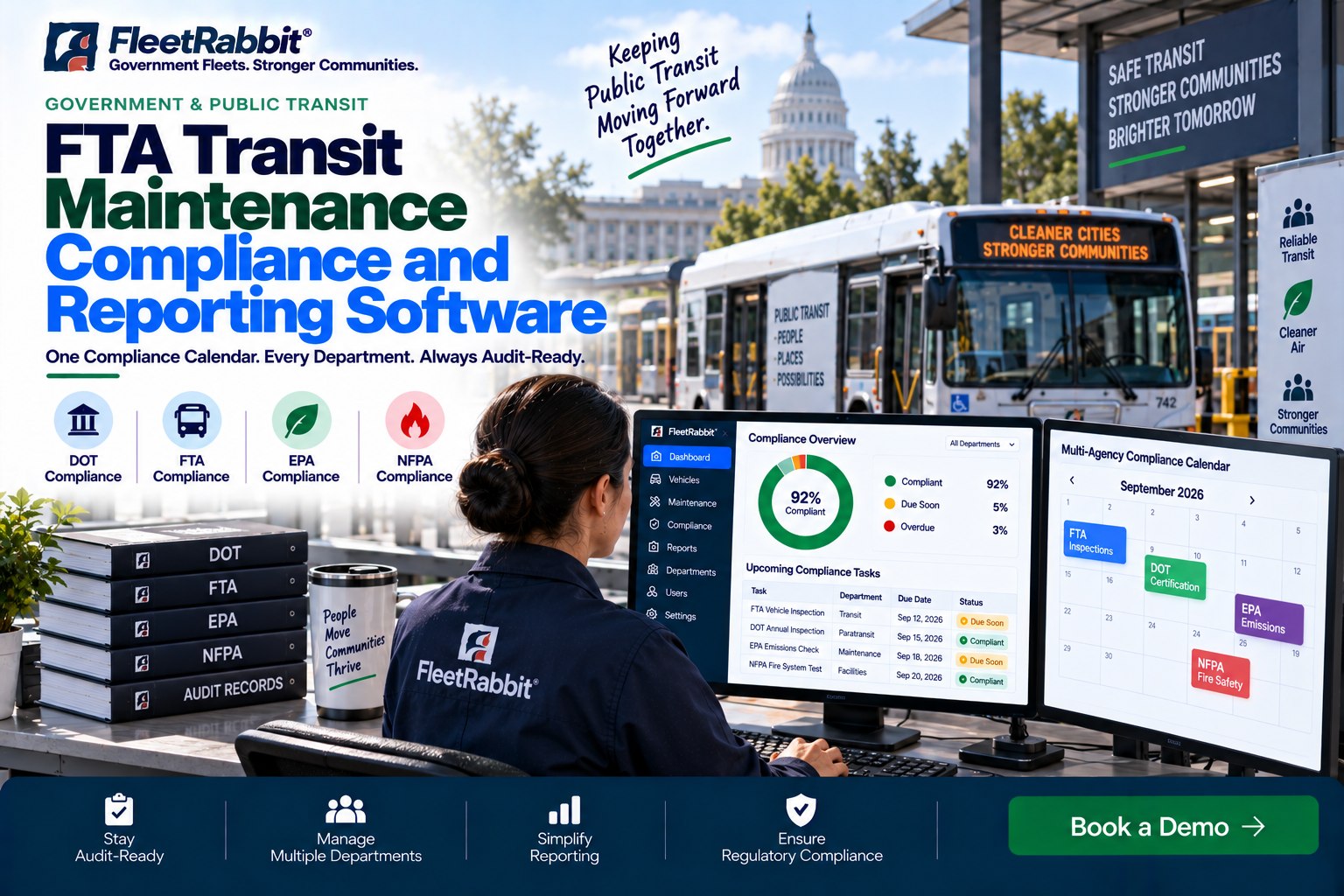
FleetRabbit maps DOT, FTA, EPA, and NFPA requirements to the sub-fleets they actually apply to.
What an FTA comprehensive review actually looks at
Section 5307 recipients go through what FTA now calls a Comprehensive Review — the successor to the Triennial Review — roughly every three years. It isn't limited to safety paperwork; it covers a wide range of how the agency runs day to day.
Whether preventive maintenance is documented and being performed on the schedule your program commits to.
Whether vehicle and equipment records in your asset management system match what's actually in service.
Whether financial operating procedures are current and properly documented.
Whether required federal clauses and certifications are present on vehicle and equipment purchases.
Whether accessible service and language-assistance obligations are being met and documented.
Historically, agencies rarely come through a comprehensive review with zero findings — most walk away with several, spread across exactly these areas. Getting maintenance and asset records right is one of the more controllable pieces, which is why teams book a demo specifically to see how those records get generated automatically instead of assembled after the fact.
One compliance calendar instead of four
PTASP certifications run on an annual cycle. Transit Asset Management condition reporting has its own rhythm. EPA emissions checks and NFPA maintenance intervals run on entirely different clocks. Left in separate systems, nobody owns the full picture — deadlines get remembered by whoever happens to notice first.
Merged onto one calendar, sorted by due date rather than by which department happens to own it.
A dashboard for every department, one rollup for the fleet manager
Transit supervisors, fire chiefs, and public works directors each need their own view of what's due on their vehicles. A fleet manager needs the rollup across all of them. FTA transit compliance software should give both without either side re-entering the same data twice — worth a book a demo call if you're currently running that rollup by hand.
Transit
PTASP status, asset condition scores, and NTD-relevant records for every bus in service.
Fire
Apparatus PM intervals and inspection records aligned to the same framework as the department's own compliance file.
Public works
DOT inspection renewals and EPA emissions documentation across the general vehicle fleet.
Compliance that holds up whoever's asking
A municipal fleet doesn't get to choose which regulator shows up first. What it can control is whether the records are ready when one does — and whether a deadline for one department quietly slipped because it lived in a system no one else could see.
See your own multi-department compliance dashboard — sign up to connect your sub-fleets, or book a demo and bring your current FTA, DOT, EPA, or NFPA records to compare.
Get one compliance calendar for every sub-fleet
Start free and map your DOT, FTA, EPA, and NFPA requirements today, or walk through it live with our team.
Common questions
What is an FTA comprehensive review
It's the current name for what was formerly called the Triennial Review — a periodic FTA audit of Section 5307 recipients covering maintenance, procurement, financial management, asset records, ADA, Title VI, and several other program areas.
Does FTA compliance software replace our NFPA or DOT tracking
It doesn't replace the requirements themselves, but it can track all of them in one place — FTA transit compliance software is most useful when it maps DOT and NFPA obligations onto the same platform instead of requiring separate systems per department.
How often does a PTASP need to be recertified
Public Transportation Agency Safety Plans need to be certified annually once an agency is subject to the rule, with the underlying safety management processes reviewed on an ongoing basis rather than just at certification time.
Do EPA and NFPA requirements apply to the same vehicles as FTA rules
Not usually the same vehicles directly, but often the same municipal fleet — a transit bus falls under FTA and DOT, a fire engine falls under NFPA, and emissions rules can apply fleet-wide, which is why a shared compliance calendar helps even when the specific rules don't overlap.
What causes most findings in an FTA comprehensive review
Historically, ADA compliance, procurement documentation, and financial management procedures account for a large share of findings, with maintenance and asset-record accuracy showing up consistently as well.
Is this only useful for large transit agencies
No — smaller municipal fleets running transit, fire, and public works sub-fleets under one department often benefit the most, since they're the ones most likely to be tracking four regulators with the fewest dedicated compliance staff.