Fuel Management Integration Software for Government Fleets
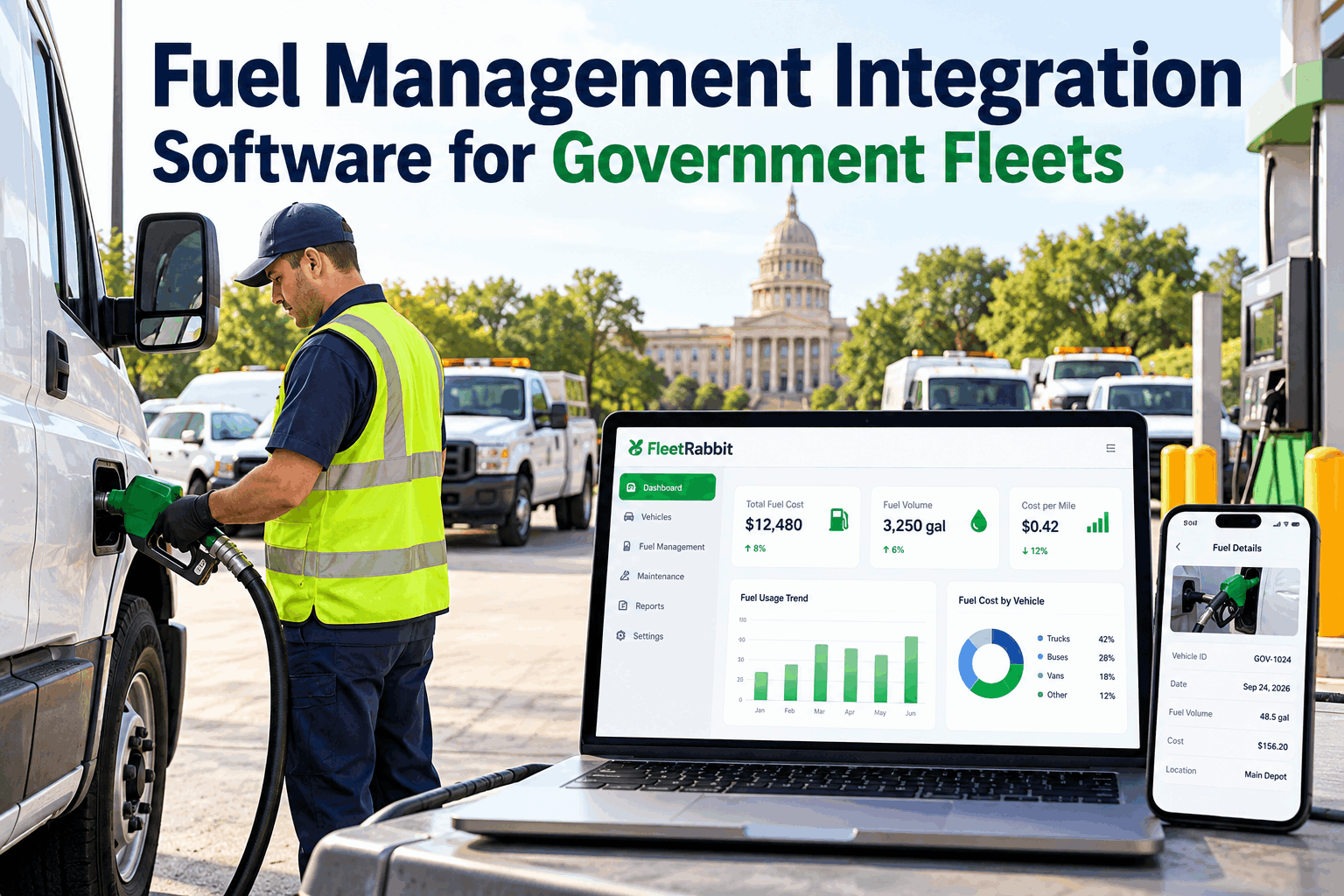
Public works directors, municipal finance officers, and city fleet superintendents carry strict fiduciary accountability to taxpayers: fuel represents the second-largest variable operational expense in local government, yet it remains one of the least controlled. In a typical municipality, fueling operations are split across disconnected systems: bulk fuel storage tanks with automated fuel island dispensers (such as Gasboy, FuelMaster, or Petrovend) in public works yards, commercial fuel credit cards (such as WEX or Voyager) used by police cruisers and utility vans on the road, and separate spreadsheet logs for off-road equipment. When these disparate sources remain siloed from vehicle telematics, cities suffer persistent operational leakages: manual odometer entry errors, unauthorized weekend fills, cross-departmental billing disputes between the General Fund and Enterprise Funds, and missed preventive maintenance intervals triggered by unrecorded mileage. Modern government fuel management integration software connects on-site pump hardware, commercial fuel cards, and vehicle CAN-bus diagnostics into a single unified telemetry pipeline. Automatically cross-reference transaction gallons against real-time fuel tank levels and GPS coordinates, eliminate manual accounting reconciliation, and generate audit-proof reports that comply with GASB 34 and state oversight rules. Fleet Rabbit provides a public sector fuel and maintenance integration platform engineered specifically for local government operations. Eliminate fuel shrinkage, synchronize multi-fund chargebacks, and protect taxpayer funds across every municipal department. Book a Demo to see our government fuel management integration software live.
Fuel Management Integration Software for Government Fleets
An engineering and financial management guide for municipal fleet superintendents, comptrollers, and public works directors: connect municipal bulk fuel islands and commercial fuel cards directly with vehicle CAN-bus diagnostics, eliminate manual odometer errors, automate internal chargebacks, and halt fuel theft.
Municipal Bulk Fuel Island, Card & Telematics Integration Pipeline
100%
Odometer Precision
Direct CAN-bus data replaces manual keypad typos that throw off preventive maintenance schedules.
0
Unreconciled Gallons
Dispensed fuel automatically matches vehicle tank capacity, location, and fuel level rise.
< 5 min
Monthly Fund Closeout
Automated general ledger chargebacks between Public Works, Police, Fire, and Water Utilities.
$5
Per Civic Asset / Month
Predictable public sector software pricing with zero locked multi-year RFP contract mandates.
Stop Fuel Leakage and Automate Inter-Departmental Chargebacks
Eliminate manual fuel logs, verify pump transactions with real-time vehicle GPS and tank telematics, and automate GASB 34 financial compliance for just $5/asset/month.
The Costly Administrative Reality of Disconnected Municipal Fuel Systems
Managing fuel across a municipal entity is significantly more complex than fueling a commercial delivery fleet. Cities operate multiple departmental budget funds, maintain high-capacity underground bulk storage tanks, deploy mobile fuel skids to construction jobs, and hand commercial fuel cards to patrol officers and inspectors. When fuel transaction records remain disconnected from vehicle telematics, municipal administration suffers from persistent friction. Sign up to unify your municipal fuel data and fleet maintenance workflows.
When public works drivers punch odometers into yard dispenser keypads, transposing digits (e.g., entering 85,000 instead of 58,000) causes preventive maintenance systems to trigger premature service alerts or hide overdue brake inspections, resulting in costly mechanical neglect. Book a demo to inspect our direct CAN-bus odometer capture.
Friction 02
Unchecked Fuel Theft and "Ghost" Card Transactions
Without real-time geofence cross-referencing, municipal fuel cards can be used to fuel personal vehicles at retail stations or fill private gas cans at unattended public works yard pumps over holiday weekends without immediate supervisor notification.
Friction 03
Inter-Departmental Accounting Disputes & General Fund Lag
Finance clerks spend days each month manually re-entering fuel slips into spreadsheets to bill Water Utility, Parks, or Police funds from the Public Works central fuel supply. Manual errors lead to contentious budget disputes during city council financial reviews. Sign up to automate multi-fund general ledger chargebacks.
Friction 04
Underground Tank Reconciliation and Environmental Audit Fines
Municipalities operating bulk fuel tanks must reconcile delivered fuel against dispensed gallons under state environmental protection standards. Unidentified slow tank leaks or dispenser calibration drift result in hefty environmental audit fines and inventory loss.
The 4 Diagnostic Pillars of Government Fuel Management Integration
Integrate directly with on-premise fuel island controllers (such as Gasboy, FuelMaster, Syntech, and Petrovend) and commercial fuel cards (such as WEX, Voyager, and Comdata) via automated APIs. Every transaction record—including gallons pumped, fuel grade, pump ID, and transaction cost—syncs automatically into a unified civic dashboard.
Pillar 02
Automated Three-Way Telematics Verification
Every fuel transaction undergoes automated algorithmic validation: (1) Does the vehicle GPS location match the fuel pump geofence? (2) Does the dispensed volume exceed the manufacturer tank capacity? (3) Did the internal fuel level sensor detect a corresponding percentage rise? Anomalies trigger immediate fraud alerts. Sign up to enable automated three-way fuel transaction checks.
Municipal vehicles—such as sewer jetters, aerial bucket trucks, and street sweepers—burn large volumes of fuel while stationary to operate hydraulic equipment. Fleet Rabbit isolates auxiliary PTO run-hours from transit miles, preventing false fuel-theft alerts and delivering accurate true-cost-per-hour metrics.
Pillar 04
Dynamic Maintenance Advance & GASB 34 Ledgers
Fuel transactions automatically update vehicle odometer and engine-hour counters, advancing preventive maintenance schedules without human intervention. The software categorizes fuel spend by department, fund code, and asset class, generating 1-click audit dossiers compliant with GASB 34 reporting rules. Book a demo to inspect our automated maintenance scheduling and GASB 34 reporting tools.
The Step-by-Step Municipal Fuel Reconciliation Lifecycle
Driver fuels a police cruiser, dump truck, or backhoe at the municipal yard or a retail commercial station using an assigned fob or fuel card.
Stage 02
Automated Telematics Ingestion
The software pulls live odometer readings, engine hours, and tank fuel level rise directly from the vehicle CAN-bus, bypassing manual driver keypad entry.
Reconciled fuel costs post to departmental fund accounts (General, Water, Police) while vehicle odometer updates advance preventive maintenance queues.
Platform Comparison: Manual Logs vs. Fleet Rabbit Integration
Evaluate the clear operational differences, fraud protections, and accounting efficiencies between manual fuel logging and Fleet Rabbit’s connected public sector platform. Sign up now to explore all platform features.
Fuel & Fleet Management Capability
Fleet Rabbit Government Suite
Manual Clipboards & Spreadsheets
Generic Commercial GPS Trackers
Subscription Rate
$5 / asset / month
High manual administration & fuel shrinkage
$25 – $45 / vehicle / month
Odometer Capture Precision
Direct J1939/OBD-II CAN-bus telemetry
Manual driver entry prone to typos
Estimated GPS mileage breadcrumbs
Three-Way Theft Prevention
Correlates location, tank capacity & fuel rise
Discovered months later during audits
Location tracking only (no pump sync)
Auxiliary PTO Hour Tracking
Automates hydraulic & stationary burn logic
Ignored; distorts MPG metrics
Not supported
Multi-Fund Billing Chargebacks
Automated General, Enterprise & ISF export
Weeks of manual spreadsheet auditing
Not available
GASB 34 & Environmental Audits
1-click exportable compliance dossiers
Boxes of physical paper fuel slips
Not compliant with civic accounting rules
Procurement & Deployment
14-day free trial, live in 14 days
Not applicable
1 to 3-year locked RFP contracts
Municipal Case Study: City of Clearfield Public Works & Public Safety
Learn how a municipal government consolidated fuel tracking across Public Works, Utilities, and Police across 68 civic vehicles to eliminate fuel shrinkage and streamline billing. Book a demo to see how Clearfield achieved these results.
Municipal Case Study
100%
Odometer Accuracy on PM Schedules
$48,000
Annual Fuel & Overtime Savings
< 15 Min
Monthly Inter-Fund Reconciliation
City Eliminates Fuel Shrinkage and Automates Multi-Departmental Accounting Across 68 Assets
Managing 68 vehicles across Public Works, Water Utility, Parks, and Police divisions, the City of Clearfield struggled with fuel data reconciliation. Drivers regularly mistyped odometers at the yard fuel island, causing maintenance software to trigger oil change work orders on vehicles that had been serviced only two weeks prior, while other high-mileage patrol cruisers missed vital brake inspections. Furthermore, accounting staff spent over twenty hours each month manually cross-referencing fuel card slips against departmental budget spreadsheets, leading to frequent inter-departmental billing disputes.
By implementing Fleet Rabbit at $5/asset/month, the city connected its municipal fuel island dispensers and commercial fuel cards directly to on-board vehicle CAN-bus diagnostics. Real-time odometer telemetry replaced keypad entries, while automated three-way validation flagged suspicious transactions where fuel volume exceeded tank capacity or occurred away from vehicle GPS locations. Monthly inter-departmental fuel billing reconciliation dropped from twenty hours to fifteen minutes, keypad odometer errors were completely eliminated, and the city saved $48,000 in prevented fuel shrinkage, reduced technician overtime, and optimized vehicle maintenance schedules.
Frequently Asked Questions
Which municipal fuel island systems and commercial cards integrate with Fleet Rabbit?
Fleet Rabbit features open REST APIs and pre-built integration modules that connect with leading municipal fuel island hardware controllers—including Gasboy, FuelMaster, Syntech FuelMaster, Petrovend, and Computrol. We also integrate directly with commercial fleet fuel cards such as WEX, Voyager, Shell, BP, and Comdata, automatically pulling transaction data into a unified platform.
How does automated telematics integration eliminate keypad odometer errors?
When drivers manually punch odometer readings into pump keypads, transposing numbers is common. Fleet Rabbit extracts true vehicle odometer and engine-hour readings directly from vehicle electronic control units (ECUs) via J1939 and OBD-II CAN-bus connections. When the fuel transaction logs, the software automatically pairs the verified telematics reading, ensuring preventive maintenance schedules advance accurately.
How does three-way fuel validation prevent fuel theft and card misuse?
Every transaction is evaluated against three live telemetry parameters: (1) Vehicle location: Was the assigned vehicle physically located within the fuel pump geofence when the card was swiped? (2) Tank capacity: Does the dispensed gallon count exceed the vehicle's fuel tank volume? (3) Fuel level sensor: Did the vehicle's internal tank sensor detect a corresponding fuel level increase? If any parameter fails, the system immediately flags the transaction for review.
How does the software handle inter-departmental fuel billing chargebacks?
Fleet Rabbit automatically associates each vehicle, fuel card, and driver with specific municipal accounting codes (such as General Fund, Enterprise Water Fund, or Internal Service Fund). When fuel is dispensed at the public works yard or a retail station, the software calculates total costs per fund code, generating ready-to-import general ledger files for city accounting software (such as Tyler Technologies, Munis, or SAP).
What are the pricing details and contract terms for Fleet Rabbit's software?
Fleet Rabbit is priced at a flat rate of $5 per active civic asset per month billed annually. This gives complete access to municipal fuel management integration, real-time CAN-bus telematics, automated maintenance scheduling, multi-fund chargeback reporting, and GASB 34 audit dossiers. We provide a 14-day free live trial on up to 3 assets with zero setup fees or locked RFP contracts.
Ready to Integrate Fuel Management Across Your Municipal Fleet?
Eliminate manual odometer errors, prevent fuel shrinkage, and automate inter-departmental chargebacks for just $5/asset/month.