Public works directors, municipal garage superintendents, county fleet directors, and state transportation administrators operate under demanding operational requirements: maintaining emergency response readiness across police cruisers and fire apparatus, ensuring heavy public works dump trucks are operational for winter storm operations, and complying with strict safety standards under DOT 49 CFR Part 396 and OSHA workplace mandates. In municipal government operations, maintaining equipment through reactive repairs—waiting for a snowplow's hydraulic pump to seize or an interceptor's brake pads to grind down—drains municipal tax funds and compromises public safety. Managing a public sector maintenance garage requires tracking Key Performance Indicators (KPIs) to monitor performance. Standard metrics like total monthly garage spend or gross diesel consumption fail to reveal whether vehicles are operating reliably or spending excessive time in repair bays. Evaluating fleet health requires empirical, unit-level maintenance metrics: Preventive Maintenance (PM) Compliance rates, Vehicle Availability, Planned vs. Unplanned Maintenance Ratios, Mean Time Between Failures (MTBF), and Maintenance Cost Per Operating Mile. When town garages manage work orders on clipboards, whiteboards, or siloed spreadsheets, maintenance staff lack visibility into overdue service intervals, chronic repair repeat rates, and rising vehicle downtime. FleetRabbit delivers dedicated public sector fleet maintenance software built to benchmark, track, and optimize municipal vehicle KPIs. By connecting J1939 and OBD-II CAN-bus engine-hour telemetry, automated work orders, parts inventory management, mobile driver pre-trip eDVIR walkarounds, and council-ready reporting into an integrated platform priced at $5 per asset per month, FleetRabbit turns maintenance data into actionable operational control. Track your garage metrics in real time, reduce unscheduled vehicle downtime by up to 35%, and manage municipal work orders completely offline inside concrete public works barns, underground utility bays, and rural DPW storage facilities with zero cellular reception. Discover how our software modernizes your agency's fleet metrics when you book a demo or explore our public sector platform when you sign up for our platform.
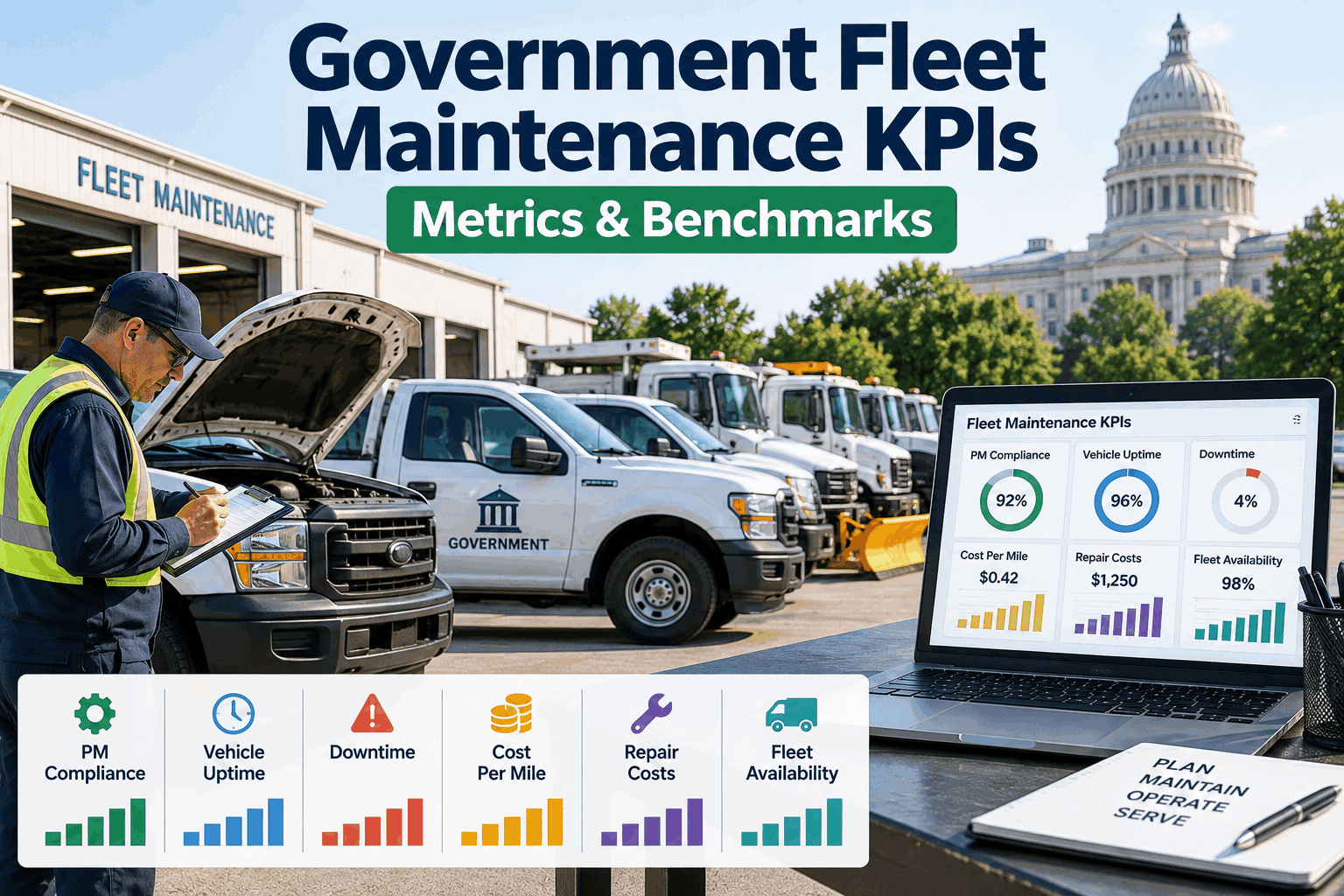
Modernize public sector fleet governance through empirical benchmarking. Track PM compliance above 90%, maintain 95%+ vehicle availability, achieve an 80/20 planned-to-unplanned maintenance ratio, and generate defensible capital asset reports that demonstrate operational accountability to town councils and taxpayer boards.
The 4 Core Government Fleet Maintenance KPI Formulas
Managing public equipment requires standardized mathematical equations; tracking these core indicators provides objective data for town managers and municipal finance committees.
Preventive Maintenance Compliance
Tracks the percentage of scheduled services completed within approved mileage or run-hour windows before component wear causes failures.
Fleet Availability Rate
Measures the proportion of municipal assets operational and ready for deployment versus vehicles grounded in the shop or awaiting repair parts.
Planned vs. Unplanned Ratio
Monitors garage workflow balance; shifts above 80% planned maintenance reduce costly emergency part orders and outside mechanic surcharges.
Maintenance Cost Per Operating Unit
Evaluates financial efficiency by normalizing repair expenses against actual vehicle usage, isolating aging vehicles that require replacement.
Public Sector Fleet Maintenance Benchmark Standards
Compare your town or agency performance against established North American public works and fleet administration standards across light, medium, and heavy public assets.
| Maintenance KPI Dimension | Top-Quartile Public Fleets | Average Municipal Fleets | Lagging / At-Risk Fleets | Operational Decision Impact |
|---|---|---|---|---|
| PM Compliance Rate | 94% – 98% | 82% – 88% | < 75% | Predicts future breakdown frequency and towing calls |
| Fleet Availability Rate | 95% – 98% | 88% – 92% | < 85% | Determines emergency response and public works staffing capacity |
| Planned-to-Unplanned Work Ratio | 80/20 to 85/15 | 60/40 to 65/35 | < 50/50 (Reactive) | Directly controls overtime payroll and emergency parts shipping costs |
| Repeat Repair Rate (within 30 days) | < 3.0% | 4.5% – 7.0% | > 9.0% | Measures shop mechanic diagnostic accuracy and parts reliability |
| Unscheduled Downtime Percentage | < 2.5% | 4.0% – 6.5% | > 8.0% | Reflects true service disruption across police, fire, and road crews |
| Work Order Turnaround Time | < 24 Hours | 36 – 48 Hours | > 72 Hours | Measures shop bay throughput and spare parts inventory availability |
The Real Costs of Operating Without Formal Fleet KPIs
Managing government vehicles on clipboards, dry-erase whiteboards, and fragmented spreadsheets creates hidden liabilities that compromise municipal service delivery. Review our fleet risk mitigation models when you book a demo or start testing our cloud tools directly when you sign up for immediate platform access.
Emergency Equipment Failures During Weather Events
When preventive maintenance compliance falls below 80%, critical hydraulic fluid flushes and brake services get skipped. Equipment stalls during major snowstorms or storm cleanup operations, stranding municipal crews, delaying emergency response, and generating public complaints.
Unbudgeted Emergency Repairs Overrunning Town Tax Funds
Emergency roadside towing and outside diesel repair shop invoices carry a 150% to 200% cost premium over planned in-house garage preventive maintenance. A single blown diesel engine on a 7-year-old municipal utility truck can cost $18,000 to replace, wiping out a small town's annual fleet repair contingency fund.
Failed Capital Replacement Requests at Town Council
Requesting $250,000 for a new municipal dump truck or front-end loader without clear maintenance cost records creates budget battles with town boards. Lacking empirical repair-versus-replacement data, town councils routinely defer replacements, forcing shops to pour tax money into failing assets.
Steel DPW Barns and Rural Municipal Dead Zones
Public works garages, salt sheds, and utility treatment plants are built with steel reinforcement, creating cellular dead zones. Cloud-only tools crash, causing operators to abandon digital pre-trip inspection logs and leaving municipal equipment undocumented.
Built Specifically for Public Sector Fleet Maintenance Management
FleetRabbit connects CAN-bus telematics gateways, mobile driver walkaround forms, shop work orders, and town council budget reporting into an integrated command platform. Discover how our software streamlines your municipal operations when you book a demo with our team.
Dual Engine-Hour & Mileage Schedulers
Automate preventive maintenance intervals based on whichever threshold occurs first—engine hours, odometer miles, or calendar days—protecting high-idle police and utility equipment.
Real-Time Roster Availability Board
Track municipal vehicle availability across departments in real time, identifying grounded assets and active work orders to ensure full public service coverage.
eDVIR Defect Dispatch Lockout
Vehicles tagged with critical mechanical defects on morning walkarounds—such as leaking hydraulic lines, worn tires, or steering play—are automatically blocked from service dispatch.
DPW Garage Offline Mobile Sync
Municipal mechanics sign off work orders and operators complete pre-trips inside reinforced steel DPW sheds with zero cellular reception; all diagnostic records auto-sync upon departure.
Town Garage Parts Inventory Control
Link parts consumption directly to work orders: reserve filters, hydraulic fluid, and brake pads automatically when vehicles approach their service window to avoid supply delays.
1-Click Town Council Budget Dossiers
Generate clear, professional fleet lifecycle reports, maintenance histories, and capital justification sheets formatted for town managers, select boards, and municipal auditors.
Direct Mapping to Federal & Municipal Safety Regulations
Operating a public sector fleet with formal maintenance KPI tracking maintains compliance with commercial motor carrier safety standards, employee protection laws, and public accounting directives.
Standardizes daily pre-trip and post-trip driver walkarounds (§ 396.11), qualified mechanic corrective action signatures (§ 396.13), and statutory 90-day electronic maintenance record retention across heavy municipal assets.
Enforces statutory employee protection requirements: mandatory documentation of emergency brake systems, backup alarms, tire condition, and hydraulic liftgate safety latches across public works equipment.
Tracks historical acquisition costs, annual depreciation schedules, and cumulative overhaul expenditures for municipal rolling stock, ensuring compliance with capital asset reporting standards.
Provides standardized preventive maintenance frameworks matching national fire and emergency apparatus service standards, including pump transmission checks, chassis inspections, and electrical load monitoring.
Public Sector Fleet KPI Software Benchmark Comparison
A feature-level comparison evaluating maintenance KPI depth, public sector suitability, and offline mobile resilience as of 2026. Schedule a personalized walkthrough when you book a demo with our municipal team.
| Maintenance Capability | FleetRabbit | Legacy Enterprise Municipal CAD | Basic Telematics Portals | Paper Clipboards & Spreadsheets |
|---|---|---|---|---|
| Pricing (per asset/month) | $5/month flat | $35–$75/month | $15–$30/month | High emergency breakdown costs |
| PM Compliance Rate Tracking | Automated dual-interval tracking | Requires custom module setup | Mileage only | Manual spreadsheet estimation |
| Setup & Onboarding Surcharges | $0 (Free self-onboarding) | $3,500–$12,000 professional fees | $500–$1,500 setup charge | Hundreds of municipal staff hours |
| Planned vs. Unplanned Ratio Analysis | Real-time 80/20 split solver | Periodic custom query build | Not supported | None (Reactive culture) |
| DPW Barn Offline Mobile Sync | Full store-and-forward | Network dependent | Data dropped offline | Paper logs only |
| Free Trial Access | 14 days, up to 3 assets | Sales demonstration only | Limited sandbox demo | None |
| Contract Terms & Procurement | Monthly or annual (No lock-in) | 3 to 5-year mandatory contract | 2 to 3-year contract | None |
5-Step Municipal Fleet KPI Implementation Pathway
FleetRabbit embeds cleanly into your municipal public works garage, administrative offices, and operator mobile devices in under two weeks without operational disruptions. Begin testing immediately when you sign up for our free trial.
Municipal Asset Master & Meter Type Ingestion
Import municipal trucks, police cruisers, snowplows, backhoes, acquisition dates, department cost centers, and historical maintenance ledgers via automated CSV tools.
Dual Engine-Hour & Mileage Interval Configuration
Set up automated service schedules based on manufacturer guidelines: establish engine-hour PM thresholds for heavy equipment and mileage intervals for public safety patrol vehicles.
Digital eDVIR & Dispatch Lockout Setup
Configure digital mobile inspection walkaround checklists tailored to municipal vehicle classes, establishing automated dispatch lockouts for safety-critical defects.
Operators & Shop Technicians Mobile Rollout
Equip municipal equipment operators, police officers, and town mechanics with the offline-first mobile app on standard smartphones or rugged tablets for rapid pre-trips.
Maintenance KPI Command Go-Live
Activate live fleet status dashboards, automated shop work order queues, parts inventory reorder triggers, and 1-click town council budget reporting archives.
2-Week Deployment Plan & Milestones
A structured timeline designed to transition small municipal fleet operations from paper binders to digital KPI tracking with zero disruption to daily public services. Review our full onboarding plan when you book a demo today.
Week 1: Department Data & Rule Setup
- Audit paper work order clipboards, previous capital requests, and maintenance invoices
- Configure vehicle profiles by department: Police, Fire, DPW, Parks, and Administration
- Set up dual engine-hour and mileage preventive maintenance schedules
- Assign user access roles for Town Managers, Public Works Superintendents, and Shop Mechanics
Week 2: Garage Rollout & Live Verification
- Distribute mobile app to municipal operators and conduct 15-minute training on digital pre-trips
- Validate store-and-forward offline syncing inside concrete maintenance garages and utility yards
- Simulate a critical safety defect to verify automated dispatch lockout gating and shop routing
- Launch live fleet management dashboard and town council replacement budget reporting
Documented Public Sector Fleet KPI Results
Operational improvements documented by local government agencies that transitioned from reactive maintenance to automated KPI tracking. Review the complete municipal case study when you book a demo with our team.
PM Compliance Increased to 96% Across 48 Heavy Dump Trucks
A county road department managing 48 heavy dump trucks and plows was struggling with a 68% PM compliance rate and frequent roadside winter breakdowns. FleetRabbit implemented dual engine-hour tracking and automated mobile pre-trips, raising PM compliance to 96% and saving $48,000 in emergency towing and outside contractor repairs in year one.
Planned Maintenance Shifted from 45% to 84%
A municipal police department operating 26 patrol vehicles experienced frequent out-of-service delays due to reactive brake and electrical repairs. FleetRabbit introduced automated mileage and hour-based service triggers, shifting the department's planned maintenance ratio to 84% and cutting vehicle downtime by 32%.
When you manage a public works maintenance garage for a municipality with fifty vehicles, you are constantly caught between keeping equipment on the road and keeping your budget under control. For years, our garage operated purely in reactive mode. We didn't track our preventive maintenance compliance or our planned-to-unplanned ratios; we just fixed trucks as they broke down. When three snowplows failed during a major February storm, our town manager and council demanded answers. Before FleetRabbit, we had no data to show them what was happening. FleetRabbit changed our garage operations. It gave us clear, automated benchmarks for our PM compliance, tracked our true engine hours directly from the vehicles, and gave our mechanics clear work orders that cut our turnaround time in half. We pushed our PM compliance rate above ninety-five percent, cut our emergency repairs, and proved to the town council that our department is operating efficiently and responsibly.
Frequently Asked Questions
Take Control of Your Fleet's Maintenance KPIs in Less Than 2 Weeks
Elevate PM compliance above 90%, cut unexpected repair costs, and maintain 95%+ fleet availability at $5/asset/month with a 14-day free trial.