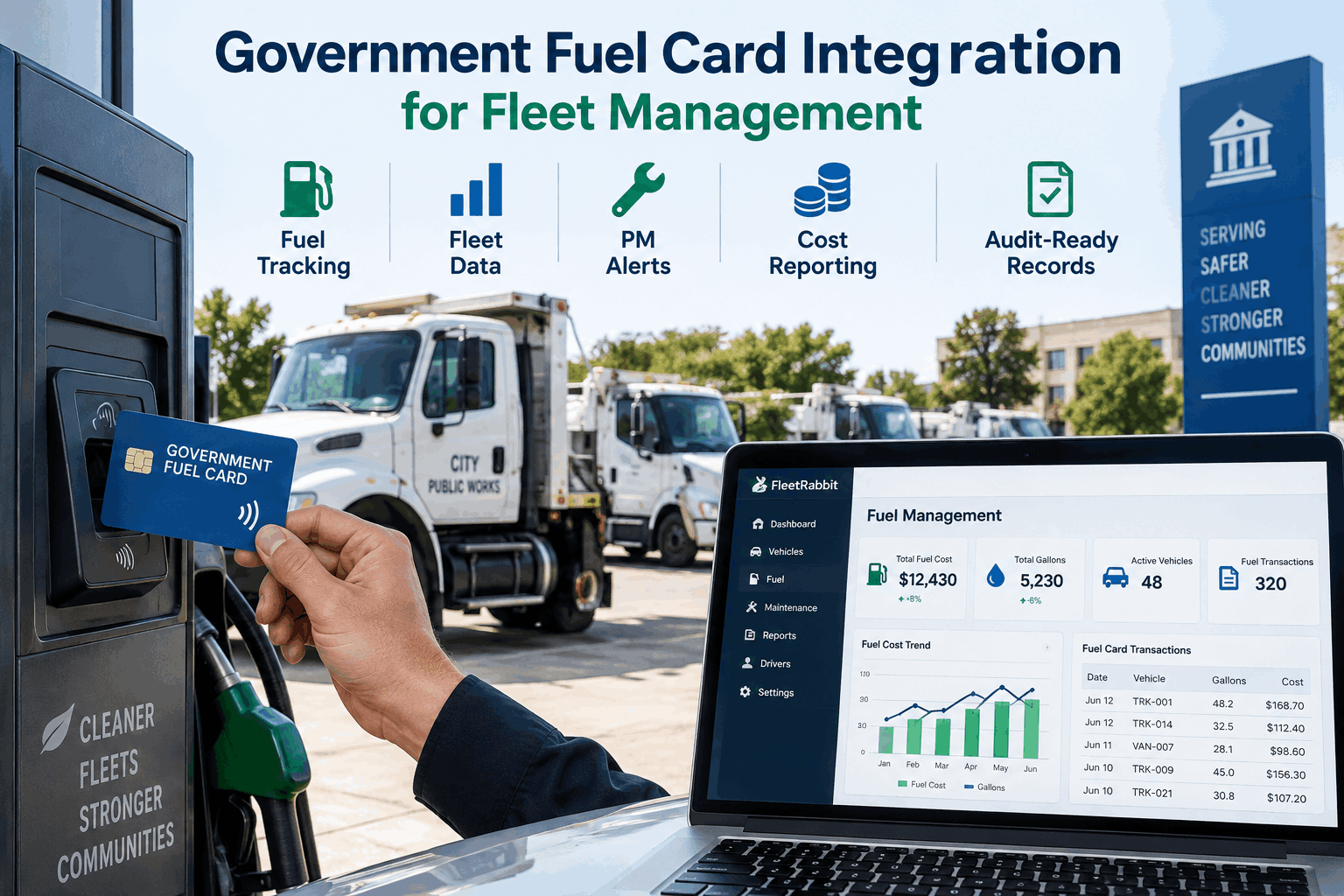
Municipal public works departments, county law enforcement divisions, and regional transit agencies operate large, diversified vehicle rosters that demand strict financial stewardship over municipal energy expenses. Fuel represents one of the single largest continuous operational budget expenditures across local government entities, yet public sector fleet managers are often forced to reconcile thousands of commercial fuel transactions by hand. When municipalities manage fuel purchases using disconnected commercial fleet cards (such as WEX, Voyager, or Fuelman) alongside disparate bulk municipal fuel island pumps, serious accounting discrepancies arise. Without unified software, fleet divisions struggle with inaccurate odometer entries, unmonitored off-hours fuel siphoning, card-sharing fraud, and misallocated departmental chargebacks that trigger contentious city council audit reviews. Integrating government fuel card data directly with telematics and preventative maintenance software bridges this operational divide. By validating pump transaction timestamps against live CAN-bus GPS coordinates, true odometer readings, and tank capacities, fleet superintendents achieve 100% cost transparency and eliminate unauthorized fuel waste. To explore how automated fuel card integration reconciles your municipal fuel disbursements in real time, book a technical demonstration with our government fuel integration engineers or activate automated transaction tracking right away through our free platform sign up.
Government Fuel Card Integration for Fleet Management
A definitive municipal accounting and telematics integration blueprint for city finance leads, public works superintendents, and government fleet managers. Connect WEX, Voyager, and municipal automated fuel islands to automated CAN-bus odometers, eliminate fuel shrinkage, and automate multi-fund general ledger chargebacks.
Automate Municipal Fuel Accounting and Eliminate Siphoning Fraud
Eliminate paper fuel logs, match commercial card transactions to live vehicle telematics, automate meter-based preventative maintenance triggers, and streamline multi-fund general ledger chargebacks starting from $3/vehicle/month with no hardware lock-in.
The Anatomy of Fuel Card Vulnerability in Municipal Fleets
Fuel mismanagement represents a quiet drain on local government general fund reserves. In municipal operations, drivers frequently fill up at off-site retail gas stations using universal purchasing cards or at municipal public works bulk fuel islands. Under conventional unintegrated systems, card security relies almost entirely on the employee manually entering their Driver ID (PIN) and current odometer reading into the gas station pump terminal keypad. This manual workflow creates extensive data corruption: drivers rush the entry, enter dummy numbers (such as entering "11111" or "99999"), or fat-finger the odometer reading. Because the garage fleet maintenance management system calculates scheduled oil changes, tire rotations, and chassis greasings from these corrupted odometer logs, preventative maintenance schedules are thrown completely off track. Worse, unmonitored fuel cards enable severe municipal shrinkage: employees pump fuel into unauthorized personal vehicles, fill handheld gas cans for personal lawn equipment, or swipe cards outside assigned operating hours. By establishing a direct, bi-directional API link between fuel card network clearinghouses and onboard vehicle telematics, FleetRabbit closes every fraudulent gap. The software verifies that the vehicle's true J1939 CAN-bus odometer updates the vehicle dossier, ensures the vehicle is physically positioned within 20 meters of the pump station at swipe time, and validates that gallons pumped never exceed the vehicle’s physical tank capacity. Public works directors and finance superintendents can explore automated transaction validation by scheduling a personalized fuel card integration demo or configure test commercial card feeds directly via our quick platform sign up.
Geofence & GPS Proximity Swiping Verification
Whenever a card is swiped at a commercial station, the integration cross-references the merchant's physical address against the vehicle’s live telematics location. If the card is swiped while the municipal truck is parked miles away in the city yard, the transaction flags as an immediate fraud exception.
OEM Fuel Tank Capacity Threshold Enforcement
Every asset in the platform is mapped to its factory OEM specifications (e.g., Ford Police Interceptor Utility: 21.4 gallons; Freightliner M2 Dump: 70.0 gallons). If a transaction attempts to disburse fuel exceeding 100% of tank volume, the software flags potential off-tank siphoning.
True CAN-Bus Odometer Overwrite for PM Scheduling
Instead of relying on whatever numbers the driver typed at the pump keypad, FleetRabbit overwrites the pump log with the vehicle’s true electronic engine odometer read directly from the ECM. Preventative maintenance triggers stay completely accurate.
Automated General Ledger Fund Accounting Export
Fuel charges are mapped directly to departmental cost centers, general ledger accounts, and grant funds (such as State Liquid Fuels or Highway Aid). The system exports balanced monthly debit and credit journal entries directly into municipal ERP platforms.
Direct Benchmark Comparison: Disconnected Spreadsheets vs. FleetRabbit Connected Fuel Engine
Managing public fuel purchases through end-of-month commercial billing statements, paper receipt envelopes, and manual spreadsheet entries creates significant accounting backlogs that leave unauthorized purchases unexamined for months. Review how legacy manual reconciliation compares directly against FleetRabbit's automated, real-time government fuel card integration platform across core municipal operations benchmarks. City finance leads and public works superintendents can inspect automated chargeback logic by booking an executive municipal fleet software demo or explore our pre-configured fuel accounting templates via our self-service sign up.
| Fuel Management Dimension | Manual Monthly CSV Statements & Paper Receipts | FleetRabbit Automated Fuel Card Engine | Municipal Taxpayer Advantage |
|---|---|---|---|
| Transaction Clearing Velocity | Reconciled 30 to 45 days late after invoices arrive | Automated daily API clearing and real-time alerts | Stops unauthorized fueling patterns immediately |
| Odometer Accuracy & Integrity | Typo-ridden (drivers enter dummy numbers at pump) | True electronic odometer pulled directly from ECM | Guarantees 100% accurate preventative maintenance triggers |
| Theft & Siphoning Interception | Undetected; buried inside thousands of line items | Instant flags on tank-capacity overfills and off-hours swipes | Recovers thousands annually in unapproved fuel purchases |
| Municipal ERP General Ledger Sync | Days spent manually keying entries into city software | 1-click automated API journal export to Tyler Munis / SAP | Saves over 40 administrative finance hours every month |
| Off-Road Auxiliary Fuel Tax Rebates | Unclaimed; impossible to separate PTO fuel on paper | Automated separation of PTO pump and stationary idle fuel | Recovers up to $1,850 per heavy asset in annual tax refunds |
4-Stage Automated Fuel Clearing and Accounting Sequence
FleetRabbit operationalizes municipal fuel management into an automated, four-stage digital sequence that follows every drop of fuel from the pump nozzle to the audited municipal balance sheet. To explore how our engineering engine automates transaction reconciliation, schedule an operational fuel integration walkthrough demo with our team.
Card Swipe & Network Ingestion
The driver swipes their card at a commercial retail pump or municipal bulk fuel ring. Transaction metadata—gallons, product grade, dollar total, merchant ID, and prompt data—streams to FleetRabbit via secure clearinghouse APIs.
Telematics Triangulation & Validation
The system cross-references the transaction against vehicle telematics: validating that the truck is physically at the station, overwriting pump keypad entries with true ECM mileage, and verifying tank volume limits.
Preventative Maintenance Triggering
Validated odometer readings immediately update vehicle dossiers in the maintenance CMMS. If the new mileage crosses a service threshold (e.g., 5,000-mile interval), the system generates an automated PM work order for the shop.
Multi-Fund General Ledger Allocation
Reconciled transactions are mapped to specific departmental accounting strings (Police, Parks, Public Works, Water Utility). The system exports balanced monthly journal batches directly into municipal accounting software.
Financial Capital Stewardship: Eliminating the Hidden Costs of Unreconciled Fuel
Operating a municipal vehicle fleet without automated fuel card integration creates compounding financial losses across untracked fuel shrinkage, clerical administrative wages, missed preventative maintenance intervals, and unclaimed state fuel tax rebates. When an employee repeatedly tops off a personal vehicle on a city fuel card without oversight, public funds are quietly siphoned away from essential community services. Identifying these common operational drains helps fleet superintendents and finance directors build a strong business case for automated fuel integration software before city councils and county commissions. Calculate your agency's exact cost recovery by booking an operational fuel assessment demo or get started directly via our rapid platform sign up.
Top Causes of Municipal Fuel Budget Waste Under Disconnected Management
Government Fuel Integration Capabilities
Pre-configured API connections for WEX, Voyager, Fuelman, Comdata, and municipal automated bulk fuel rings (Gasboy, FuelMaster, PetroVend).
Splits fuel disbursements across general funds, enterprise utility funds, and state highway aid accounts with zero risk of commingling funds.
Connects cloud fuel card data directly to existing vehicle telematics modems and municipal ERP systems without expensive black-box hardware.
ROI & Fiscal Stewardship Framework for Municipal Leaders
When municipal leadership evaluates fuel management technology, elected officials must measure financial return across shrinkage reduction, clerical labor savings, tax recovery, and preventative maintenance optimization. FleetRabbit delivers quantifiable financial return across all primary public sector fleet operating categories. To review your customized municipal fuel savings forecast, schedule an executive briefing demo with our government fleet advisors or start configuring your fuel card integration today with a free account.
Theft & Siphoning Elimination
Automated tank-capacity enforcement and GPS proximity verification eliminate illicit card swipes and off-hours personal fueling, cutting unapproved fuel losses by over 90%.
Automated Off-Road Fuel Rebates
Fuel consumed while running stationary PTO equipment (such as sewer jetters, boom lifts, and street sweepers) qualifies for off-road fuel tax refunds. FleetRabbit logs this consumption automatically.
Clerical Accounting Savings
Automating journal entry calculations, maintenance billings, and fuel reconciliation eliminates weeks of manual data entry for municipal finance and fleet administrative clerks.
Frequently Asked Questions: Government Fuel Card Integration
Which fuel card networks can integrate with FleetRabbit?
FleetRabbit integrates with all major government and commercial fleet fuel card networks, including WEX, Voyager (U.S. Bank), Fuelman, and Comdata. Additionally, the platform integrates with municipal bulk fuel management systems (such as Gasboy, FuelMaster, and PetroVend) to track fuel dispensed from city-owned fuel yards.
How does the system prevent drivers from entering inaccurate odometer readings at the pump?
FleetRabbit connects directly to the vehicle's onboard telematics gateway. Instead of trusting the number typed by the driver at the pump terminal keypad, the platform overwrites the fuel transaction with the true electronic odometer reading pulled directly from the engine control module (ECM), ensuring maintenance intervals remain completely accurate.
How does the software detect if fuel is pumped into a personal vehicle?
FleetRabbit cross-references every transaction against two parameters: vehicle GPS location and factory tank capacity. If a card is swiped at a gas station while the municipal vehicle is parked elsewhere, or if a driver attempts to pump 35 gallons into a vehicle with a 20-gallon fuel tank, the system flags the transaction as an immediate fraud exception.
Can fuel transactions be exported directly to municipal accounting software?
Yes. FleetRabbit features automated API connectors and pre-formatted general ledger export templates compatible with major municipal financial platforms, including Tyler Technologies (Munis), SAP, Workday, Infor, and Oracle, ensuring balanced departmental journal entries with zero manual re-entry.
Upgrade Your Municipal Fleet Fuel Management Today
Eliminate manual paper logs, stop unauthorized fuel shrinkage, automate preventative maintenance scheduling, and ensure complete fiscal transparency for your city or county. Deploy FleetRabbit today with zero proprietary hardware lock-in.