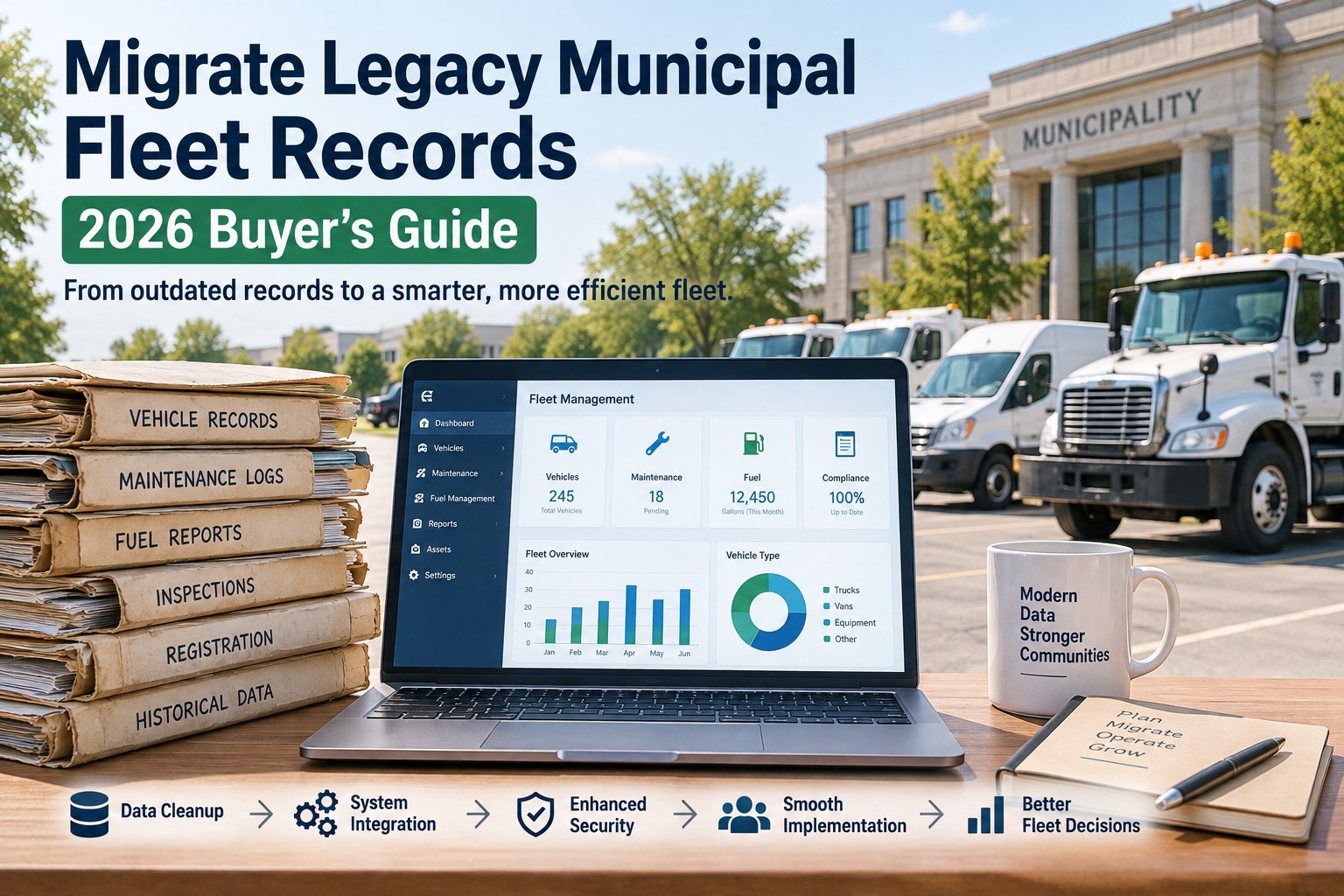
Public works directors, municipal town managers, county fleet superintendents, and public sector transit coordinators face an urgent administrative challenge: transitioning decades of historical vehicle maintenance logs, paper work orders, and fragmented desktop spreadsheets into modern, cloud-native government fleet management software. Many local government agencies still rely on on-premise legacy municipal software originally installed in the early 2000s, outdated Microsoft Access databases, or physical service binders kept in shop basements. When municipal staff attempt to migrate these legacy archives, they encounter severe data obstacles: corrupt CSV exports, duplicate vehicle identification numbers (VINs), inconsistent part descriptions, incomplete preventive maintenance records, and missing lifecycle cost ledgers. Without a structured migration protocol, public agencies risk losing essential historical repair expenditures needed to calculate asset depreciation and justify capital replacement requests to town select boards. Furthermore, legacy government enterprise vendors routinely charge between $5,000 and $15,000 in professional data conversion consulting fees, locking small municipalities into multi-month onboarding delays. FleetRabbit delivers a dedicated municipal fleet data migration architecture engineered specifically for local government and public sector fleets. By providing automated CSV schema cleansing, pre-built field mapping for work orders and parts inventories, J1939 telematics diagnostic synchronizations, and an all-inclusive pricing structure of $5 per asset per month with zero implementation surcharges, FleetRabbit enables agencies to digitize historical records in days rather than months. Safeguard historical public works data, prevent records corruption during system transitions, and manage asset archives completely offline inside concrete public works garages, underground municipal utility bays, and rural DPW storage facilities with zero cellular connectivity. Learn how our migration engine preserves your agency's historical records when you book a demo or start testing our conversion tools immediately when you sign up for our platform.
Stop letting corrupt spreadsheets and expensive legacy database consulting stall your municipal fleet modernization. Discover the complete data conversion blueprint: audit legacy files, clean dirty work order ledgers, preserve GASB 34 asset depreciation histories, and transition to a cloud platform for $5/asset/month with zero setup fees.
The 5 Core Municipal Fleet Datasets to Extract and Standardize
Migrating public sector records requires breaking monolithic legacy databases into structured operational tables; organizing these five primary datasets prevents data corruption during system transitions.
Asset Master & VIN Profiles
Vehicle identification numbers (VINs), chassis classes, department assignments (DPW, Police, Fire, Water), acquisition dates, original purchase prices, and salvage values.
Work Order & Labor Histories
Historical mechanical repair logs, completed work orders, outside contractor repair invoices, mechanic labor hours, and specific technician repair notes.
Parts & Consumables Catalogs
Town inventory part numbers, descriptions, supplier contacts, unit pricing, bin storage locations, and current stocking levels for oil filters, brake pads, and plow edges.
Fuel & Dispensing Ledgers
Historical fuel transactions, municipal fuel pump keycard imports, transaction timestamps, gallons pumped, fuel types, and associated meter readings (hours/miles).
Preventive Maintenance Rules
Existing service intervals, PM-A and PM-B inspection checklists, seasonal equipment setups (such as winter plow readiness), and state commercial vehicle inspection schedules.
The 4 Hidden Traps in Legacy Municipal Records Conversions
Municipal database migrations fail when agencies treat legacy records as clean digital files; recognizing these four common failure modes protects public works departments from operational disruption. Explore our data verification protocols when you book a demo with our migration team.
Inconsistent and Corrupted Odometer & Hour Logs
Decades of manual data entry result in typos, inverted numbers, and missed meter entries. When importing legacy spreadsheets, inaccurate historical mileage and engine hours break automated preventive maintenance triggers, causing missed oil changes and unbudgeted component failures.
Non-Standardized Part Names and Duplicate SKUs
Legacy systems frequently contain multiple naming conventions for the same physical inventory item (e.g., "Oil Fltr", "FLTR-OIL", and "Filter, Engine Oil"). Importing uncleaned parts catalogs creates duplicate SKUs, distorts stock inventory levels, and causes inaccurate reorder alerts.
Broken Asset Cost Histories & Lost Council Proof
When migrating between systems, relational links between completed work orders and vehicle assets can break. When public works directors present capital budget requests to town councils, they discover they cannot produce the multi-year repair cost curves needed to justify vehicle replacements.
Vendor Data Hostage Fees and Proprietary Formats
Outdated enterprise software providers often store public records in encrypted, proprietary database schemas. When small municipalities request their historical data during contract terminations, legacy vendors charge thousands in data extraction fees and deliver unstructured text files.
Modern Software Tools Engineered for Seamless Municipal Migration
FleetRabbit connects automated CSV schema mapping, duplicate asset detection, digital inspection checklists, and town council budget reporting into a unified management interface. Learn how our software simplifies municipal records conversion when you book a demo with our staff.
Automated CSV Data Mapper
Upload existing spreadsheets or database exports; our schema engine automatically aligns columns, validates VIN formats, and standardizes date structures across your fleet records.
GASB 34 Depreciation Calculator
Maintains historical acquisition costs, annual depreciation schedules, and cumulative overhaul expenditures for municipal rolling stock, ensuring compliance with capital asset reporting rules.
Meter Anomaly Detection Radar
Scans historical mileage and engine-hour records during import to flag rollover errors, missing entries, and inverted values before generating automated maintenance schedules.
Municipal Shop Offline Mobile Sync
Town mechanics sign off work orders and operators complete pre-trips inside reinforced steel DPW sheds with zero cellular reception; all records auto-sync upon reconnection.
Duplicate SKU Reconciliation Engine
Identifies and merges duplicate part entries from legacy databases into clean, unified inventory records with designated bin locations and automated reorder alerts.
1-Click Town Council Budget Dossiers
Generate clear, professional fleet lifecycle reports, maintenance histories, and capital justification sheets formatted for town managers, select boards, and municipal auditors.
Compliance Directives Governing Municipal Fleet Recordkeeping
Public sector fleet data management must satisfy specific federal, state, and public accounting recordkeeping standards during software transitions.
Requires local governments to report all capital assets—including infrastructure, vehicles, and heavy equipment—along with historical depreciation and repair expenditures in annual public financial statements.
Mandates that motor carriers and public agencies maintain records identifying vehicles, inspection schedules, lubrication records, and repair histories for a minimum retention window of one year.
Enforces statutory public access and retention guidelines for municipal expenditures: work orders, purchasing records, and vehicle disposal documentation must remain accessible for official public records inquiries.
Standardizes maintenance documentation for emergency apparatus while enforcing strict data privacy and encryption controls for public safety vehicle deployment schedules and patrol equipment records.
Migration & Software Pricing Comparison for Municipalities
A cost comparison evaluating data migration fees, ongoing subscription costs, and vendor lock-in terms as of 2026. Schedule a personalized walkthrough when you book a demo with our municipal team.
| Evaluation Dimension | FleetRabbit | Legacy Enterprise Municipal CAD | Generic Fleet Telematics | Manual Excel & Paper Records |
|---|---|---|---|---|
| Subscription Pricing | $5 / asset / month flat | $35–$75 / asset / month | $15–$35 / asset / month | $0 (High administrative drag) |
| Data Migration Consulting Fees | $0 (Automated self-serve tools) | $5,000–$15,000 mandatory fee | $1,000–$3,500 setup charge | Hundreds of staff hours |
| Migration Completion Timeline | < 14 days to full cutover | 3 to 9 months consulting cycle | 4 to 8 weeks | Indefinite paper backlog |
| Contract Terms & Procurement | Monthly or annual (No lock-in) | 3 to 5-year mandatory contract | 2 to 3-year contract | None |
| Historical Cost Tree Retention | Complete work order preservation | Often requires custom archiving | Not supported (Telematics only) | Scattered paper receipts |
| Public Works Offline Mobile Sync | Full store-and-forward | Network connection required | Data dropped offline | Paper logs only |
| Free Trial Availability | 14 days, up to 3 assets | Sales demonstration only | Limited sandbox demo | None |
5-Step Municipal Fleet Records Migration Pathway
FleetRabbit enables small municipalities to migrate historical records cleanly in under two weeks without interrupting daily town maintenance operations. Begin testing immediately when you sign up for our free trial.
Legacy Data Inventory & Export
Export existing spreadsheets, database tables, and parts records to standard CSV files, assembling all historical maintenance logs and department asset rosters.
Data Cleansing & Anomaly Resolution
Run legacy files through FleetRabbit’s automated mapping utility to identify duplicate VINs, correct inverted meter readings, and merge duplicate inventory part descriptions.
Department & Cost Center Assignment
Structure assets by municipal cost center—Police, Fire, DPW, Parks, and Water—and configure dual preventive maintenance intervals using engine hours and odometer miles.
Shop Technicians & Mobile Rollout
Equip town mechanics and equipment operators with the offline-first mobile app on standard smartphones or tablets for daily pre-trip inspections and digital work order sign-offs.
Cloud Governance Go-Live
Retire legacy spreadsheets permanently. Activate live fleet health dashboards, automated inventory reorder alerts, and 1-click town council budget reporting archives.
2-Week Deployment Plan & Milestones
A structured timeline designed to transition small municipal fleet operations to a modern cloud platform with zero disruption to daily public services. Review our full onboarding plan when you book a demo today.
Week 1: Data Extraction, Cleansing & Mapping
- Audit paper work order clipboards, previous capital requests, and maintenance invoices
- Export legacy databases or Excel files into CSV and upload to FleetRabbit's automated mapper
- Standardize vehicle profiles by department: Police, Fire, DPW, Parks, and Water
- Assign user access roles for Town Managers, Public Works Superintendents, and Shop Mechanics
Week 2: Garage Rollout & Live Verification
- Distribute mobile app to municipal operators and conduct 15-minute training on digital pre-trips
- Validate store-and-forward offline syncing inside concrete maintenance garages and utility yards
- Simulate a critical safety defect to verify automated dispatch lockout gating and shop routing
- Launch live fleet management dashboard and town council replacement budget reporting
Documented Municipal Records Migration Results
Operational improvements documented by local government agencies that transitioned from legacy databases to modern fleet software. Review the complete municipal case study when you book a demo with our team.
12 Years of Paper Work Orders Digitized in 8 Business Days
A small New England town operating 32 municipal vehicles was trapped on an on-premise Windows database from 2004 that required manual data backups. Using FleetRabbit's automated data mapping tools, the department extracted 12 years of historical maintenance records, cleaned 8,400 repair logs, and launched digital work orders in eight business days, saving $12,000 in quoted vendor conversion fees.
Zero Data Loss Across 45 Mixed Public Works Assets
A regional water and sewer district managing 45 service trucks and backhoes struggled with duplicate part numbers and missing meter readings in disconnected Excel sheets. FleetRabbit reconciled 600 inventory SKUs and connected J1939 telematics feeds, eliminating duplicate inventory purchases and passing state financial audits with zero discrepancies.
When you run a municipal fleet for a small township with thirty vehicles, the thought of switching software is terrifying. For fifteen years, all our vehicle records were stored in an old on-premise database program that ran on a single desktop computer in our shop office. Whenever we looked into modernizing, enterprise software companies wanted ten thousand dollars just to extract our records, plus months of consulting fees that our town board would never approve. We reached out to FleetRabbit, and the transition was seamless. We exported our historical maintenance files into CSV spreadsheets, their system automatically mapped our work orders and vehicle profiles, and we had our entire town roster live in less than two weeks. We didn't lose a single oil change record or repair invoice. Now, our mechanics track repairs on mobile tablets, our parts inventory updates automatically, and our town manager has complete visibility into our vehicle lifecycle costs without spending taxpayer money on expensive software consultants.
Frequently Asked Questions
Migrate Your Legacy Municipal Fleet Records in Less Than 2 Weeks
Eliminate paper work orders, preserve historical maintenance ledgers, and modernize operations at $5/asset/month with a 14-day free trial.