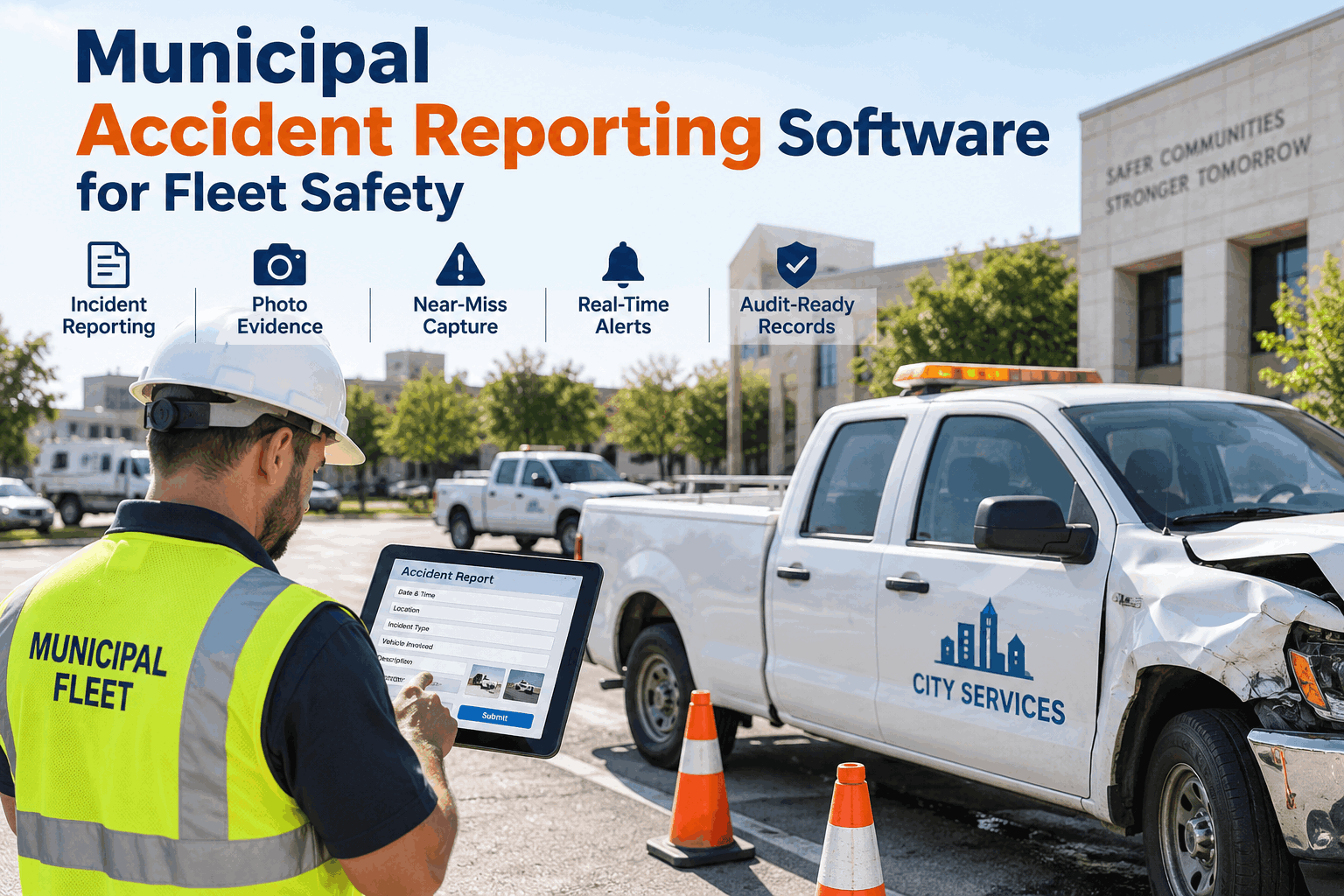
Municipal risk managers, city attorneys, and civic fleet directors know that the first thirty minutes following a municipal vehicle collision dictate whether the municipality faces manageable subrogation or catastrophic tort liabilities. When heavy public works dump trucks, police pursuit sedans, utility boom vehicles, or parks mowers are involved in roadway incidents, paper-based glovebox crash packets fail. Operators forget critical scene details, skid mark evidence and vehicle rest positions go unphotographed, third-party witness information vanishes, and commercial self-insurance pools face inflated liability claims. Municipal accident reporting software equips civic drivers and garage supervisors with guided on-scene mobile workflows that capture cryptographic time-and-location-stamped photographic evidence, record witness audio statements, document police report details, and trigger instant supervisory triage. Eliminate liability disputes, manage proactive near-miss logs under OSHA and public safety guidelines, and automate vehicle out-of-service maintenance work orders before damaged equipment compromises civilian safety. Book a Demo to experience our municipal accident reporting platform live.
Municipal Tort Risk Governance
Rapid Incident Triage
Public Sector Claims Defense
Municipal Accident Reporting Software for Fleet Safety
A comprehensive operational and legal risk guide for civic fleet superintendents and city attorneys: standardize on-scene digital accident capture, record proactive near-misses, automate shop triage, and defend municipal reserves against unverified claims.
< 3 min
On-Scene Intake
Guided smartphone prompts walk drivers through scene safety and evidence capture.
68%
Faster Claim Settlement
Complete photographic dossiers eliminate months of protracted legal subrogation.
100%
Near-Miss Tracking
Proactive hazard reporting resolves mechanical and road hazards before crashes occur.
$5
Per Asset / Month
Transparent civic software pricing with zero expensive enterprise consulting fees.
Standardize Municipal On-Road Incident Intake and Protect Taxpayer Reserves
Replace missing glovebox forms with step-by-step mobile incident reports, capture cryptographic damage proof, and automate shop work orders seamlessly.
The Legal and Financial Liabilities of Paper Accident Reporting
Municipalities face unique legal exposure during roadway accidents. Plaintiffs frequently target city governments under the assumption of deep municipal pockets. Relying on outdated glovebox clipboards and delayed verbal reporting creates severe systemic vulnerabilities. Sign up to digitize your municipal accident intake workflows.
Liability 01
Disputed Municipal Tort Claims
Liability 02
Unreported Citizen Property Contact
Public works and sanitation vehicles routinely operate in narrow residential cul-de-sacs, clipping mailboxes, curbs, or retaining walls. Without instant mobile logging, property owners submit inflated repair invoices that cities cannot substantiate or contest.
Liability 03
Severe Self-Insured Retention Pool Hikes
Municipal risk pools require detailed, timely loss runs. Incomplete accident documentation forces pool managers to post high reserve values, triggering steep contribution increases across all participating city departments.
Sign up to reduce municipal loss-run reserves.
Liability 04
Neglected Corrective Retraining Deficiencies
During civil depositions, municipal safety directors must prove that past collisions triggered formal operator debriefs and corrective training. Lacking auditable electronic training records exposes the municipality to charges of negligent entrustment.
The 5-Step Guided Roadside Incident Intake Journey
Fleet Rabbit replaces driver panic and disorganized paperwork with an intuitive smartphone intake sequence designed specifically for municipal operators under stressful road conditions. Book a demo to test our mobile on-scene driver intake flow.
Step 01
Scene Safety & Emergency Dispatch Notification
The mobile app guides the driver through immediate safety protocols: confirming personal safety, checking for civilian injuries, activating hazard beacons, and setting reflective safety triangles. A single tap dials emergency dispatch while sending a live incident beacon to central management.
Step 02
Cryptographic Photo Evidence & Scene Context
Drivers are guided through an interactive four-quadrant photo capture checklist: vehicle damage points, license plates, lane markings, skid signs, and surrounding scene context. Every photo embeds an unalterable satellite GPS coordinate and UTC timestamp.
Sign up to capture verified photographic crash evidence.
Step 03
Third-Party & Eyewitness Document Scanning
Operators use smartphone optical scanning to ingest third-party driver licenses, insurance declaration cards, and vehicle registrations, eliminating handwriting errors from wet or damaged paper forms.
Step 04
Responding Police Agency & Citation Logging
The driver logs responding police department names, officer badge numbers, and collision exchange report slips, providing city claims officers with immediate tracking references for official accident reports.
Book a demo to see our law enforcement report tracking tools.
Step 05
Automated Garage Red-Tagging & Work Order Opening
If the collision involves steering, brake, or suspension damage, the platform automatically flags the vehicle as out-of-service on the central dispatch board, opens a priority work order in the municipal garage, and routes backup assets immediately.
Municipal Incident Severity & Operational Triage Matrix
Standardizing incident classification ensures appropriate legal, medical, and operational procedures are executed immediately according to severity. Sign up to configure custom municipal incident triage rules.
| Severity Tier |
Municipal Incident Type |
Automated Dispatch Action |
Required Safety Action |
Regulatory & Legal Mandate |
| Level 1: Critical |
Injury collision, multi-vehicle crash, major tow-away |
Instant SMS to Risk Director; Vehicle Red-Tag lock |
Mandatory post-accident drug screen; supervisor scene dispatch |
DOT Recordable / State Tort Claims Act notice |
| Level 2: Major |
Residential property damage, driveable body damage |
Asset reassignment alert; priority shop inspection |
Comprehensive telematics review; formal 1-on-1 coaching debrief |
Municipal Risk Pool claim notification |
| Level 3: Minor |
Curbed rim, mirror clip, hydraulic hose scrape |
Photo upload to maintenance queue; shop work order |
Digital safety refresher assigned to mobile app |
Internal municipal fleet maintenance register |
| Level 4: Near-Miss |
Harsh braking avoidance, icy road skid, pedestrian close-call |
G-force spike alert; driver debrief notification |
Driver self-review of event telemetry; proactive coaching |
Proactive OSHA / public sector safety logs |
The 4 Pillars of Proactive Near-Miss & Risk Analytics
Capturing minor incidents and near-misses before they escalate into high-dollar claims is the hallmark of modern civic risk governance. Book a demo to inspect our near-miss reporting modules.
Pillar 01
Frictionless 30-Second Near-Miss Capture
Equip operators with a simplified mobile form to log roadway hazards, overgrown intersections, low utility lines, and sudden near-misses without fear of punitive action, exposing municipal hazard zones early.
Pillar 02
Telematics-Triggered G-Force Verification
Pillar 03
GIS Collision Hotspot Mapping
Correlate all incident records and near-misses on a municipal geographic heat map, giving public works and traffic engineering teams empirical data to redesign high-collision municipal intersections.
Pillar 04
One-Click Legal Defense Dossier Export
Compile complete claim defense packets—including scene photos, telematics speed graphs, driver statements, police exchange slips, and repair bills—into a tamper-proof PDF for city attorneys in seconds.
Book a demo to review our legal defense dossiers.
Platform Comparison: Manual Binders vs. Fleet Rabbit Incident Suite
Compare the operational, financial, and legal differences between outdated glovebox forms and Fleet Rabbit’s connected public sector platform. Sign up now to explore all platform capabilities.
| Management Dimension |
Fleet Rabbit Incident Suite |
Paper Packets in Glovebox |
Generic Commercial Fleet GPS |
| Subscription Rate |
$5 / asset / month |
High claim payouts & admin labor |
$25 – $45 / vehicle / month |
| On-Scene Intake Speed |
< 3 minutes on smartphone |
Delayed hours or days |
No mobile driver intake portal |
| Evidence Integrity |
Cryptographic GPS & UTC watermark |
Unverified driver memory |
GPS breadcrumbs only (no photos) |
| Near-Miss Hazard Module |
Native 30-second mobile intake |
Not tracked |
Not supported |
| Garage Red-Tag Integration |
Automated dispatch lock & work order |
Manual phone call to mechanics |
Separate disconnected shop software |
| Tort Claim Defense Dossier |
1-click audit-ready export |
Disorganized paper filing cabinets |
Manual spreadsheet export |
| Procurement & Rollout |
14-day free trial, live in 14 days |
Not applicable |
1 to 3-year locked RFP contracts |
Municipal Case Study: City of Mill Creek Public Works & Utilities
Learn how a municipal fleet department deployed digital accident reporting across 64 civic vehicles to cut claim resolution times and defeat unverified property claims. Book a demo to see how Mill Creek achieved these results.
Risk Case Study
68%
Faster Claims Resolution
$74,000
Annual Disputed Claim Savings
100%
Digital Incident Compliance
City Defeats Unverified Property Claims and Streamlines Garage Repairs Across 64 Civic Assets
Operating 64 vehicles across Streets, Water Utility, and Parks divisions, the City of Mill Creek was burdened by disputed citizen property claims. Residents frequently accused public works dump trucks and street sweepers of damaging driveways and mailboxes. Because drivers rarely completed paper accident slips stored in gloveboxes, the city risk management office had no evidence to refute claims, paying out over $85,000 annually in unverified settlements.
By deploying Fleet Rabbit at $5/asset/month, the city mandated mobile on-scene photo reporting for all vehicle contacts, property disputes, and near-misses. Operators photograph clearances, road conditions, and third-party damage immediately. During the first winter, photographic evidence disproved eight false mailbox collision claims, saving $74,000 in payouts. Claim resolution cycles dropped from 45 days to under two weeks, and automated garage work orders ensured damaged plow hitches were repaired before returning to service.
Frequently Asked Questions
Can municipal operators complete accident reports in remote areas without cellular service?
Yes. Fleet Rabbit features an offline-first mobile architecture. Operators can photograph vehicle damage, capture third-party driver information, and record statements in rural conservation parks, remote highway maintenance sheds, or concrete basement garages without internet reception. All data caches securely on the device and auto-synchronizes to dispatch the moment cellular connectivity returns.
How does photographic on-scene documentation help city attorneys defend tort claims?
Under municipal tort claims acts, photographic evidence captured immediately following impact provides unalterable proof of road conditions, skid marks, vehicle positioning, and weather factors. Fleet Rabbit embeds cryptographic UTC timestamps and satellite coordinates into every photo, preventing opposing counsel from claiming evidence was altered or staged.
What is the benefit of tracking near-misses in a municipal fleet?
For every catastrophic collision, organizations experience dozens of minor near-misses. Tracking near-misses allows safety superintendents to identify hazardous roadway intersections, blind corners, and driver behavior trends before an actual crash occurs, allowing the city to implement corrective driver training or traffic engineering changes proactively.
What happens if a municipal vehicle sustains steering or brake damage during a crash?
When an operator logs critical steering, suspension, or safety system defects in the mobile report, Fleet Rabbit automatically flags the vehicle as red-tagged and out-of-service on the central dispatch board. The platform alerts garage supervisors immediately and generates a priority repair work order in the maintenance shop.
What are the pricing details and contract terms for Fleet Rabbit's software?
Fleet Rabbit is priced at a flat rate of $5 per active civic asset per month billed annually. This gives complete access to digital accident reporting, near-miss logging, vehicle telematics, mobile driver walkaround tools, and legal defense archives. We provide a 14-day free live trial on up to 3 assets with zero setup fees or locked RFP contracts.
Ready to Digitize Accident Reporting Across Your Municipal Fleet?
Capture verifiable on-scene photographic proof, automate near-miss tracking, and defend municipal reserves for just $5/asset/month.
September 22, 2026
By Mark
All Posts