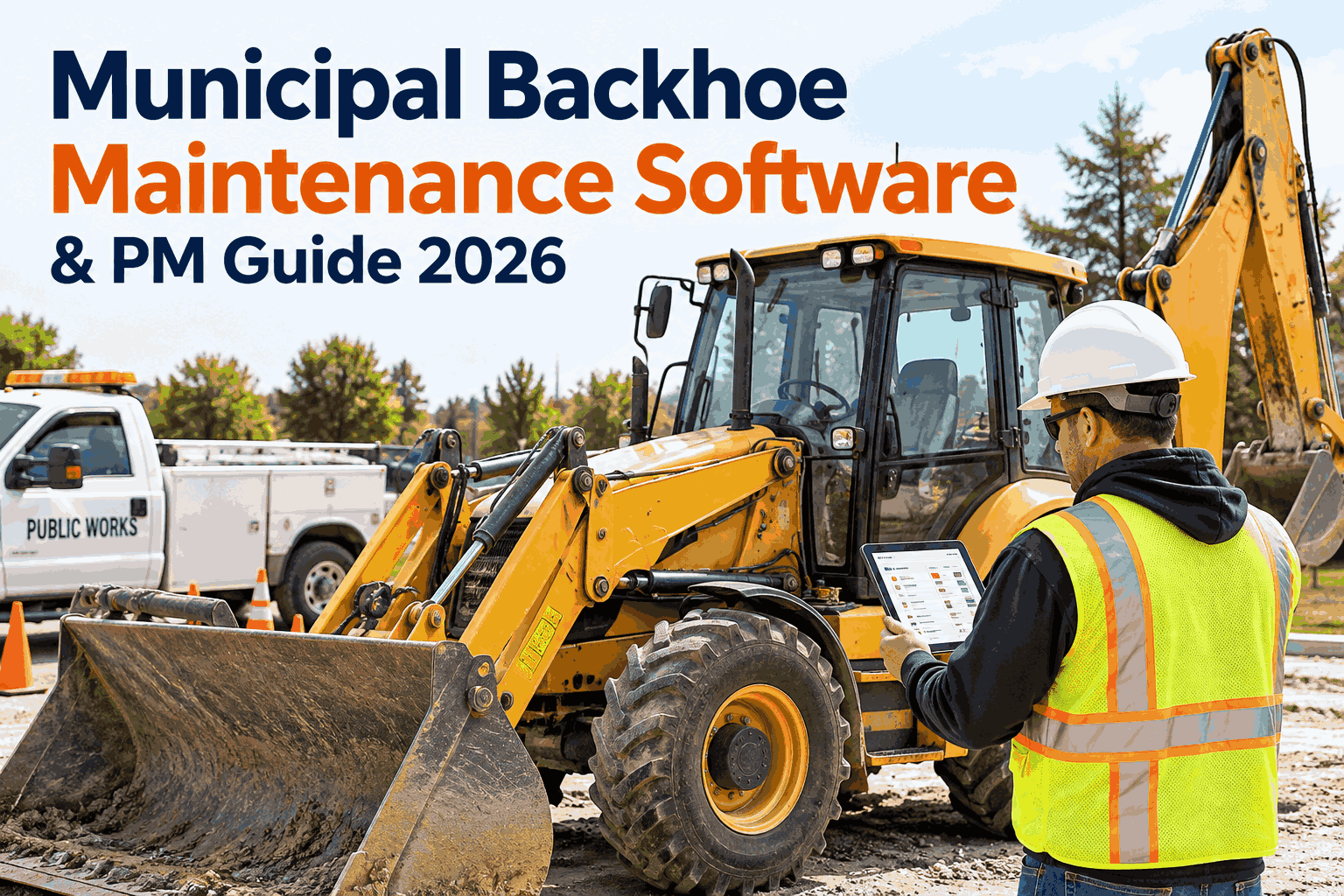
Municipal Backhoe Maintenance Software & PM Guide 2026
Municipal public works directors, utility superintendents, and county heavy-equipment supervisors oversee an asset under relentless operational punishment: the municipal backhoe loader. Whether excavating emergency main line ruptures in frozen ground, ditching storm runoff culverts, or backfilling utility trenches under live traffic, backhoes operate across high-strain hydraulic cycles where machine hours accumulate while road mileage remains virtually static. Relying on calendar guesses or paper grease logs causes vital service intervals to slip: dipperstick pivot pins starve of grease, hydraulic fluid shears under sustained pressure, shuttle-shift transmissions slip, and DPF canisters clog with idle soot. A single hydraulic cylinder rupture during an emergency street excavation halts repair crews, floods properties, and incurs thousands in emergency equipment rental fees. Purpose-built municipal backhoe maintenance software links real-time J1939 CAN-bus engine-hour telemetry with mobile operator inspections, automated multi-tier PM scheduling, and audit-ready public works asset records. Maintain uninterrupted infrastructure readiness, eliminate costly component failures, and defend replacement capital before city councils. Book a Demo to see our municipal backhoe fleet maintenance software live.
Public Works Heavy Machinery GovernanceJ1939 CAN-Bus Hour Meter TrackingGASB 34 Capital Asset Compliance
Municipal Backhoe Maintenance Software & PM Guide 2026
An operational engineering, hydraulic reliability, and fleet accounting guide: automate engine-hour PM triggers, enforce digital daily operator walkarounds, prevent catastrophic cylinder failures, and track total cost of ownership across municipal work sites.
Guided mobile walkarounds ensure all 22 pivot points are lubricated before morning roll-out.
< 10 min
Inter-Fund Billing Sync
Automated equipment chargebacks between Water, Sewer, Street, and General Fund ledgers.
$5
Per Heavy Asset / Mo
Full-featured public sector software pricing with zero locked long-term enterprise RFP contracts.
Eliminate Job-Site Hydraulic Stalls and Safeguard Public Works Budgets
Connect municipal backhoes to automated engine-hour maintenance triggers, digitize operator walkarounds, and track total cost of ownership for just $5/asset/month.
The Costly Operational Realities of Municipal Backhoe Maintenance
Local government public works agencies operate heavy machinery in conditions commercial fleets rarely face. A municipal backhoe loader is shared among multiple crews: water utilities use it for main line digs, street departments use it to clear drainage ditches, and parks staff use it for site grading. Because rotating operators share machines, individual inspection accountability declines. When equipment maintenance relies on paper clipboards or calendar spreadsheets, systemic vulnerabilities emerge that threaten infrastructure reliability. Sign up to modernize your municipal backhoe maintenance operations.
Failure 01
Starved Pivot Pins & Expensive Ovalized Bushings
A backhoe features more than twenty-two grease zerks across loader arms, boom swivels, dipper extensions, and bucket linkages. When rotating crews assume another team greased the pins, steel-on-steel friction destroys hardened bushings and ovalizes cast-iron pin bosses. Replacing pin bosses and line-boring boom structures costs over $7,500 in specialized outside machining and weeks of downtime. Book a demo to inspect our digital pin greasing verification tools.
Failure 02
Calendar Service Models in High-Idle Civic Environments
Municipal backhoes spend up to 45% of their working day stationary at idle: maintaining auxiliary hydraulic flow while pipe fitters lay water lines, or idling during traffic control staging. Scheduling oil changes every six months ignores the fact that the diesel engine and hydraulic pump have logged 500 working hours, causing oil acid buildup, thermal hydraulic shearing, and clogged DPF exhaust traps.
Failure 03
Inter-Departmental Accounting Disputes & General Fund Lag
Public works departments frequently lend backhoes to ratepayer-funded Water and Sewer Enterprise Funds. Lacking automated telematics tracking, finance clerks spend days estimating hourly machine usage on paper spreadsheets. Disputed internal chargeback allocations cause budget friction during city council fiscal reviews and delay capital replacement planning. Sign up to automate multi-fund equipment chargeback tracking.
Failure 04
Catastrophic Hydraulic Blowouts During Emergency Utilities
High-pressure hydraulic hoses that articulate across boom knees and dipper extensions endure constant flexing and abrasion. When pre-shift inspections are pencil-whipped on paper, minor hose blistering or weeping crimp fittings go unnoticed until the boom lifts a 3,000-pound trench box over a broken water main, blowing the line, spraying hot oil, and halting emergency repairs. Book a demo to see our pre-shift hydraulic walkaround checklists.
The Tiered Municipal Backhoe PM Matrix: 50 to 2,000 Operating Hours
To maximize heavy machinery lifespans, preserve factory powertrain warranties, and maintain audit-defensible capital asset records, public works departments must schedule backhoe servicing around true engine-hour triggers rather than arbitrary calendar assumptions. Sign up to configure automated backhoe preventive maintenance intervals.
Preventive Maintenance Tier
Engine Runtime Trigger
Mechanical, Hydraulic & Chassis Scope
Operational Reliability & Asset Protection Target
Tier 1: Daily Walkaround & Lube
Every 10 Operating Hours / Pre-Shift
Grease all loader arm, boom, dipper, and bucket pivot zerks; inspect hydraulic cylinder chrome rods for scoring; check engine oil and coolant sight levels; drain fuel-water separator bowl; test backup alarm and seatbelt interlocks.
Prevent premature bushing ovalization, eliminate water ingestion into common-rail fuel injectors, and verify basic job-site safety compliance.
Tier 2: Minor Lubrication PM
Every 50 Operating Hours / Weekly
Grease front 4WD steer axle universal joints and trunnion bearings; inspect air cleaner restriction indicator; check tire pressure and wheel lug nut torque; verify swing lock pin and transport boom latch engagement.
Eliminate front axle steer joint binding, prevent engine dusting from torn air filter elements, and prevent accidental boom drop during road transit.
Tier 3: Engine Oil & Filter Service
Every 250 Operating Hours / 3 Months
Full synthetic heavy-duty diesel engine oil and filter flush; primary and secondary fuel filter swap; clean crankcase breather filter; battery terminal cleaning and conductance test; alternator belt tension check.
Prevent engine soot thickening from high idle cycles, protect high-pressure fuel pumps from abrasive wear, and ensure reliable cold-weather starting.
Tier 4: Hydraulic & Driveline PM
Every 500 Operating Hours / 6 Months
Replace hydraulic system return-line filter; replace power shuttle transmission filter; inspect front and rear axle differential oil levels; check brake fluid reservoir and pedal travel; test auxiliary hydraulic flow.
Stop abrasive metal particulates from circulating through pilot valves, prevent transmission clutch pack glazing, and maintain full breakout digging force.
Tier 5: Comprehensive Overhaul
Every 1,000 to 2,000 Operating Hours
Complete hydraulic reservoir fluid drain and flush; front and rear axle planetary hub and differential oil flush; engine cooling loop flush and pressure test; valve lash adjustment; DPF soot clean-out.
Ensure long-term structural and hydraulic integrity, prevent differential gear failure, and certify State of Good Repair (SGR) under GASB 34 standards.
The 4 Core Pillars of Municipal Backhoe Maintenance Software
Connect directly to Caterpillar, John Deere, Case, or JCB electronic control modules (ECUs). The software continuously captures true engine operating hours, fuel consumption, idle percentages, and diagnostic fault codes (DTCs), ensuring maintenance counters advance accurately without manual hour-meter logging.
Pillar 02
Operator Mobile Pre-Shift Walkaround & Photo Logs
Equip machine operators with an offline-ready mobile application on rugged job-site tablets or smartphones. The guided inspection enforces grease zerk verification, hydraulic hose checks, and tire condition audits, requiring photo documentation of any detected defects before the machine is dispatched. Sign up to deploy digital pre-shift inspection walkarounds.
Pillar 03
Automated Inter-Departmental Fund Chargebacks
Assign backhoe machine hours automatically to specific municipal accounting codes (such as General Fund, Water Enterprise Fund, or Stormwater District). The software records exact machine operating times per job site, exporting validated general ledger journal entries to city financial packages (such as Tyler Munis or BS&A).
Pillar 04
GASB 34 Capital Asset Lifecycle & TCO Modeling
Combine original capital procurement acquisition costs with cumulative engine hours, fuel consumption, technician labor, and replacement parts into an objective total cost of ownership (TCO) score. Generate audit-ready asset balance sheets compliant with GASB 34 rules to defend capital replacement requests. Book a demo to inspect our GASB 34 capital asset reporting modules.
The Step-by-Step Municipal Equipment Maintenance Pipeline
Follow the automated workflow that translates pre-shift walkaround inspections and live telemetry into staged shop work orders and budget-cleared ledger records. Sign up to test our automated maintenance pipeline.
Step 01
Pre-Shift Walkaround
The operator completes a 3-minute digital walkaround on an agency smartphone, verifying hydraulic fluid levels, inspecting hose connections, and confirming grease points.
Step 02
Telemetry Polling & Thresholds
On-board telematics stream verified engine hours into the cloud engine. When machine #42 hits 250 operating hours, the system triggers a Tier 3 engine oil service ticket.
Step 03
Shop Parts & Bay Staging
The garage supervisor receives a pre-populated work order. The software automatically reserves matching oil filters, synthetic fluids, and fuel filters from municipal parts inventory. Book a demo to see our digital storeroom inventory staging.
Step 04
Digital Sign-Off & GL Sync
The technician logs wrench time and signs off on the digital work order. Service counters reset automatically, and maintenance costs post to the appropriate departmental fund ledger.
Platform Comparison: Manual Binders vs. Fleet Rabbit Platform
City Public Works Eliminates Job-Site Downtime Across 22 Backhoe Loaders
Operating twenty-two rubber-tired backhoes across streets, stormwater, water distribution, and cemetery operations, the City of Oakridge Public Works Department struggled with expensive equipment breakdowns. Shared across four municipal divisions, backhoes routinely missed grease intervals, causing severely worn pins and ovalized dipper bushings that cost over $30,000 in specialized outside machining. Furthermore, because machines were serviced on a six-month calendar schedule regardless of working hours, three backhoes blew hydraulic boom cylinders during winter water main repairs, requiring expensive emergency equipment rentals.
By deploying Fleet Rabbit at $5/asset/month, the city installed plug-and-play telematics gateways to track true engine run-hours directly from machine controllers, while equipping operators with a 3-minute mobile pre-shift checklist requiring photo confirmation of grease zerks and hydraulic lines. Service intervals shifted to genuine 250-hour and 500-hour triggers, while equipment operating hours automatically generated inter-departmental chargeback entries between the General Fund and the Water Enterprise Fund. Over 12 months, unplanned hydraulic downtime dropped by 65%, premature pin wear was eliminated, and the city saved $78,000 in avoided line-boring repairs, eliminated machine rentals, and streamlined municipal accounting.
Frequently Asked Questions
Why is engine-hour maintenance essential for municipal backhoe loaders?
Municipal backhoes spend extensive operating hours stationary at idle while digging trenches, breaking asphalt, or holding utility trench boxes. A machine traveling only fifteen miles across town in a week may operate its diesel engine and hydraulic pump under heavy load for forty hours. Scheduling maintenance by truck odometer miles or calendar months severely neglects engine oil, hydraulic return filters, and transmission fluids, leading to premature pump wear and unexpected job-site breakdowns.
How does the software ensure operators grease backhoe pivot pins properly?
A backhoe loader features over twenty-two grease points that require lubrication every ten operating hours. Fleet Rabbit provides a visual, step-by-step mobile walkaround checklist on rugged agency tablets. Operators must physically inspect and check off loader arm, boom, dipper, and swing pivot pins, with the ability to upload photo proof of greased zerks. If an operator reports a seized zerk or excessive pin play, the software immediately flags the defect for garage attention.
How does automated inter-departmental fund allocation work for public works fleets?
Municipalities maintain separate financial funds: tax-funded General Funds (Streets, Parks) and ratepayer-funded Enterprise Funds (Water, Wastewater). Fleet Rabbit tracks machine operating hours by job-site geofence or operator shift login, calculating exact machine-hour chargeback amounts. The platform exports pre-formatted general ledger files that import directly into municipal financial packages (such as Tyler Munis, BS&A, or SAP), eliminating manual billing reconciliation.
Can operators complete pre-shift inspections in remote trenches without cellular service?
Yes. Fleet Rabbit features an offline-first mobile architecture. Equipment operators can perform complete pre-shift checklists, take defect photos, and review past service logs inside rural ditches, gravel pits, or concrete culverts without cellular reception. All data caches securely on the mobile device and automatically synchronizes to central public works dispatch the moment cellular or depot Wi-Fi connectivity returns.
What are the pricing details and contract terms for Fleet Rabbit's software?
Fleet Rabbit is priced at a flat rate of $5 per active heavy equipment asset per month billed annually. This includes complete access to engine-hour telematics tracking, mobile pre-shift walkaround checklists, hydraulic PM scheduling, inter-departmental fund chargeback accounting, and GASB 34 capital asset reporting. We provide a 14-day free live trial on up to 3 machines with zero setup fees or locked enterprise contracts.
Ready to Automate Maintenance Across Your Municipal Backhoe Fleet?
Deploy engine-hour preventive maintenance triggers, enforce daily pin lubrication, and automate inter-fund chargebacks for just $5/asset/month.