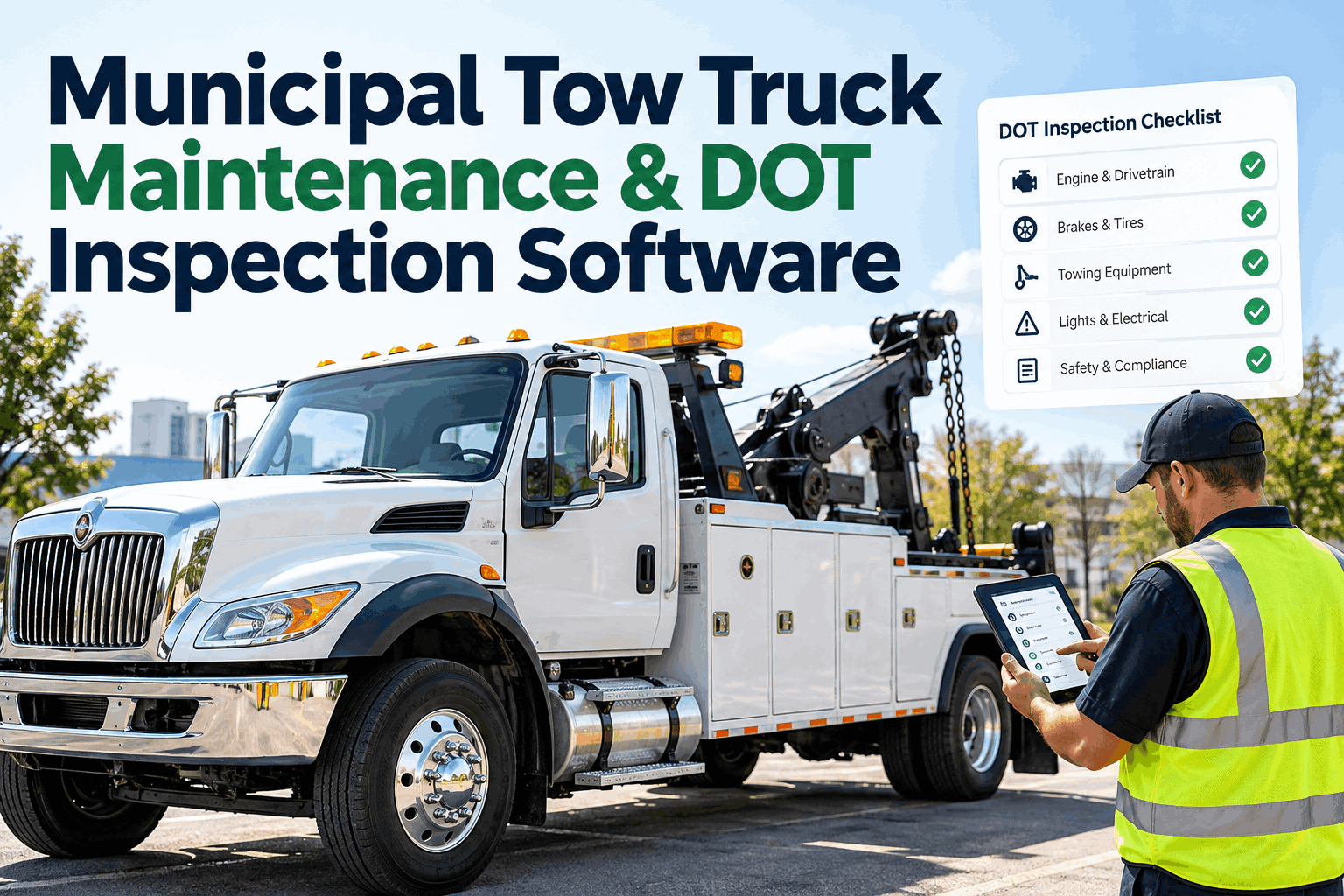
Municipal Tow Truck Maintenance & DOT Inspection Software
Municipal police impound units, public works incident response divisions, county road departments, and metropolitan transit breakdown teams oversee high-liability civic response vehicles: municipal recovery and towing apparatus. Whether clearing multi-lane expressway collisions in peak traffic, impounding illegally parked commercial vehicles, or recovering disabled 40-foot city transit buses, municipal rollbacks and heavy wreckers operate under intense structural, pneumatic, and hydraulic duty cycles. Unlike standard municipal utility trucks that run predictable point-to-point routes, a municipal wrecker accumulates massive auxiliary hydraulic workload: holding heavy structural winching tension, stabilizing subframe tilt beds, and pumping hydraulic fluid while stationary on active highway shoulders. When municipal fleet supervisors rely on manual clipboards, paper DVIRs, or calendar-based maintenance schedules, life-critical safety vulnerabilities are overlooked: wire rope winch cables develop uninspected bird-caging and broken strands, wheel-lift crossbar pivot pins run dry, hydraulic underlift cylinders leak, and chassis air brakes drift past federal pushrod stroke limits. Neglecting strict Federal Motor Carrier Safety Administration (FMCSA) and Department of Transportation (DOT) periodic safety requirements risks catastrophic mechanical failures under tow load, roadside out-of-service (OOS) enforcement citations, and severe municipal tort liability. Purpose-built municipal tow truck maintenance and DOT inspection software bridges auxiliary PTO engine hours, daily mobile walkaround inspections, automated winch cable life logs, and tamper-proof DOT compliance files in a unified platform. Maintain frontline incident-clearing readiness, eliminate unexpected hydraulic downtime, and safeguard taxpayer capital across your entire civic towing fleet. Book a Demo to see our municipal tow truck DOT inspection software in action.
Municipal Emergency Fleet GovernanceDOT 49 CFR Part 396 ReadyWinch & Hydraulic PTO Runtime Telematics
Municipal Tow Truck Maintenance & DOT Inspection Software
An engineering, hydraulic recovery, and regulatory safety guide for public works and municipal police fleets: automate PTO auxiliary engine-hour PM intervals, standardize digital daily pre-trip walkarounds, verify wire rope and wheel-lift integrity, and eliminate roadside DOT out-of-service violations.
Municipal Wrecker Multi-Zone Telematics & DOT Inspection Topology
100%
Annual DOT Decal Verification
Automated expiration tracking prevents public vehicles from operating with expired periodic safety inspections.
0
Winch Cable Failure Stalls
Mandatory pre-shift photo logs enforce wire rope strand inspection and hook throat opening checks before highway runs.
62%
Fewer Hydraulic Leaks
Decoupled auxiliary PTO hours trigger return filter swaps and hose crimp tests based on real recovery work.
$5
Per Tow Vehicle / Month
Complete municipal software pricing covering chassis, rigging, and hydraulic management with zero RFP markups.
Eliminate Out-of-Service Violations and Protect Highway Recovery Teams
Replace scattered paper DVIR clipboards, track auxiliary PTO winch run-hours, automate annual DOT inspection files, and protect municipal budgets for just $5/asset/month.
The Costly Mechanical Dangers of Municipal Tow Truck Operations
Operating a municipal recovery fleet demands coordinating two separate stress systems: a heavy commercial truck chassis and an auxiliary hydraulic recovery apparatus. A city police tow truck or public works rollback driving just twenty miles across urban surface streets may spend five hours parked on freeway shoulders with the engine idling at elevated RPM to run high-tonnage planetary winches and slide tilt-beds. When fleet maintenance relies on truck odometer miles or calendar intervals, critical safety systems fail under load. Sign up to automate municipal tow truck inspections and preventive maintenance.
Vulnerability 01
Winch Wire Rope Fatigue & Sudden Cable Snaps
Steel wire rope cables wind through snatch blocks and guide rollers under tens of thousands of pounds of pull. Kinks, bird-caging, internal core corrosion, and crushed drum wraps weaken load capacity dramatically. When drivers skip manual rope inspections on paper, compromised cables snap during heavy vehicle recovery, endangering recovery operators and civilians in traffic lanes. Book a demo to inspect our digital rigging inspection workflows.
Vulnerability 02
Chassis Road Miles vs. Auxiliary PTO Hour Disconnect
A city rollback covering only 4,000 driving miles per year can accumulate over 1,600 hours on its transmission power take-off (PTO), hydraulic pump, and valve manifold. Scheduling oil changes and hydraulic filter replacements by road mileage allows hydraulic oil to overheat and shear, destroying directional valve spools and causing uncommanded bed drop during vehicle transit. Sign up to decouple PTO engine hours from chassis road miles.
Underlifts and wheel-lift assemblies carry intense dynamic bounce loads over city expansion joints and potholes. Lacking scheduled grease lubrication, crossbar pivot pins and bronze bushings wear into oval shapes, causing excessive play. Worn L-arm retainers or bent safety chains cause towed vehicles to break free in highway traffic, inviting devastating municipal tort liability.
Vulnerability 04
Roadside DOT Out-of-Service Brake & Weight Orders
Commercial vehicle enforcement troopers aggressively audit municipal tow trucks under FMCSA 49 CFR Part 396 criteria. Air brake pushrod strokes that drift past 2-inch chamber limits, cracked subframe slide-rails, inoperable tailboard lighting, or expired annual inspection decals result in immediate roadside red-tagging, stranding public incident-clearing assets. Book a demo to inspect our DOT periodic inspection modules.
The Tiered Municipal Tow Truck Preventive Maintenance Matrix
To preserve heavy recovery hardware, prevent catastrophic winch failures, and maintain complete DOT safety compliance, public works and police fleet departments schedule tow truck servicing around dedicated operating hours and hydraulic duty cycles rather than calendar estimates. Sign up to calibrate your municipal tow truck PM matrix.
Preventive Maintenance Tier
Operating Benchmark Trigger
Wrecker Rigging, Hydraulic & Chassis Scope
DOT Compliance & Failure Prevention Objective
Tier 1: Daily Shift Pre-Trip
Every Shift Prior to Dispatch
Visual wire rope sweep for bird-caging, broken wires, and flat spots; winch drum spool inspection; wheel-lift L-arm latch and crossbar grease check; safety chain grade identification; air brake pushrod stroke check; emergency lightbar functional test.
Satisfy DOT 49 CFR Part 396 pre-trip mandates, prevent highway towed vehicle detachment, and eliminate winch cable snaps under load.
Tier 2: Auxiliary Hydraulic PM
Every 250 PTO Hours / 3,000 Miles
Grease subframe slide rails, boom pivot pins, and winch drum bearings; replace hydraulic return-line filter; sample hydraulic fluid; test PTO drive shaft universal joints; inspect hydraulic cylinder chrome rods for pitting and packing seal leaks.
Prevent directional control valve spool stick, eliminate premature hydraulic pump cavitation, and prevent uncommanded tilt-bed drop.
Tier 3: Annual DOT & Proof Test
Every 12 Months / 1,000 PTO Hours
Comprehensive annual DOT 49 CFR Part 396 periodic safety audit; full chassis air brake tear-down and slack adjuster stroke calibration; hydraulic reservoir fluid flush; subframe anchor bolt torque test; magnetic particle inspection on recovery tow hooks.
Certify annual state DOT operating compliance, verify subframe structural integrity under maximum gross axle loads, and pass roadside safety inspections.
The 4 Core Pillars of Tow Truck Maintenance Software
Fleet Rabbit unites on-board vehicle diagnostic telemetry, ruggedized mobile operator pre-trip checklists, and municipal maintenance work order queues into a unified public fleet management platform. Book a demo to evaluate our four-pillar fleet software in action.
Pillar 01
Guided Mobile Tow Truck Walkaround App
Equip recovery drivers with a guided mobile DVIR application on agency smartphones or rugged tablets. The workflow requires drivers to physically inspect winch cables, test auxiliary hydraulic bed slides, verify wheel-lift retention pins, and photograph any detected defects before dispatch clearance is granted.
Pillar 02
Dedicated Auxiliary PTO Hour Decoupling
Capture dedicated power take-off (PTO) run-hours directly from vehicle CAN-bus links or auxiliary hydraulic pressure switches. By separating stationary recovery winch operations from road mileage, the platform automatically triggers hydraulic oil sampling, filter changes, and slide-pad lubrications based on actual mechanical usage. Sign up to enable auxiliary PTO telematics tracking.
Pillar 03
DOT 49 CFR Part 396 Compliance Decal Sync
Maintain a centralized, tamper-proof repository for annual DOT periodic safety inspections, brake chamber stroke measurements, and technician certifications. The software monitors inspection decal expirations, automatically notifying municipal fleet supervisors sixty days before deadlines to prevent compliance lapses.
Pillar 04
Critical Defect Red-Tag Lockout & Work Orders
When an operator flags a safety-critical defect during pre-trip inspection—such as a frayed winch cable, leaking underlift cylinder, or air brake chamber leak—the system red-tags the truck in the dispatch console. The vehicle is locked from road deployment while an emergency repair ticket routes to the municipal shop with attached photos. Book a demo to see our digital lock-out controls.
The Step-by-Step Municipal Tow Truck Inspection Pipeline
The operator inspects commercial chassis systems: air brake lines, pushrod stroke travel, tire inflation, tailboard emergency lightbars, and hydraulic reservoir fluid levels.
Step 02
PTO Engagement & Bed Test
The driver engages the PTO, deploys the rollback tilt-bed or wrecker boom, tests directional hydraulic control spools, and inspects cylinder chrome rods for packing seal leaks.
Step 03
Rigging & Winch Cable Audit
The operator unspools the wire rope winch line, checking for broken strands or bird-caging, verifying drum tensioner rollers, and inspecting tow chains and safety hooks. Book a demo to test our mobile wrecker checklist format.
Step 04
Wheel-Lift Lock & Dispatch Pass
The driver verifies crossbar pivot pin lubrication, tests L-arm retention pins, submits a digitally signed mobile pre-trip inspection, and receives gate clearance for highway response.
Platform Comparison: Manual Binders vs. Fleet Rabbit Platform
Metropolitan Police Fleet Eliminates Roadside Violations Across 38 Recovery Wreckers
Operating 38 heavy-duty wreckers and rollbacks responsible for clearing major highway accidents and managing city police impound yards, the municipal fleet division faced serious regulatory pressure. Recovery operators filled out paper inspection clipboards inconsistently, leading to unrecorded hydraulic weeping around winch motors and worn wheel-lift pivot pins. During a commercial vehicle safety enforcement sweep, state troopers placed two municipal flatbeds out of service due to air brake pushrod stroke drift and an expired annual inspection decal, delaying emergency traffic clearing on a major interstate.
By deploying Fleet Rabbit at $5/asset/month, the department equipped recovery operators with mobile inspection tablets running standardized pre-trip walkarounds that required photo-verified checks of winch wire ropes, wheel-lift L-arms, and air brake travel. Direct telematics tracked auxiliary PTO hours separately from chassis miles, triggering hydraulic fluid flushes based on true winch workload. Over 12 months, roadside out-of-service orders dropped to zero, DOT periodic inspection compliance reached 100%, and the division saved $82,000 in prevented roadside emergency repairs, avoided fines, and reduced administrative labor.
Frequently Asked Questions
What specific checks does DOT 49 CFR Part 396 require for municipal tow trucks?
Under FMCSA 49 CFR Part 396, tow trucks and commercial recovery vehicles must undergo a daily pre-trip Driver Vehicle Inspection Report (DVIR) and pass a comprehensive periodic safety inspection at least once every 12 months. Key daily inspection points include service brakes, parking brakes, steering mechanisms, lighting devices, tires, horn, windshield wipers, coupling devices, and emergency equipment. For wreckers, inspectors also scrutinize winch cable condition, chain ratings, and chassis subframe mounting hardware.
Why is auxiliary PTO engine-hour tracking critical for tow trucks and rollbacks?
Tow trucks spend extensive time stationary at accident scenes, vehicle impound facilities, and highway shoulders with engines idling at high RPM to run transmission-mounted power take-off (PTO) units and hydraulic pumps. A wrecker traveling only 5,000 road miles a year can accumulate more than 1,500 hours on its hydraulic system. Scheduling servicing based strictly on odometer miles ignores severe oil shear, filter clogging, and pump wear, causing hydraulic failures under heavy recovery loads.
How does the software track wire rope winch cable health and replacement?
Fleet Rabbit logs the installation date, cable diameter, steel grade, and rated working load limit (WLL) for every winch on the apparatus. During daily mobile pre-trip walkarounds, drivers must inspect the full working length of the cable and verify the absence of bird-caging, core protrusion, kinks, or broken wires. If an operator reports a compromised cable, the platform red-tags the winch immediately, locking the truck from dispatch until the cable is replaced.
Can recovery operators complete pre-trip inspections in areas without cellular reception?
Yes. Fleet Rabbit features an offline-first mobile architecture. Operators can perform complete pre-shift walkaround checklists, upload defect photos, and review maintenance histories inside concrete parking structures, rural highway corridors, or underground impound garages without cellular coverage. All inspection data caches securely on the mobile device and automatically synchronizes with dispatch the moment cellular or depot Wi-Fi connectivity returns.
What are the pricing details and contract terms for Fleet Rabbit's software?
Fleet Rabbit is priced at a transparent flat rate of $5 per active tow truck per month billed annually. This gives complete access to municipal tow truck inspection checklists, PTO telematics integration, DOT 49 CFR Part 396 compliance tracking, winch cable life logs, and audit-ready reporting exports. We provide a 14-day free live trial on up to 3 vehicles with zero setup fees or long-term locked enterprise contracts.
Ready to Automate DOT Compliance Across Your Municipal Tow Fleet?
Enforce daily pre-trip walkarounds, decouple auxiliary PTO engine-hour maintenance, and eliminate roadside out-of-service orders for just $5/asset/month.