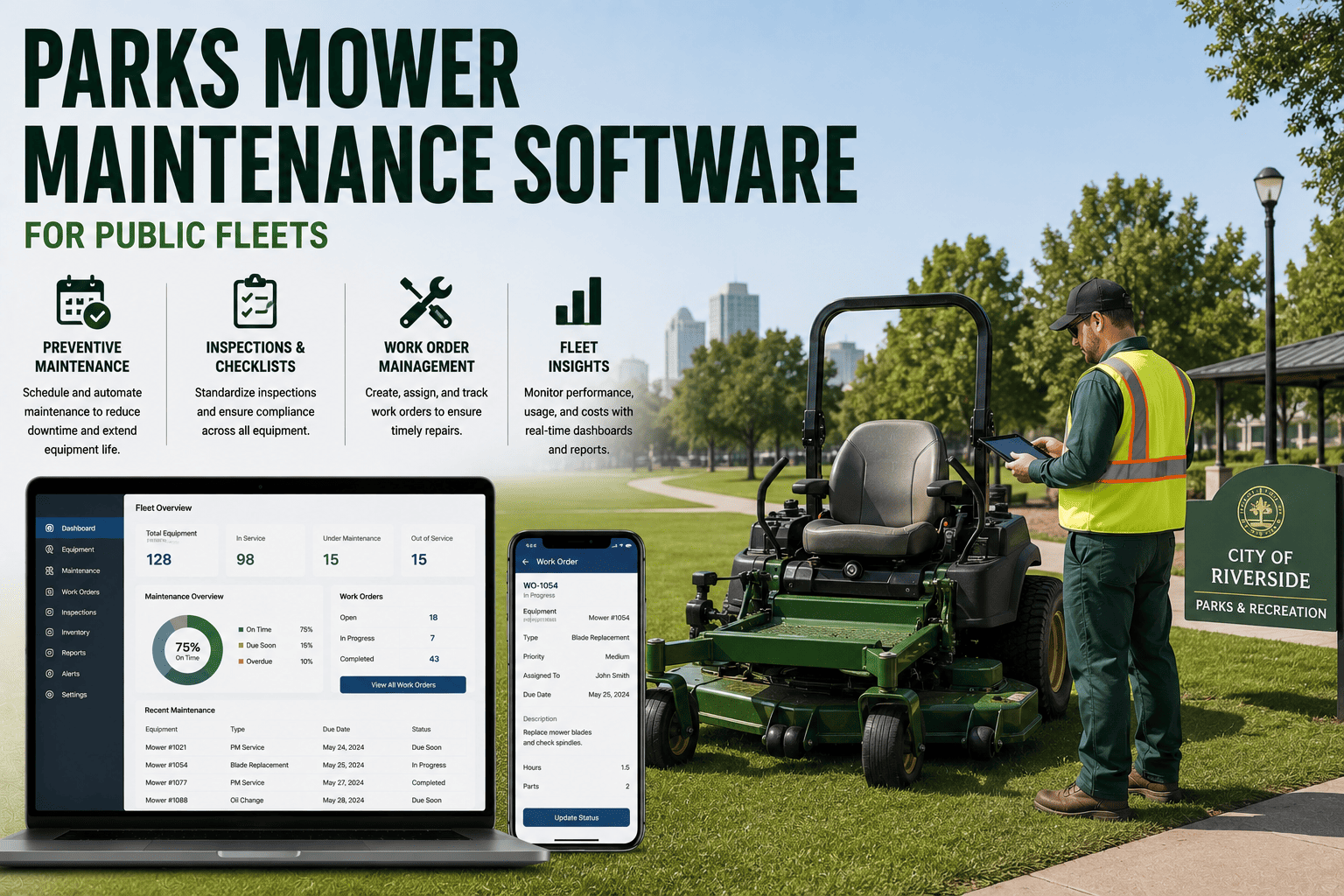
A zero-turn mower running eight hours a day during peak mowing season will hit its next service interval in days, not weeks, no matter what the calendar says. Parks and grounds equipment wears on usage, not distance, and a maintenance program built around mileage or a fixed monthly reminder will always be a step behind the machines that actually get used the hardest.
One Grounds Fleet, Half a Dozen Equipment Types
Parks departments rarely manage a single equipment class. A typical grounds fleet mixes riding mowers, tractors, chippers, aerators, sprayers, and utility vehicles, and each one wears differently depending on the season and the crew using it. A universal PM checklist applied across all of them tends to either over-service light-use equipment or, more often, miss the machines running hardest through peak season.
Purpose-built parks mower maintenance software keeps each equipment type on its own template instead of stretching one generic schedule across all of them, which is usually where PM compliance quietly starts to slip.
Why Engine Hours Beat the Calendar for Grounds Equipment
Two identical mowers can sit on the same monthly PM calendar and still need completely different service. One running 300 hours a season is wearing far faster than one running 50, even though both machines are the same age in calendar time. Interval-based maintenance triggered by operating hours catches that difference, while a calendar-only schedule cannot.
Blade sharpening and balance, tracked separately from general engine service hours
Deck condition inspection, since buildup and wear directly affect cut quality
PTO safety checks on any equipment using a power take-off attachment
Filter and fluid service timed to season start, not just a fixed calendar date
Crews still relying on a monthly reminder instead of real usage data can book a demo to see hour-based PM scheduling applied across a mixed grounds fleet.
Combining Calendar and Hour Triggers the Right Way
The most reliable grounds equipment schedule uses both triggers together, calendar dates for seasonal startup and shutdown tasks, and hour-based intervals for anything that sees heavy use once the season is underway.
Pre-season filter and fluid replacement, winterization, and storage checks tied to fixed dates each year.
Blade, deck, and engine service tied to actual runtime, catching heavy-use machines before light-use ones.
The safest rule for most grounds equipment, since either trigger alone will eventually miss real wear.
Departments ready to move off a single fixed calendar can sign up and let engine hours and season dates trigger PM together instead of relying on one or the other.
Give Every Machine Its Own PM Trigger
FleetRabbit tracks engine hours and seasonal calendar dates together, so every mower, tractor, and sprayer gets serviced on real usage, not a shared monthly guess.
Fleet Lifecycle Planning Before the Next Budget Cycle
Grounds equipment has a service life that is usually measured in hours, not years, and knowing where a machine sits on that scale is what turns a replacement request into a defensible budget line instead of a guess. A well-maintained mower commonly reaches somewhere between 1,500 and 2,000 hours before replacement becomes the more economical choice, though some units run considerably longer under close maintenance.
Utilization data across a full season often reveals equipment that is barely used relative to its assigned role, information that strengthens a replacement request or, just as often, justifies not buying a new unit at all.
Records That Hold Up at Council and Budget Review
Grounds equipment purchases and replacements get the same level of public scrutiny as any other municipal asset. A repair history, hour log, or PM compliance rate can end up in front of a budget committee with little warning, and documentation disciplined enough to satisfy NFPA-style audit rigor and standard DOT recordkeeping practices turns that review into a quick export instead of a scramble through paper logs.
Typical service-hour range before mower replacement becomes the economical choice
Portion of municipal equipment commonly found underused once hour data is tracked closely
Time it should take to produce a full PM and lifecycle record for a budget review
What a Grounds-Specific Maintenance Platform Handles
Separate service checklists for mowers, tractors, chippers, aerators, sprayers, and utility vehicles.
Seasonal startup tasks and heavy-use service intervals tracked together automatically.
Hour accumulation measured against expected service life to support budget planning.
Season-long usage data that flags underused equipment before purchase decisions are made.
PM history and lifecycle records structured for council or budget committee review.
Want to see this running against your own equipment list? Book a demo and walk through your fleet's actual hour data with our team.
Plan Replacements Before They Become Emergencies
Hour-based PM, lifecycle tracking, and audit-ready records built specifically for parks and grounds equipment fleets.
Frequently Asked Questions
Why does grounds equipment need hour-based PM instead of mileage
Most parks equipment covers little or no distance but accumulates significant engine runtime, so hours reflect actual wear far more accurately than an odometer reading ever could.
How many hours does a mower typically last before replacement
A well-maintained unit commonly reaches somewhere between 1,500 and 2,000 hours before replacement becomes the more economical option, though careful maintenance can extend that considerably.
Should calendar-based or hour-based triggers be used for PM
Both together work best, calendar dates for seasonal startup and shutdown tasks, and hour-based intervals for heavy-use service, with PM firing on whichever threshold comes first.
What PM items are specific to mowers and grounds equipment
Blade sharpening and balance, deck condition, and PTO safety checks are wear points that a generic vehicle PM checklist typically does not cover at all.
How does this support fleet lifecycle planning
Tracking hour accumulation against expected service life gives fleet managers documented evidence for replacement requests instead of relying on guesswork at budget time.
Can this work for a small parks department, not just a large city system
Yes, the same equipment-type templates, dual PM triggers, and lifecycle tracking apply just as cleanly to a handful of mowers as they do to a citywide grounds fleet.