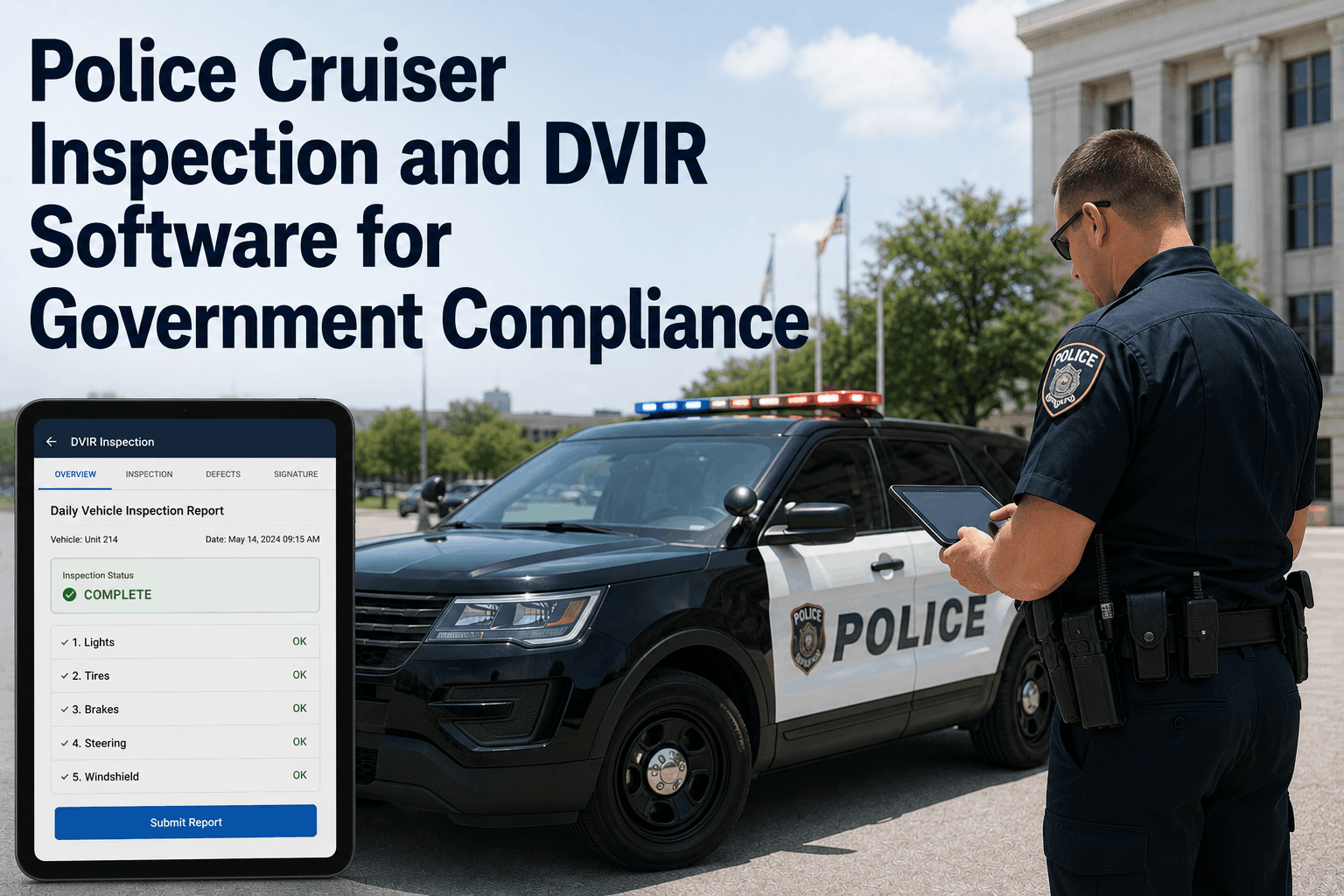
It is 6 a.m. shift change, and a patrol officer is doing a walkaround on a cruiser that logged fourteen hours of idle-heavy, stop-start driving the night before. The light bar checks out, the radio checks out, but nobody notices the brake pads are down to the wear indicator until a sergeant flags it three shifts later. On a commercial truck, a missed defect like that shows up in a DOT audit. On a marked patrol unit, it shows up in a pursuit, and the stakes are a different order of magnitude entirely. Police cruiser inspection software exists to close that gap, turning a paper clipboard walkaround into a digital, enforceable record that catches problems before the next shift ever leaves the lot.
Police Cruiser Inspection and DVIR Software for Government Fleet Compliance
Patrol cars are not built or run like the rest of a municipal fleet. A cruiser can rack up 70,000 to 120,000 miles a year under conditions no delivery van or dump truck ever sees: extended idling on stakeouts, hard acceleration in pursuit-capable duty, and constant stop-start driving during patrol shifts. Every one of those miles wears brakes, tires, and drivetrain components faster than the odometer alone suggests, which is exactly why a generic vehicle inspection checklist built for a straight commercial truck fleet leaves gaps a police department cannot afford.
Police cruiser inspection software brings the same digital DVIR discipline that DOT compliance already demands and adds the pieces a patrol fleet actually needs: light bar and radar checks, prisoner partition integrity, weapon rack security, mobile data terminal function, and pursuit-use maintenance tracking, all captured in an audit-ready record a fleet director can hand to a chief, a city council, or an auditor without digging through binders.
Generic Fleet Software Misses What a Cruiser Actually Needs
Most inspection software was built for over-the-road commercial trucking. It covers brakes, tires, and lights well. It was never built around a vehicle that also carries emergency lighting, in-car radios, and law enforcement equipment that has to be verified every single shift.
Generic Fleet Inspection Software
Standard commercial vehicle checklist covering brakes, tires, lights, and fluids. No fields for pursuit-rated equipment, no separate tracking for stop-start patrol duty versus highway mileage, and no way to flag an unmarked detective unit that quietly skips the PM board entirely.
Police Cruiser Inspection Software
Pre-shift DVIR built around cruiser-specific components, pursuit-use duty cycle tracking, engine-hour PM for idle-heavy shifts, and a single dashboard that keeps marked units, unmarked units, and support vehicles on the same compliance record.
If your department is still running patrol cars through a checklist built for delivery trucks, it is worth a short call to book a demo and see what a cruiser-specific inspection workflow actually looks like.
What a Proper Cruiser Pre-Shift Inspection Covers
A patrol car walkaround has to move fast, because an officer completing it before shift start does not have twenty minutes to spare. A digital checklist keeps it thorough without slowing anyone down.
Brake wear, suspension, tires, and fluid levels checked against pursuit-duty wear thresholds.
Emergency lighting and audio warning systems verified operational before the unit leaves the lot.
In-car radar unit and mobile data terminal confirmed functional for the shift ahead.
Cage integrity and rear door child-lock function checked for officer and detainee safety.
Mounted rack security and lock function verified as part of the standard walkaround.
In-car and portable radio function confirmed before the officer is out of range of the yard.
Give Every Shift a Cruiser That's Actually Ready
Digital pre-shift DVIRs built for patrol duty, with defects routed straight to your shop before the next unit rolls out.
Built for the Realities of Patrol Duty
Police fleets run in conditions that break assumptions most inspection software makes. Officers work in dead zones, at odd hours, and under time pressure a delivery driver never faces.
Offline-capable inspections
A cruiser parked in a basement garage or a rural substation with no signal still completes and stores its DVIR, syncing automatically the moment connectivity returns.
Engine-hour PM for idle duty
A unit that idles for hours on a stakeout wears differently than one that logs the same hours at highway speed. Engine-hour tracking catches that wear instead of relying on mileage alone.
Pursuit-use maintenance flags
Vehicles logged in pursuit-capable duty are tracked separately, so brake and tire service triggers earlier than a standard mileage interval would suggest.
Unmarked unit coverage
Detective and surveillance vehicles that quietly log heavy idle time and curb duty stay on the same PM board as marked cruisers instead of falling through the cracks.
From Walkaround to Repair, Without a Gap
A defect that gets caught on a walkaround only matters if it actually turns into a completed repair. The chain of accountability is what auditors and city councils actually look for.
Officer completes DVIR
Pre-shift walkaround logged digitally, with photo evidence and a timestamp for any defect found.
Work order generated
A flagged defect automatically creates a work order and routes it to the shop, no re-entry required.
Repair certified
A mechanic signs off on the completed repair, closing the loop back to the original inspection record.
Audit-ready record
The full history, from defect to repair, is exportable in minutes for a council hearing or an audit request.
Departments that sign up for this kind of closed-loop tracking stop worrying about whether a flagged defect ever actually got fixed.
What Council and Finance Actually Ask For
A fleet director defending next year's replacement budget needs numbers, not anecdotes. Government vehicles already run older than their private-sector counterparts, and every dollar spent is public money open to scrutiny.
A council-ready, cost-per-vehicle record built from real inspection and repair data is a far stronger case than a spreadsheet assembled the week before a budget hearing. Book a demo to see what that record looks like for your own fleet.
Bring Your Patrol Fleet's Records Into One System
Digital DVIRs, engine-hour PM, and council-ready compliance reports for every cruiser, marked or unmarked, in one dashboard.
Frequently Asked Questions
What is police cruiser inspection software
It is a digital DVIR and preventive maintenance platform built around the specific components and duty cycles of patrol vehicles, covering brakes and tires the same way commercial fleet software does, plus cruiser-specific items like light bars, radar units, prisoner partitions, and mobile data terminals.
Does the software work in areas with no cell signal
Yes. Inspections completed in a dead zone, an underground garage, or a rural substation are stored on the device and sync automatically once connectivity returns, so no record is lost regardless of where the walkaround happens.
How is pursuit-duty maintenance different from standard scheduling
Vehicles used in pursuit-capable or extended idle duty wear brakes, tires, and engine components faster than mileage alone would suggest. Tracking those units separately triggers service earlier than a standard mileage-based interval, catching wear before it becomes a safety issue.
Can unmarked and detective units be tracked the same way as marked cruisers
Yes, and they should be. Unmarked units often log heavy idle time and curb duty during surveillance without appearing on the same PM board as marked patrol cars. Keeping every vehicle type in one system prevents that gap.
What happens when a defect is found during an inspection
The defect is logged with photo evidence and a timestamp, and a work order is generated automatically and routed to the shop. Once the repair is completed and certified by a mechanic, the record closes the loop back to the original inspection, creating a complete audit trail.
Can this data be used for council or budget presentations
Yes. Cost-per-vehicle, inspection history, and repair records can be exported into council-ready reports, giving a fleet director defensible data for replacement requests and budget hearings instead of relying on estimates. Book a demo to see a sample report built from your own fleet data.